

About this worksheet
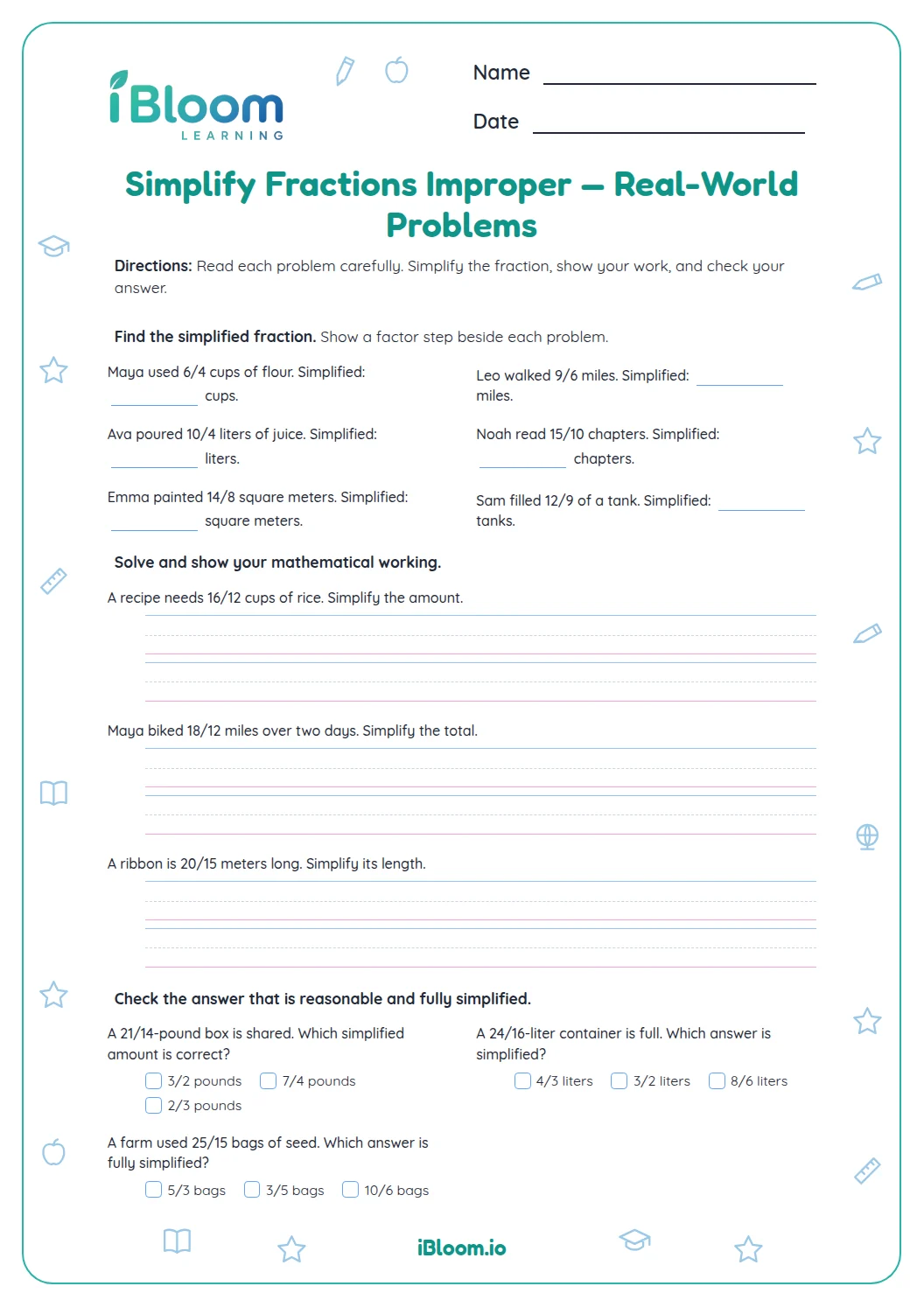
This reasoning challenge gives Grade 3 learners 14 questions about reducing improper fractions. Children write mixed numbers in simplest form, decide whether a reduction is complete, compare reduced values, and explain why two fractions are equivalent. The fraction denominators stay within thirds, fourths, sixths, and eighths. A separate answer key shows the reduced forms.
How do you reduce an improper fraction?
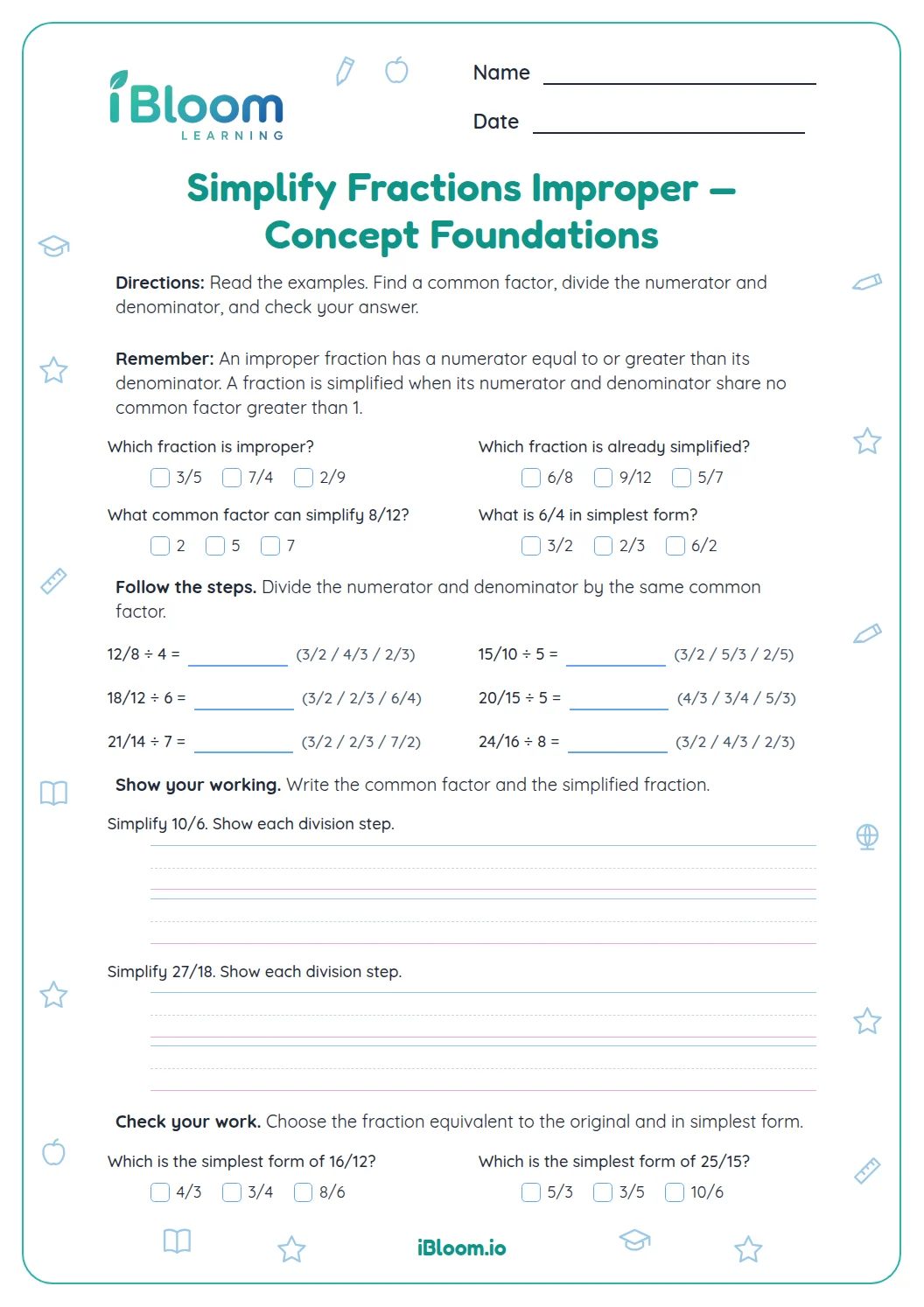
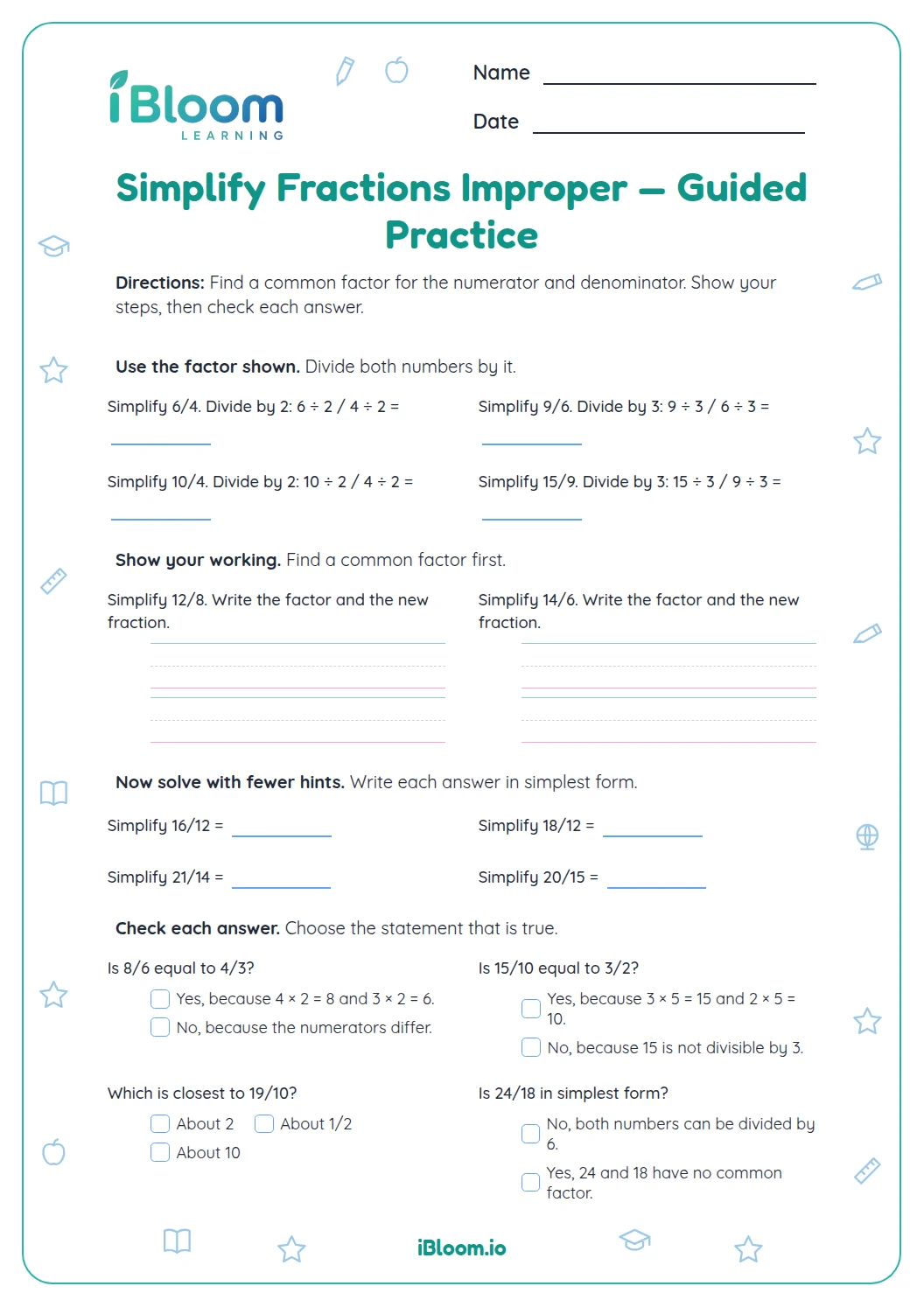
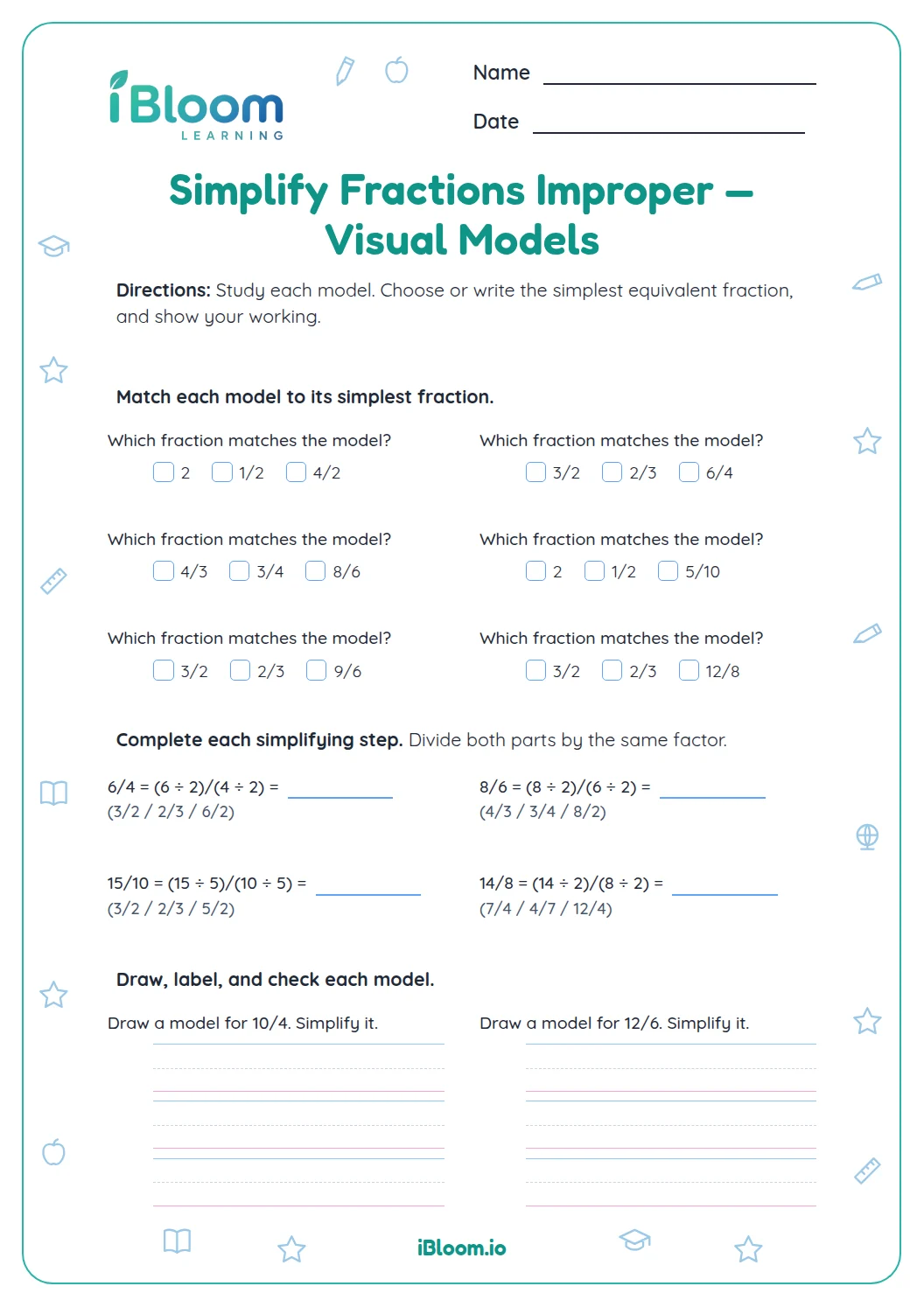
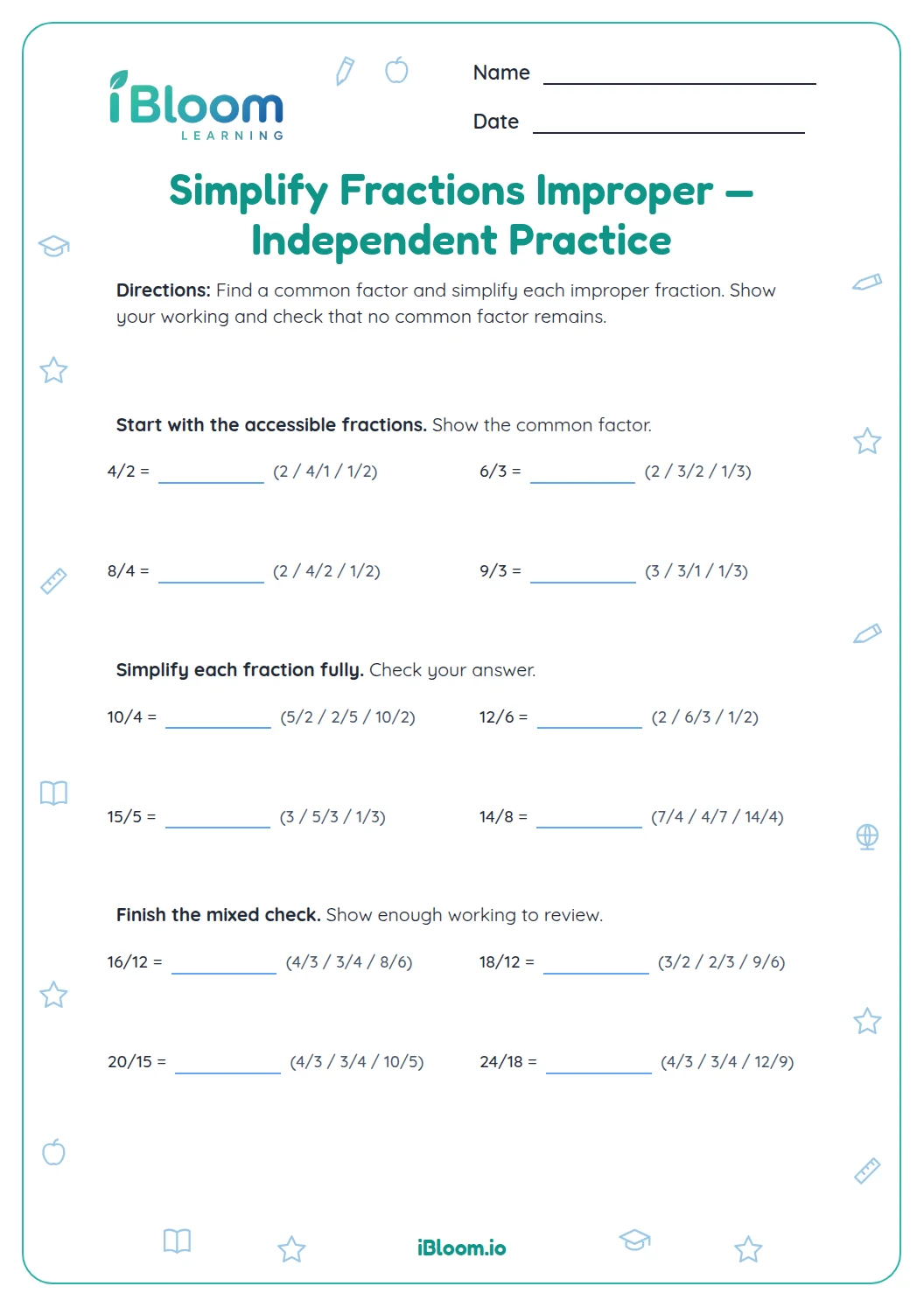
Find a factor shared by the numerator and denominator, divide both by it, and continue until no common factor remains. For question 1, divide 6/4 by 2 to get 3/2, or 1 1/2.
- 16/4 ÷ 2/2 = 3/2
- 23/2 = 1 1/2
- 3The fractional part 1/2 is simplest.
What if one reduction is not enough?
Question 9 starts with 18/12. Dividing both parts by 3 gives 6/4, which still has a common factor of 2. Divide again to get 3/2.
What does the challenge include?
The 14 questions include reduction, multiple-choice reasoning, a comparison, and one written explanation. Each response has its own answer space.
How to use this worksheet
- 1Look for a common factor of numerator and denominator.
- 2Divide both numbers by the same factor.
- 3Repeat if the new numerator and denominator still share a factor.
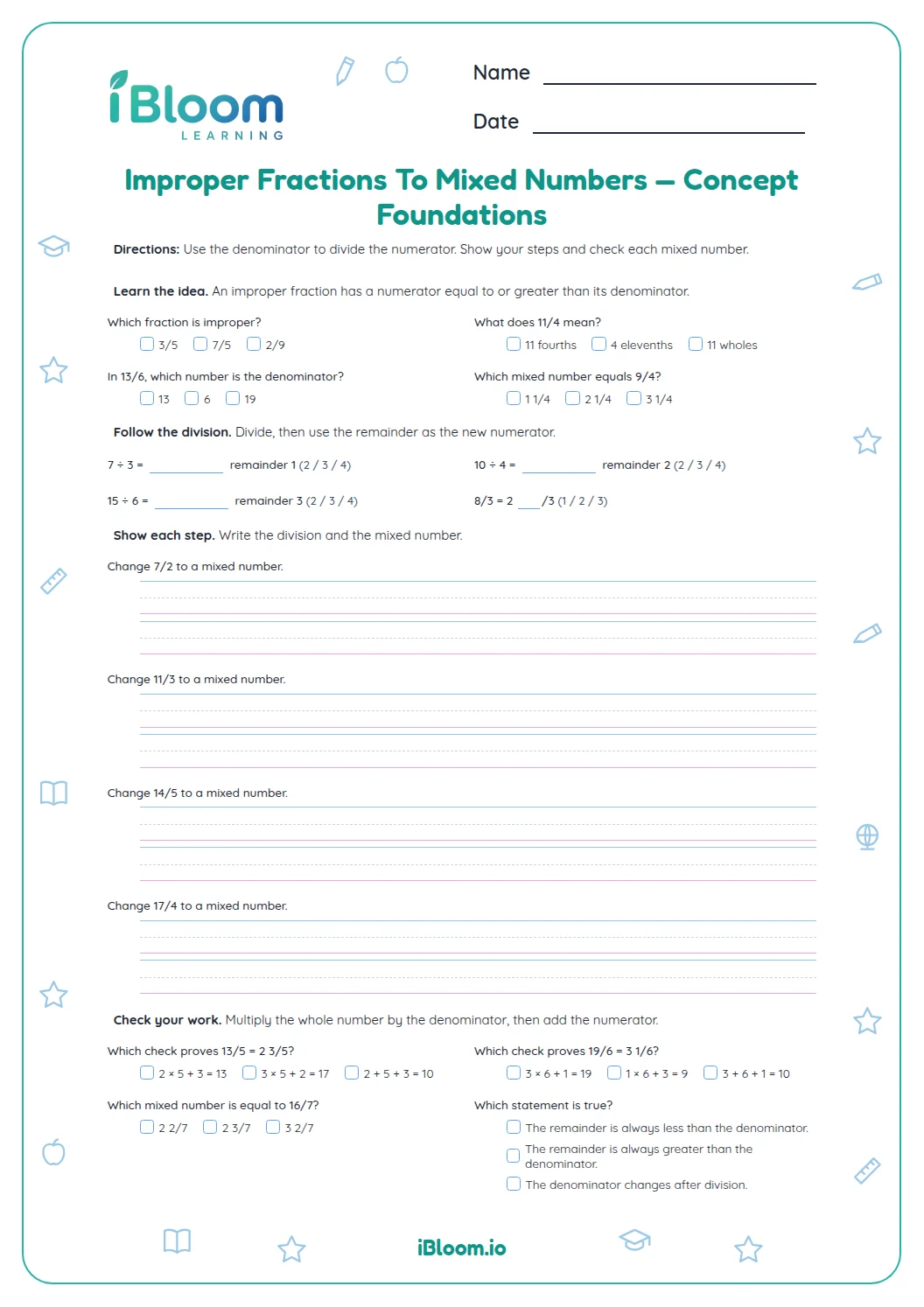
- 4Rewrite an improper fraction as a mixed number when asked.
- 5Check that the fractional part has no common factor remaining.
Common mistakes and quick fixes
The mistake
Dividing only the numerator.
The fix
Divide numerator and denominator by the same factor.
The mistake
Stopping at 6/4 when simplifying 18/12.
The fix
Check again; both 6 and 4 divide by 2, giving 3/2.
The mistake
Calling 4/3 a mixed number.
The fix
It is an improper fraction in simplest form; 1 1/3 is its mixed-number form.
What to practice next
Make more practice
Further reading
Questions parents and teachers ask
What does simplest form mean?
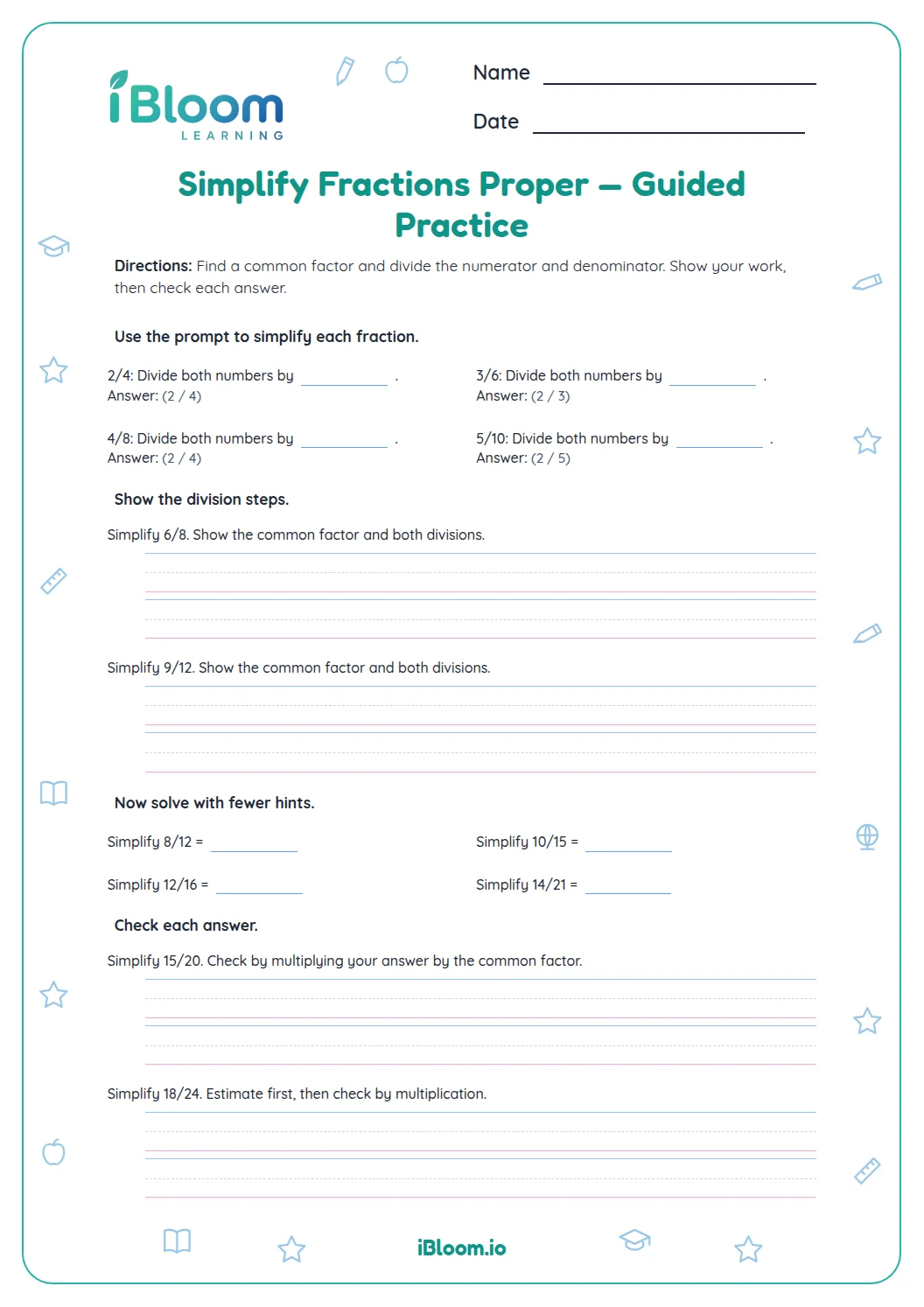
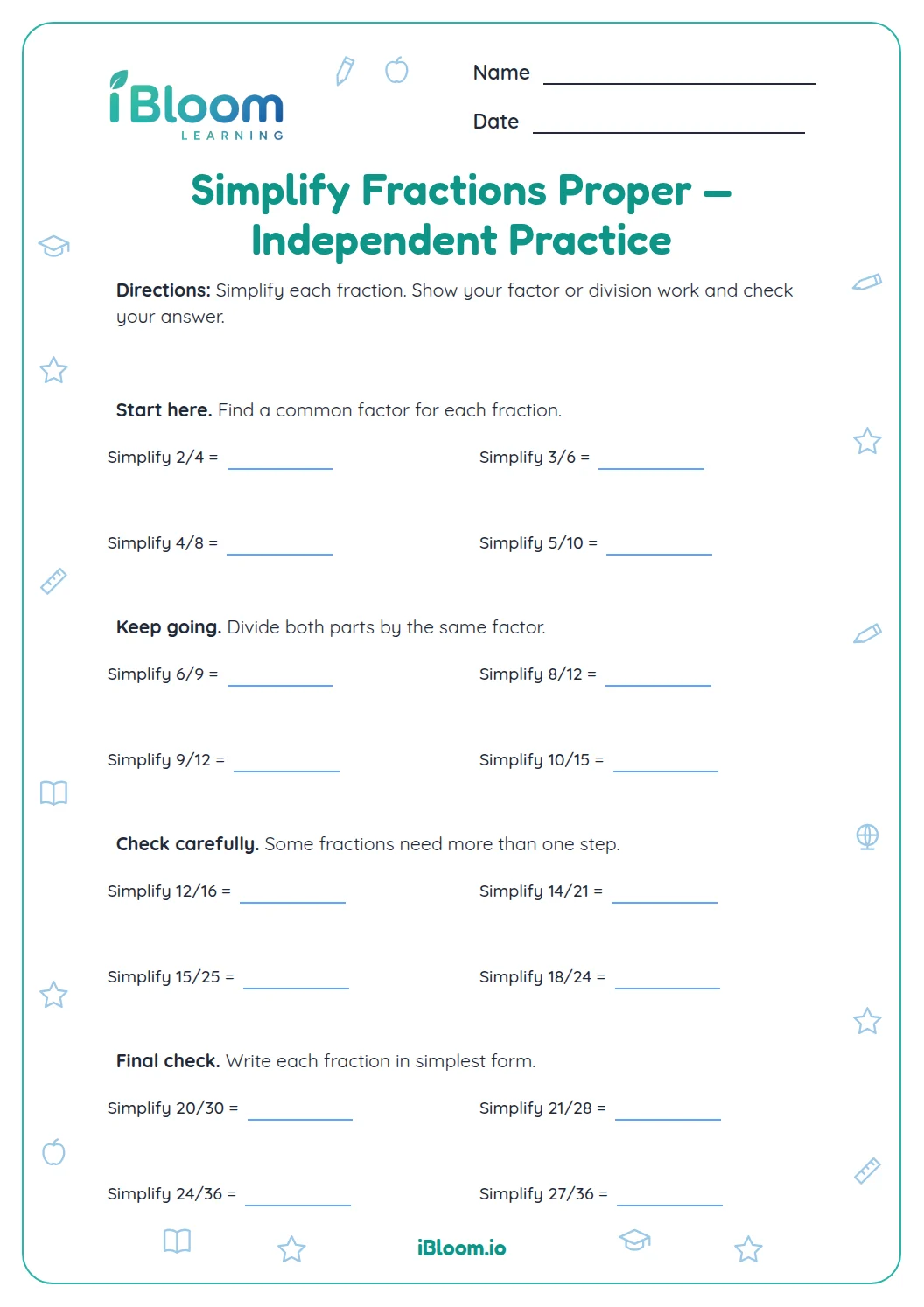
A fraction is in simplest form when its numerator and denominator have no common factor greater than 1. For example, 6/4 reduces to 3/2 because both numbers divide by 2; 3/2 has no further common factor. A common factor divides both parts evenly, so the quotient has the same value.
How many questions are on the challenge?
There are 14 questions in three parts. They include reducing improper fractions, checking another student’s reasoning, comparing values, and explaining an equivalence. The separate key lists the answer for every item. Items include both direct simplification and questions about whether a reduction can continue.
Does every item need a mixed-number answer?
No. Some answers are mixed numbers, while others ask for a fraction in simplest form or a whole number. Follow each prompt carefully; the answer key shows the expected form for that item. Read the prompt to tell whether it asks for a mixed number, a fraction, or a whole number.
Why might I need to divide more than once?
A first common factor may not remove every shared factor. For example, 18/12 becomes 6/4 after dividing by 3, and then 3/2 after dividing both parts by 2. Always check the result again. Checking common factors after each step prevents stopping at an equivalent but reducible fraction.
Is there an answer key?
Yes. The separate key lists a response for each of the 14 questions, including multiple-choice reasoning and a sample explanation for the written item. It lets learners check both the value and the reasoning. A sample response is provided where students explain the common factor and equivalent value.