

About this worksheet
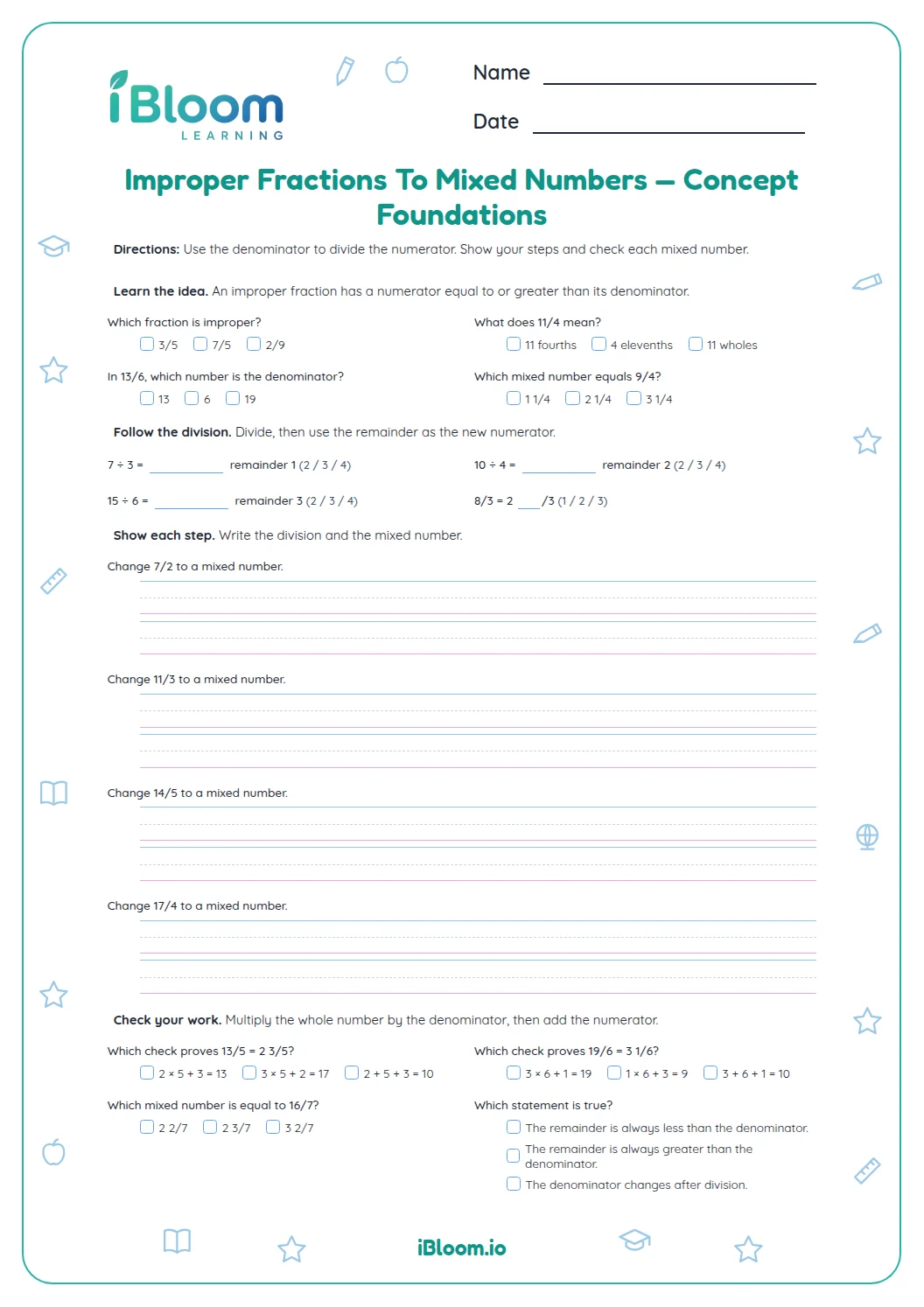
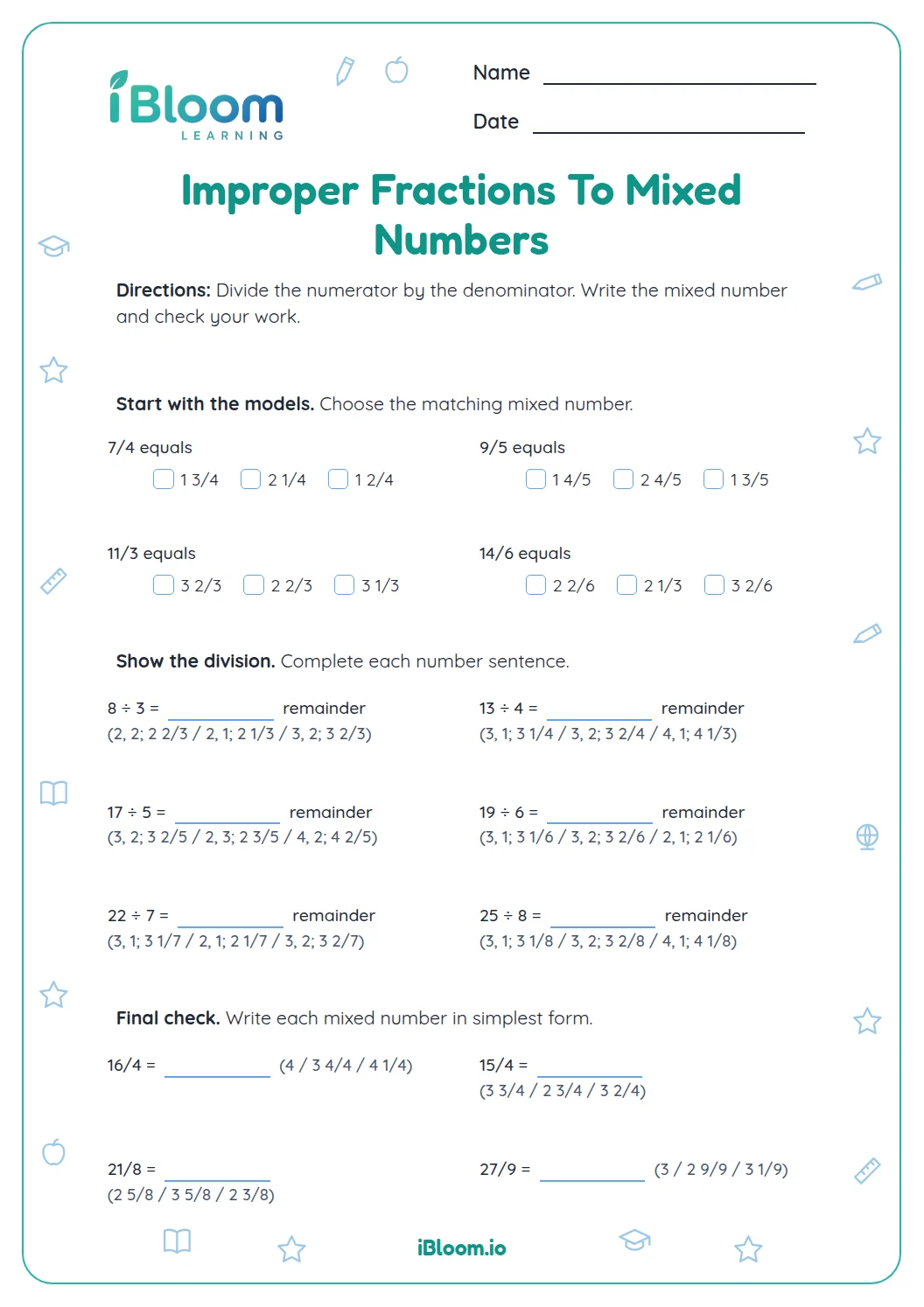
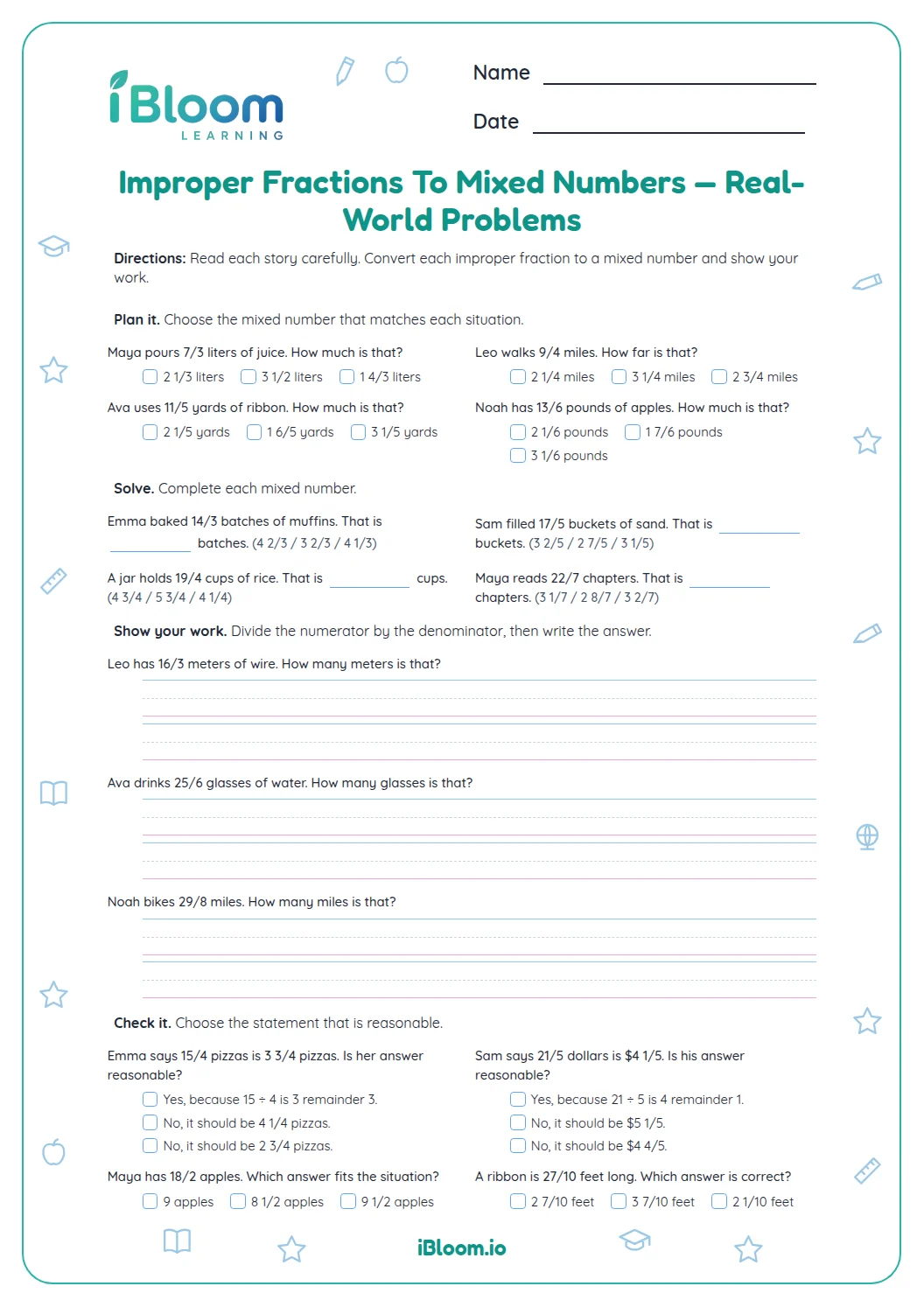
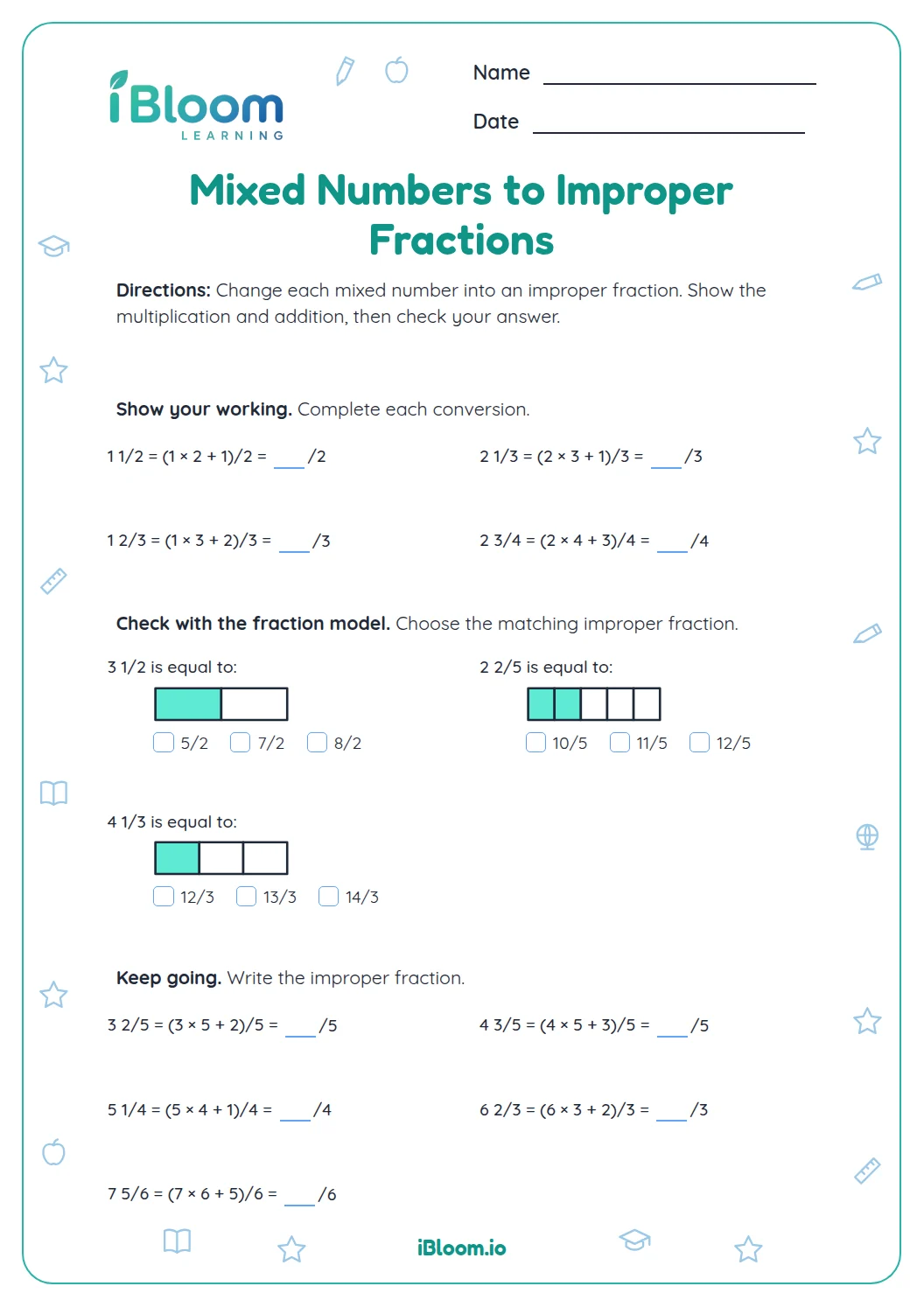
This Grade 3 printable guides learners from division with a remainder to writing an improper fraction as a mixed number. Sixteen questions include worked division clues, conversions, and answer choices. Each conversion keeps the original denominator so the remainder names the leftover fractional parts. A separate answer key shows both parts of each mixed number.
Aligned to 4.NF.B.3.b
How does division make a mixed number?
Divide the numerator by the denominator. The quotient counts full wholes, and the remainder is written over the original denominator. For 7/3, 7 ÷ 3 is 2 remainder 1, so 7/3 = 2 1/3.
In question 1, the dividend is 7 because 7 ÷ 3 = 2 remainder 1. The resulting mixed number is 2 1/3.
- 17 ÷ 3 = 2 remainder 1
- 27/3 = 2 1/3
- 3Check: 2 × 3 + 1 = 7
What does the remainder become?
The remainder is the numerator of the fractional part; the original denominator stays in place. If there is no remainder, the fraction is a whole number, as with 21/3 = 7.
What practice is on the page?
Sixteen items move from guided quotient and remainder prompts to independent conversions and choices. Each mixed-number answer keeps its fractional part visible in the key.
How to use this worksheet
- 1Divide the numerator by the denominator.
- 2Record the quotient as the number of wholes.
- 3Write the remainder over the original denominator.
- 4If the remainder is zero, write a whole number.
- 5Check by multiplying the quotient by the denominator and adding the remainder.
Common mistakes and quick fixes
The mistake
Writing the quotient in a dividend blank
The fix
The dividend is the number being divided, usually the numerator.
The mistake
Dropping the remainder
The fix
Keep it as the numerator of the fractional part.
The mistake
Changing the denominator
The fix
Keep the original denominator because the piece size has not changed.
Common Core alignment
The questions show fractions greater than one as full groups plus leftover fractional parts.
Break fractions into sums of same-denominator parts and justify them with models.
On this sheet: The models and conversions decompose each improper fraction into complete groups and a same-denominator remainder.
Show the official wordingHide the official wording
Decompose a fraction into a sum of fractions with the same denominator in more than one way, recording each decomposition by an equation. Justify decompositions, e.g., by using a visual fraction model. Examples: 3/8 = 1/8 + 1/8 + 1/8 ; 3/8 = 1/8 + 2/8 ; 2 1/8 = 1 + 1 + 1/8 = 8/8 + 8/8 + 1/8.
What to practice next
Make more practice
Further reading
Questions parents and teachers ask
What is the dividend in 7 ÷ 3 = 2 remainder 1?
The dividend is 7, the number being divided. The quotient is 2 and the remainder is 1. Together they show that 7 thirds make 2 wholes and 1 third, so 7/3 equals 2 1/3. The denominator tells the size of each piece, so keep it under the remainder.
How do I turn an improper fraction into a mixed number?
Divide the numerator by the denominator. Write the quotient as the whole number, then put the remainder over the original denominator. For example, 13 ÷ 2 = 6 remainder 1, so 13/2 = 6 1/2. The quotient counts complete groups; the remainder counts pieces left after those groups.
What if the numerator divides evenly?
Then the fraction is a whole number and has no fractional remainder. For example, 21 ÷ 3 = 7 exactly, so 21/3 = 7. The independent section includes an item with this result. Use division to check that the quotient and remainder rebuild the starting numerator.
Does the denominator change during conversion?
No. It continues to name the size of each fractional part. In 16/3, the remainder is 1, so the fractional part is 1/3 and the whole number is 5. When the remainder is zero, the improper fraction names a whole number.
Why does the first part ask for the dividend?
The dividend is the starting number being divided. Recognizing it helps connect the improper fraction’s numerator to the division sentence. Question 1 links 7/3 with 7 ÷ 3 = 2 remainder 1. The distractors change the quotient, remainder, or denominator so the conversion can be checked.
Is a separate answer key provided?
Yes. The answer key includes both the dividend and mixed number where a question has two blanks, plus all independent conversions and choices. It can be used to check each quotient and remainder. The key includes both the whole number and fractional part for every conversion.