

About this worksheet
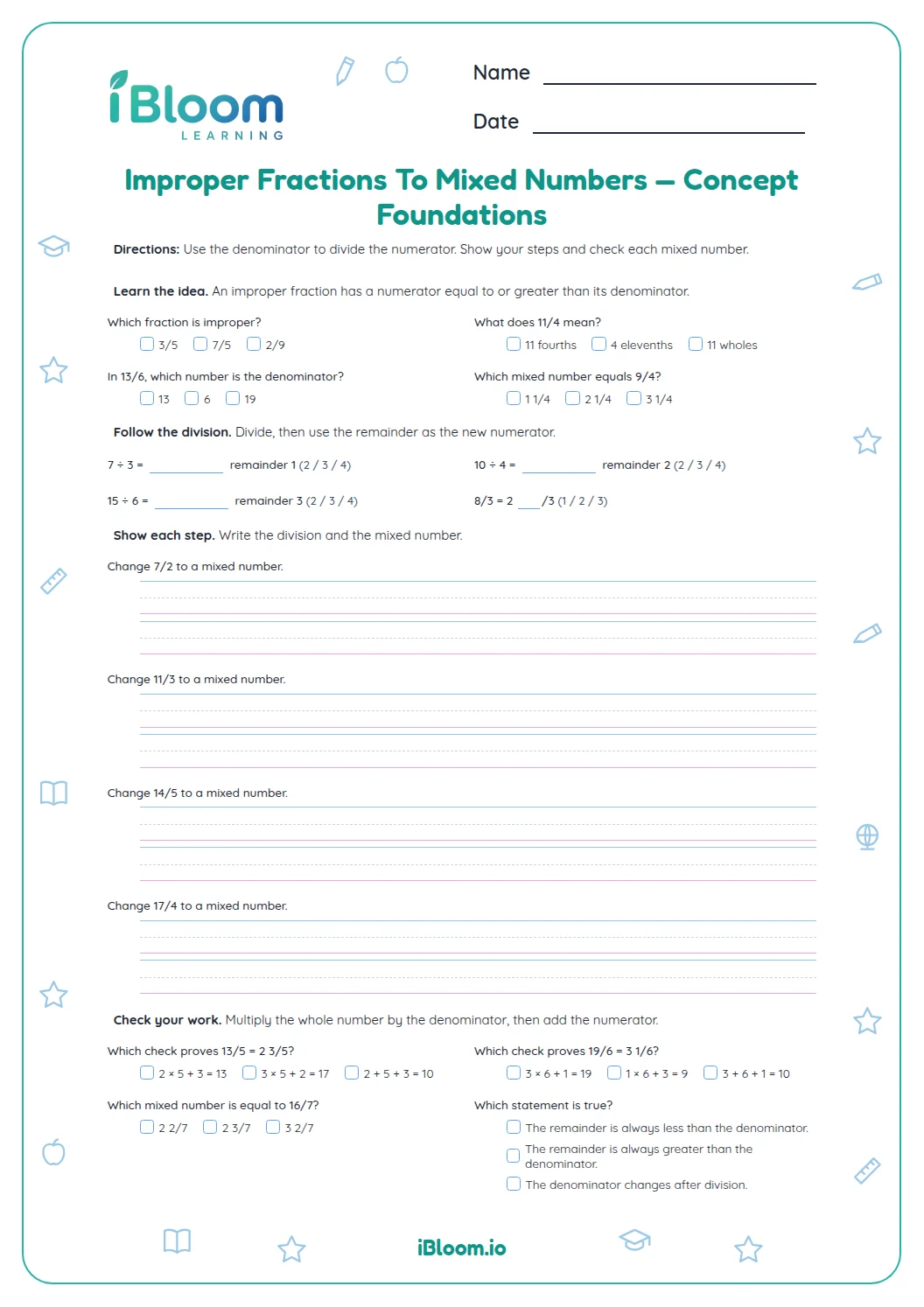
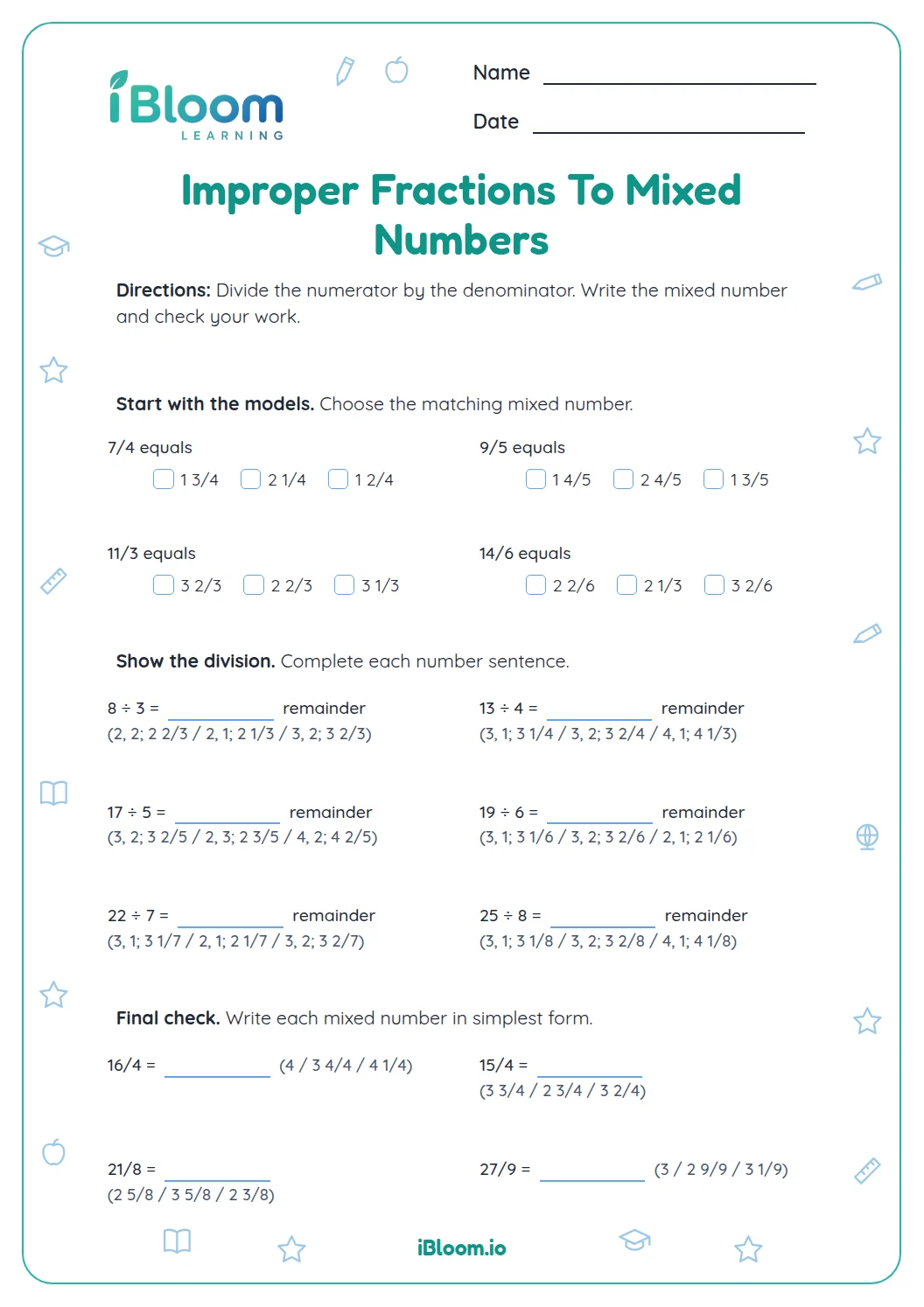
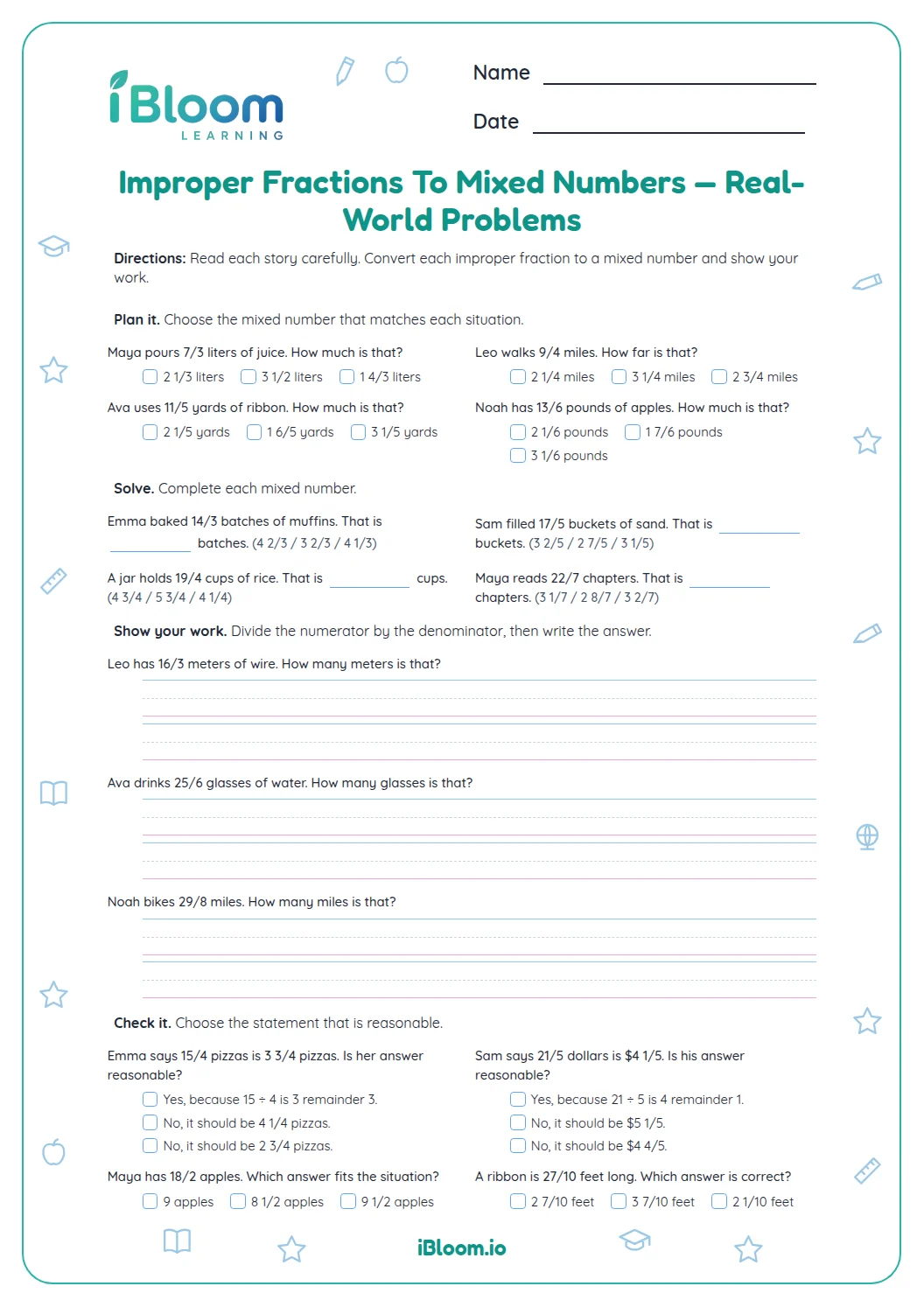
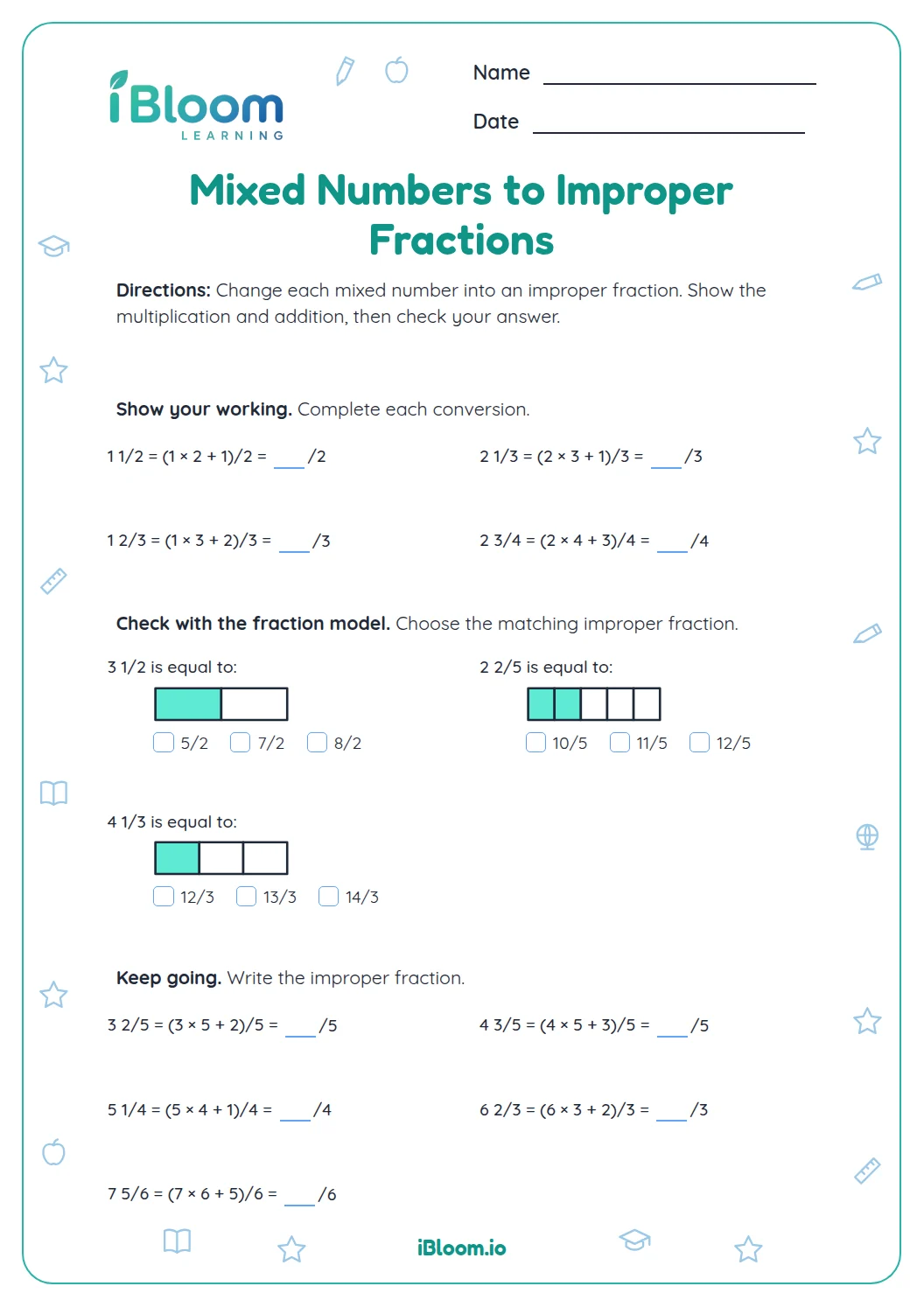
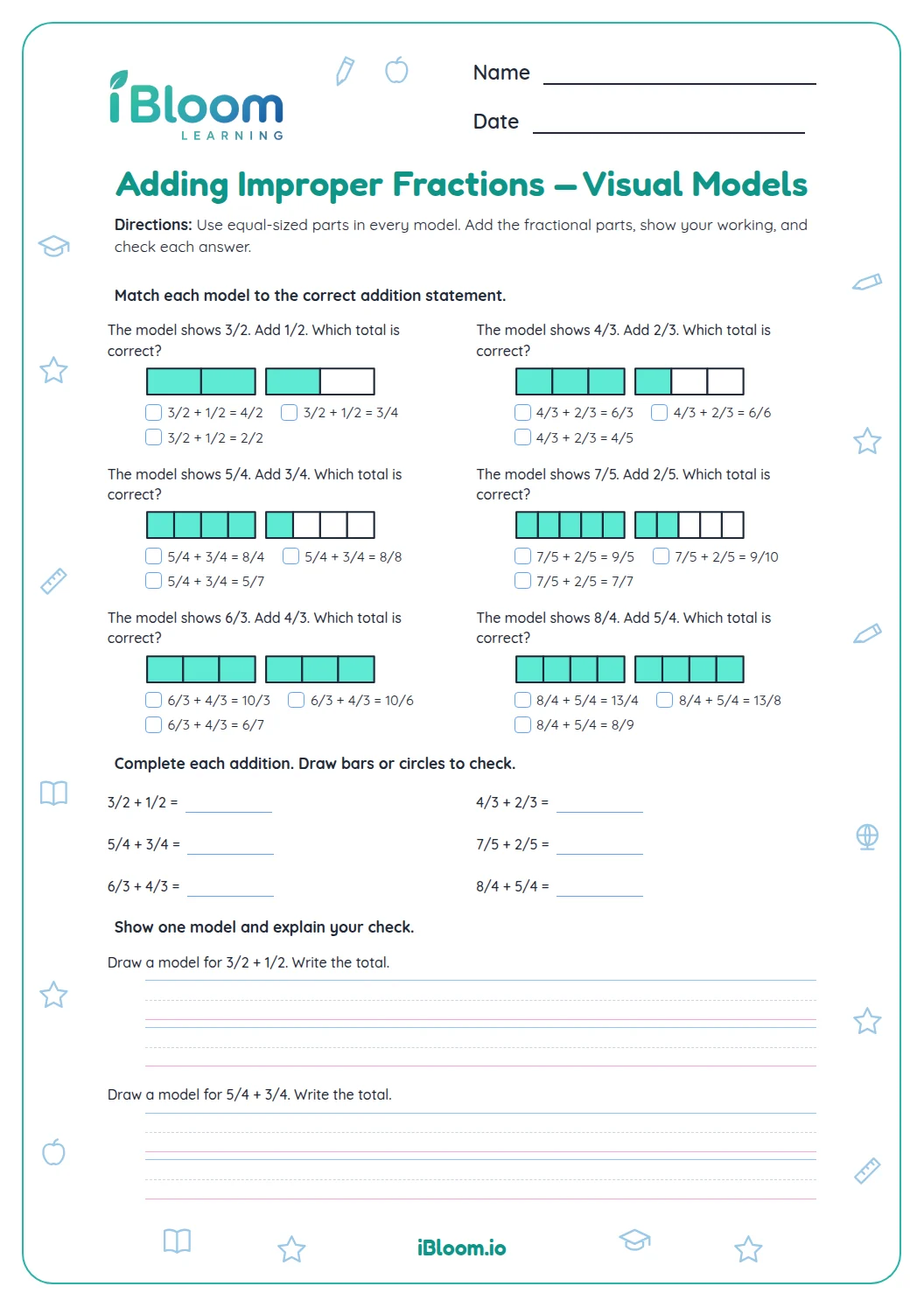
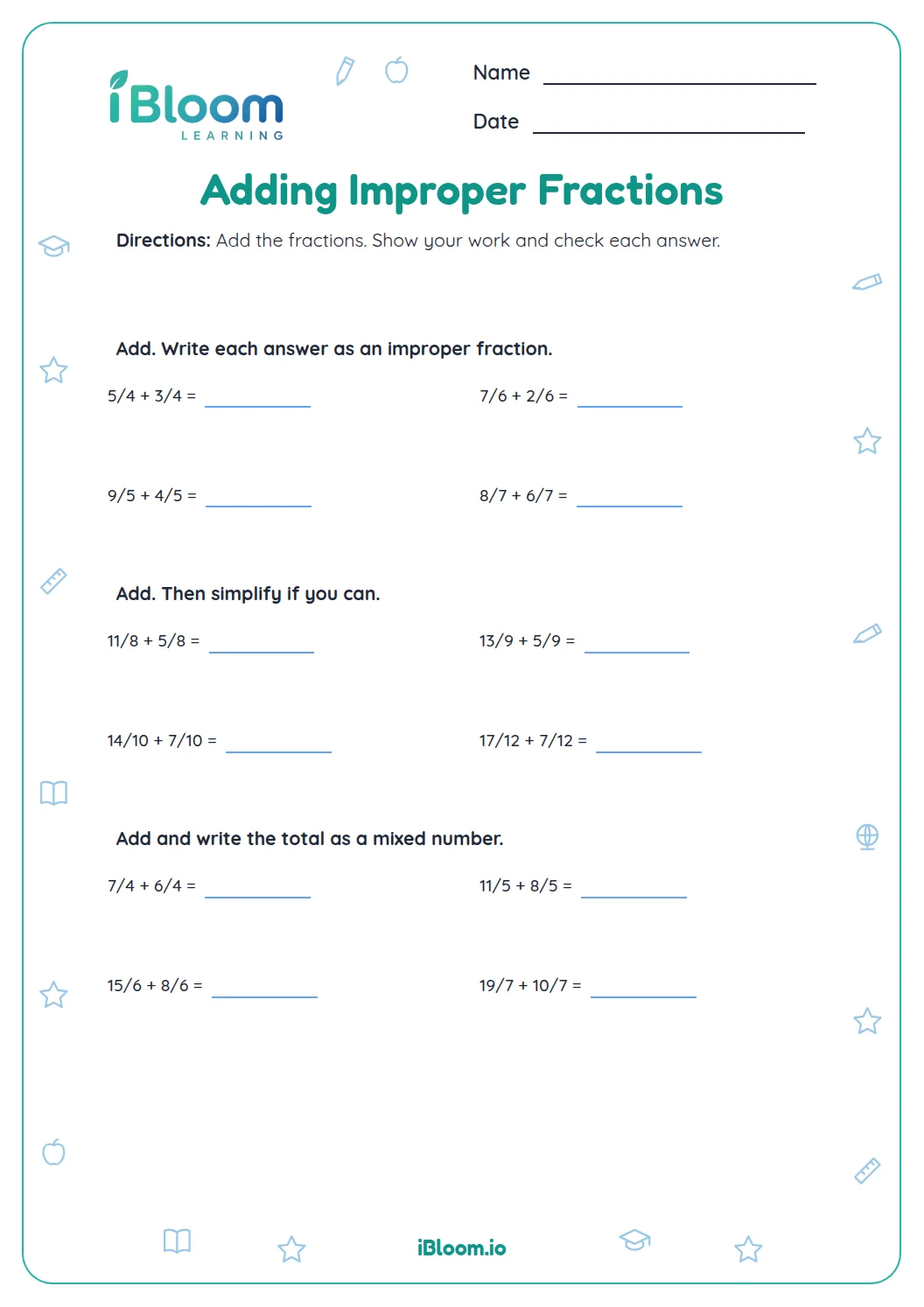
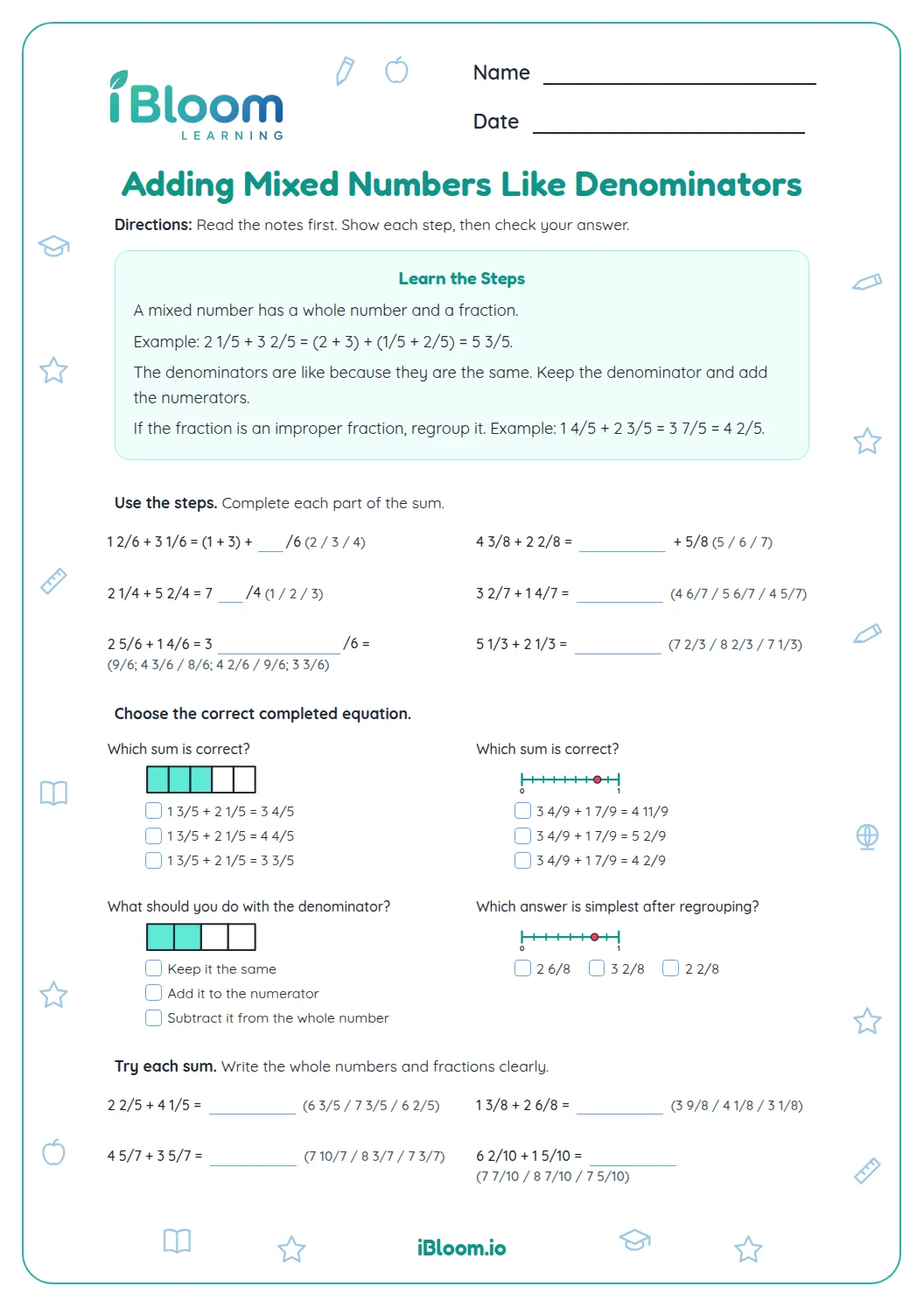
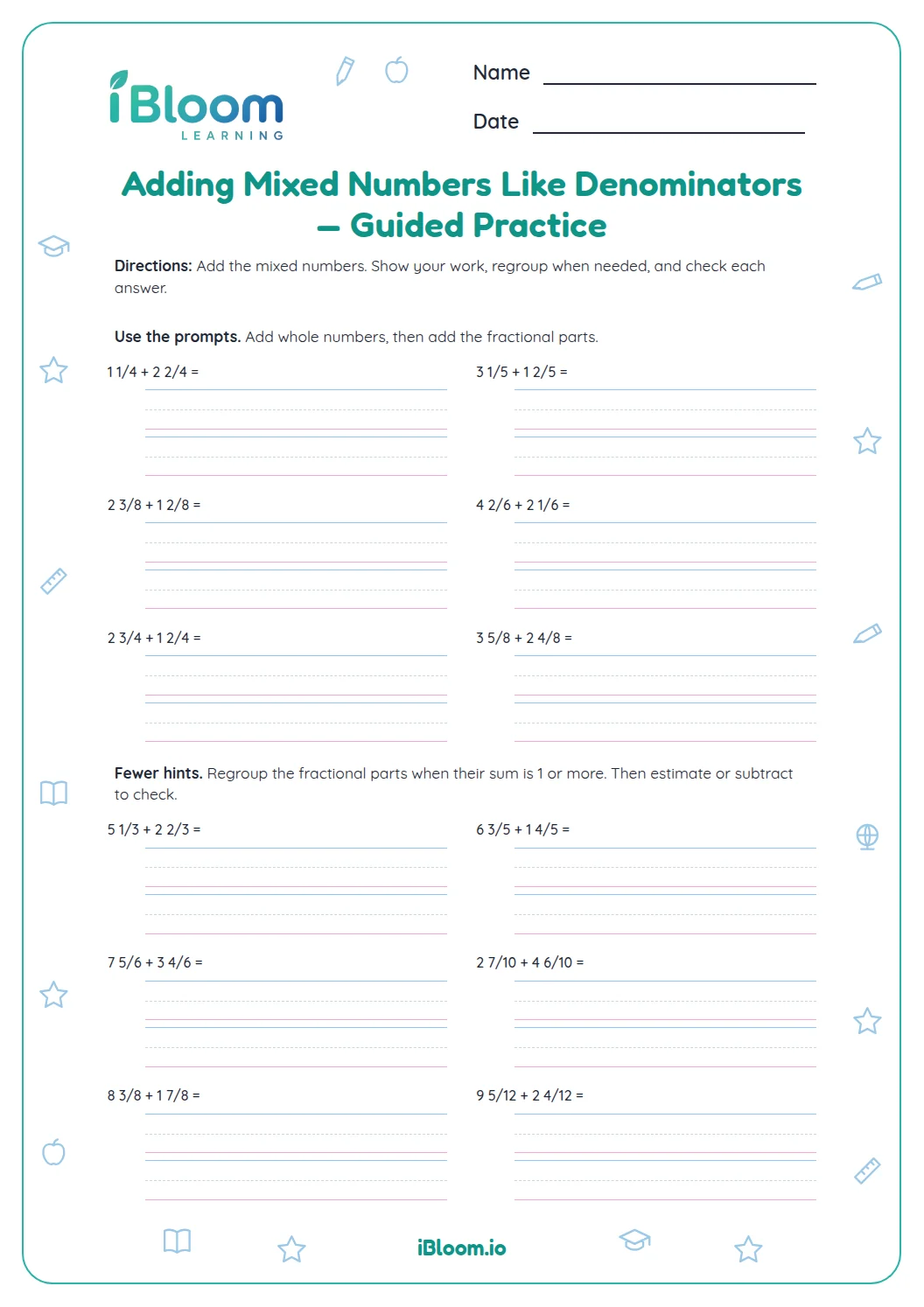
This printable uses shaded bars and circles to help Grade 3 students connect improper fractions with mixed numbers. Fourteen questions use thirds, fourths, fifths, and sixths, with every model showing complete wholes and leftover pieces. Learners read or match each model, then check the written conversion against the key. The practice connects improper fractions to sums of same-size fractional parts.
Aligned to 4.NF.B.3.b
How does a model show an improper fraction?
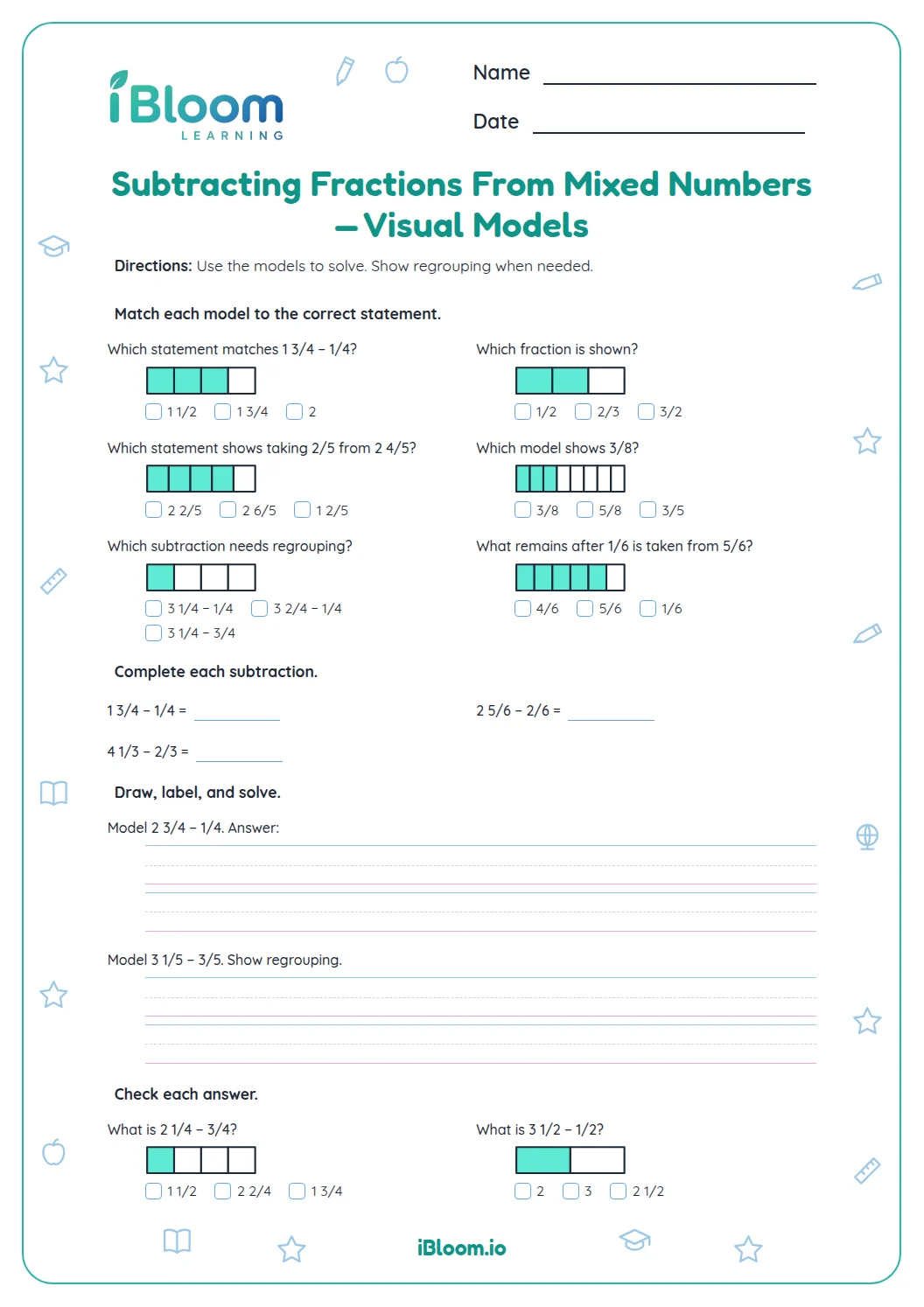
Each full shape is one whole split into equal parts. Count the complete shapes, then count the shaded parts in the unfinished shape. For 7/3, two full bars and one third make 2 1/3.
Question 1 asks children to read the shaded bars and name both the wholes and the leftover third.
- 1Two whole bars = 6/3
- 2One shaded third remains
- 37/3 = 2 1/3
How do quotient and remainder connect to the model?
The number of complete wholes matches the quotient. The shaded remainder is written over the model’s denominator. A model with 10 fourths has 2 complete wholes and 2 fourths left.
What fraction models are included?
Fourteen questions use shaded bars and circles with thirds, fourths, fifths, and sixths. Every mixed number in the key includes its fractional part.
How to use this worksheet
- 1Count the equal parts in one whole to identify the denominator.
- 2Count complete shaded wholes.
- 3Count leftover shaded parts for the numerator.
- 4Write the leftover over the original denominator.
- 5Check that the model has the same total number of pieces as the improper fraction.
Common mistakes and quick fixes
The mistake
Counting partial pieces as whole shapes
The fix
Count a whole only when every part of that shape is shaded.
The mistake
Leaving out the remainder
The fix
Record the shaded pieces after the full wholes.
The mistake
Using the number of parts as the denominator incorrectly
The fix
Keep the number of equal parts in each whole as the denominator.
Common Core alignment
The questions show fractions greater than one as full groups plus leftover fractional parts.
Break fractions into sums of same-denominator parts and justify them with models.
On this sheet: The models and conversions decompose each improper fraction into complete groups and a same-denominator remainder.
Show the official wordingHide the official wording
Decompose a fraction into a sum of fractions with the same denominator in more than one way, recording each decomposition by an equation. Justify decompositions, e.g., by using a visual fraction model. Examples: 3/8 = 1/8 + 1/8 + 1/8 ; 3/8 = 1/8 + 2/8 ; 2 1/8 = 1 + 1 + 1/8 = 8/8 + 8/8 + 1/8.
What to practice next
Make more practice
Further reading
Questions parents and teachers ask
What does 7/3 look like as a mixed number?
It looks like 2 1/3: two complete wholes made from thirds, with one third remaining. Question 1 uses a bar model to make the two full groups and leftover part visible. Each bar is divided into equal parts, and the shaded parts show the full amount.
How do I read a shaded fraction model?
Count the number of fully shaded wholes first, then count shaded pieces in the partial whole. Keep the piece count over the model’s denominator. For example, two whole circles and two fourths is 2 2/4. Count complete circles first, then read the shaded pieces in the unfinished circle.
Why are there full wholes in the models?
The worksheet focuses on improper fractions, whose numerators are at least as large as their denominators. A full shaded shape represents one whole; extra shaded pieces show the remaining fraction. The denominator stays the same because each shaded piece keeps its original size.
Can two different fractions represent the same model amount?
Yes. For example, 10/4 can be shown as 2 2/4, while simplifying the leftover part gives 2 1/2. This worksheet keeps the denominator shown in the model so children can connect each piece directly. An unsimplified remainder such as 2/4 still names the correct part of a whole.
Why does the model keep the original denominator?
The denominator names the size of each equal part in the drawing. When converting, the full shapes become whole numbers and the leftover shaded parts keep that same part size. The choices keep the original denominator so each answer can be compared with its model.
Is there an answer key?
Yes. The separate key gives the mixed number for each model and the correct multiple-choice value. It includes the fraction part, such as 2 1/3, so the visual and written answer can be compared. The key shows complete mixed numbers, including their fraction parts, beside the models.