




About this worksheet
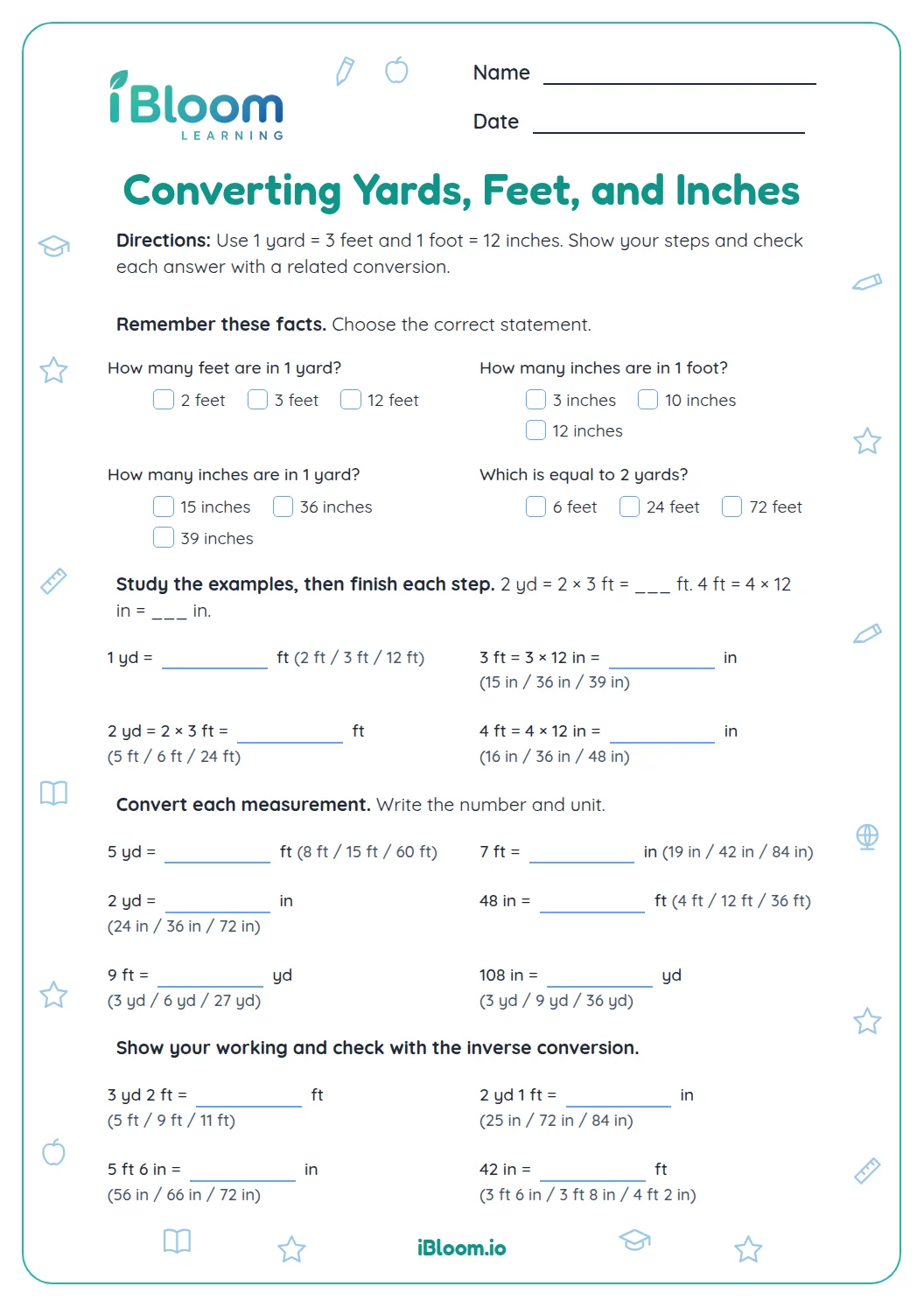
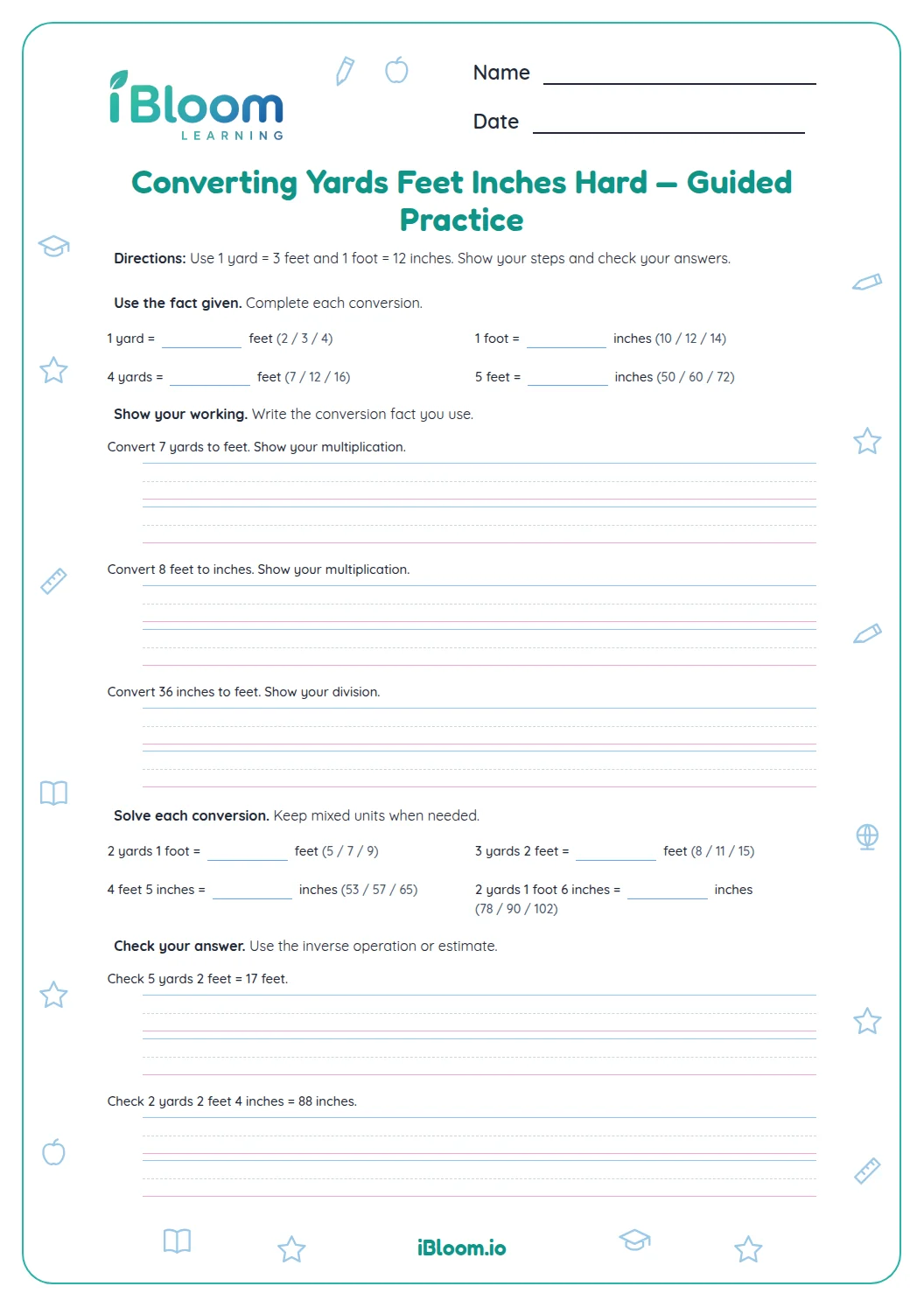
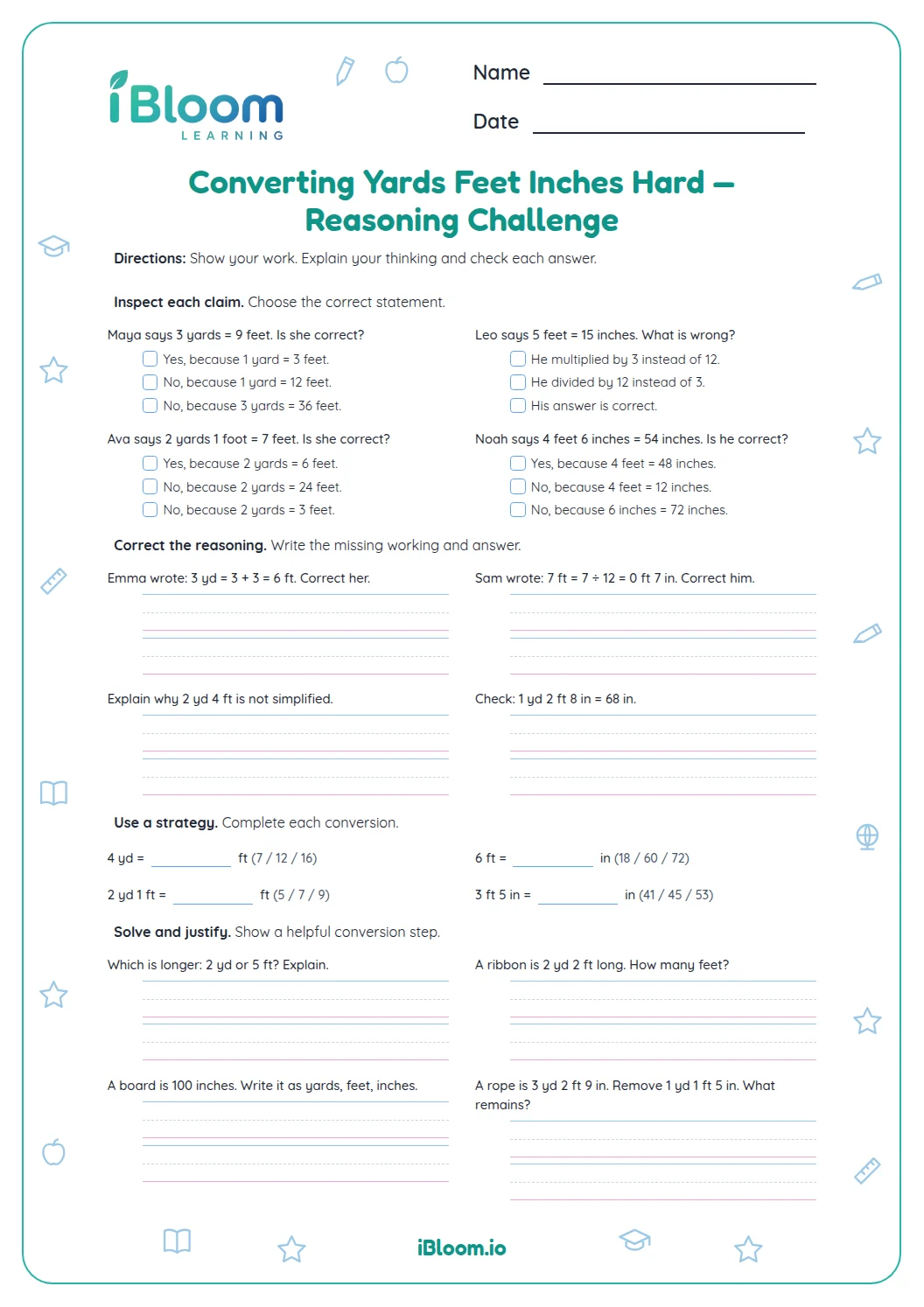
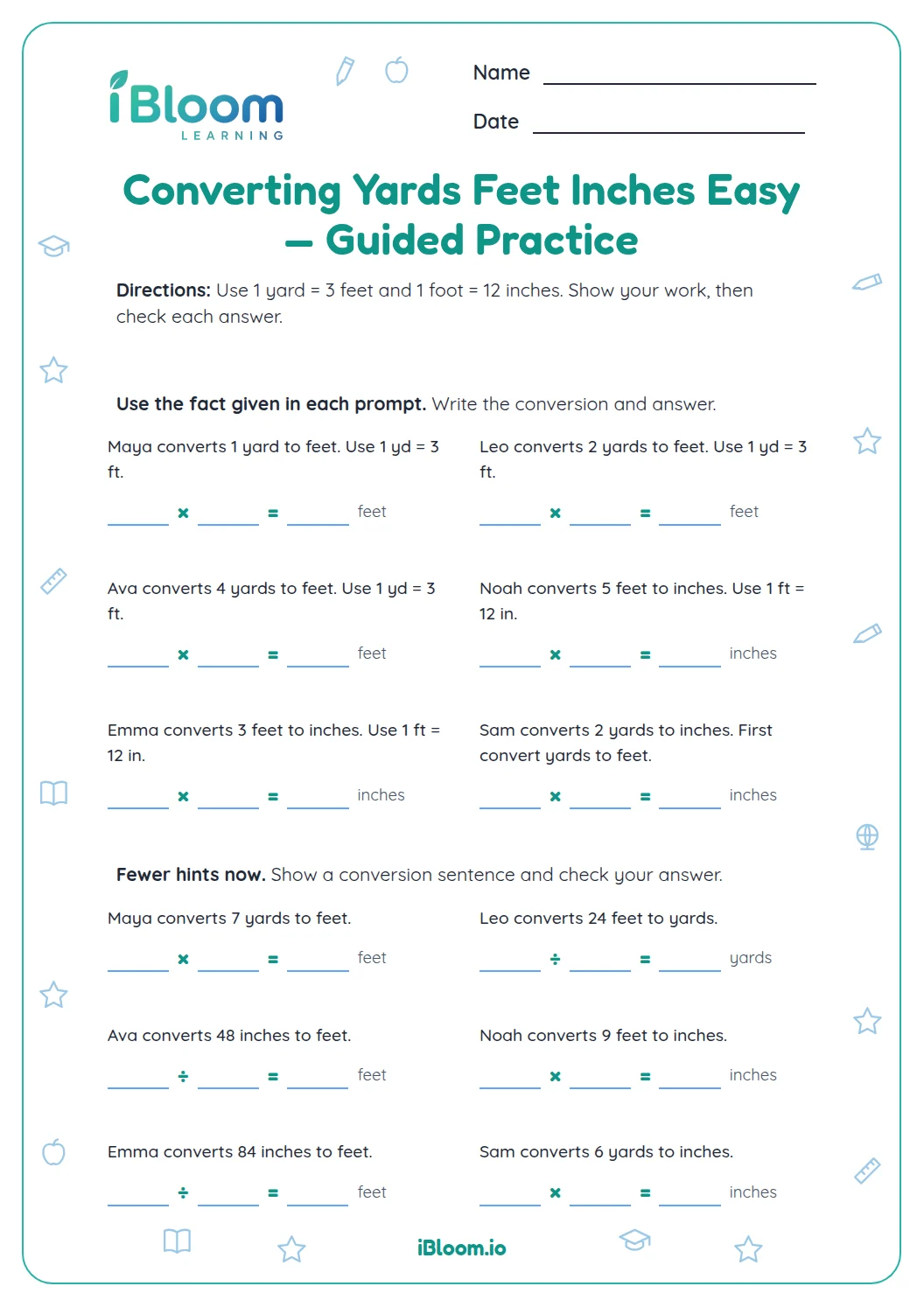
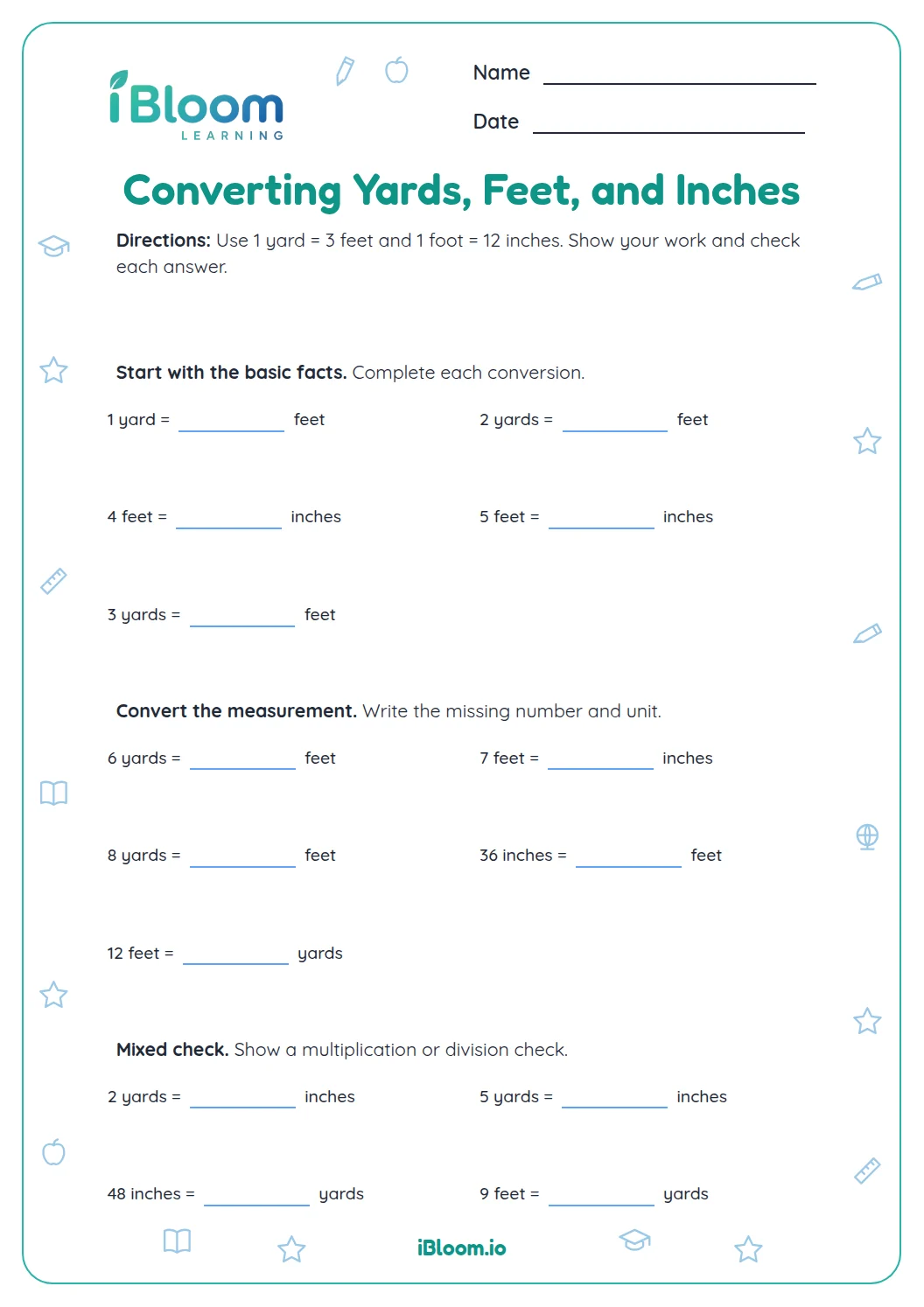
This printable Grade 3 worksheet uses 14 short situations to practice length conversions. Students use 3 feet per yard and 12 inches per foot, then combine mixed measures or regroup inches into feet. Each problem has equation space, and the answer key includes units. The page practices measurement relationships described in CCSS 4.MD.A.1.
Aligned to 4.MD.A.1
How do you choose a conversion fact?
Look at the starting unit and the requested unit. Use 3 feet per yard when changing yards to feet and 12 inches per foot when changing feet to inches.
In question 1, 30 yards × 3 feet per yard = 90 feet.
- 130 yd × 3 ft per yd
- 230 × 3 = 90
- 3Answer: 90 ft
How do you solve mixed-unit stories?
Convert each measurement to one unit before adding. In question 9, 1 yard is 36 inches, 2 feet is 24 inches, and 7 inches stays 7 inches: 36 + 24 + 7 = 67 inches.
For a feet-and-inches result, divide total inches by 12 and keep the remainder.
How can you check the result?
Reverse the conversion and compare it with the original length. Question 10 turns 65 inches into 5 feet 5 inches because 5 × 12 + 5 = 65.
Read the story again to confirm the final unit answers the question.
How to use this worksheet
- 1Underline the unit the story asks for.
- 2Choose 3 feet per yard or 12 inches per foot.
- 3Write an equation for each conversion.
- 4Convert all parts to one unit before adding.
- 5For feet and inches, divide by 12 and keep the remainder.
- 6Check the final unit against the story.
Common mistakes and quick fixes
The mistake
Multiplying yards by 12 when feet are requested
The fix
Change yards to feet with a factor of 3.
The mistake
Adding mixed units before converting
The fix
Convert each part to a common unit first.
The mistake
Leaving off the requested unit
The fix
Include the unit in each story answer.
Common Core alignment
This worksheet practices the math standard below.
Convert measurements to a smaller unit using relationships within one system.
On this sheet: The problems use relationships among yards, feet, and inches to convert measurements.
Show the official wordingHide the official wording
Know relative sizes of measurement units within one system of units including km, m, cm; kg, g; lb, oz.; l, ml; hr, min, sec. Within a single system of measurement, express measurements in a larger unit in terms of a smaller unit. Record measurement equivalents in a two-column table.
What to practice next
Make more practice
Further reading
Questions parents and teachers ask
Which facts help with these length stories?
Use 1 yard = 3 feet and 1 foot = 12 inches. Identify the starting and requested units, then choose the needed fact. The first questions practice a single conversion, while later questions combine mixed units or regroup inches into feet and leftover inches.
How do I convert a yard measurement to inches?
Change yards to feet first, then feet to inches. Four yards equal 12 feet, and 12 feet equal 144 inches. This two-step method keeps the units visible as you work and is useful for questions about ribbons, fabric, or other lengths.
What should I do with mixed units?
Convert each part into the same unit before adding. For 1 yard 2 feet 7 inches, change the yard to 36 inches and the feet to 24 inches, then add 36 + 24 + 7. The answer should use the unit requested by the story.
How do I write feet and leftover inches?
Divide the total inches by 12. The quotient is the number of feet, and the remainder is the leftover inches. For example, 65 inches is 5 feet with 5 inches left because 5 × 12 + 5 = 65.
What is in the answer key?
The separate key gives a value with the requested unit for all 14 stories. For two-part answers, it names feet and leftover inches or yards and feet so the result is easy to compare with the story. Students can use their equation space to show each conversion.