
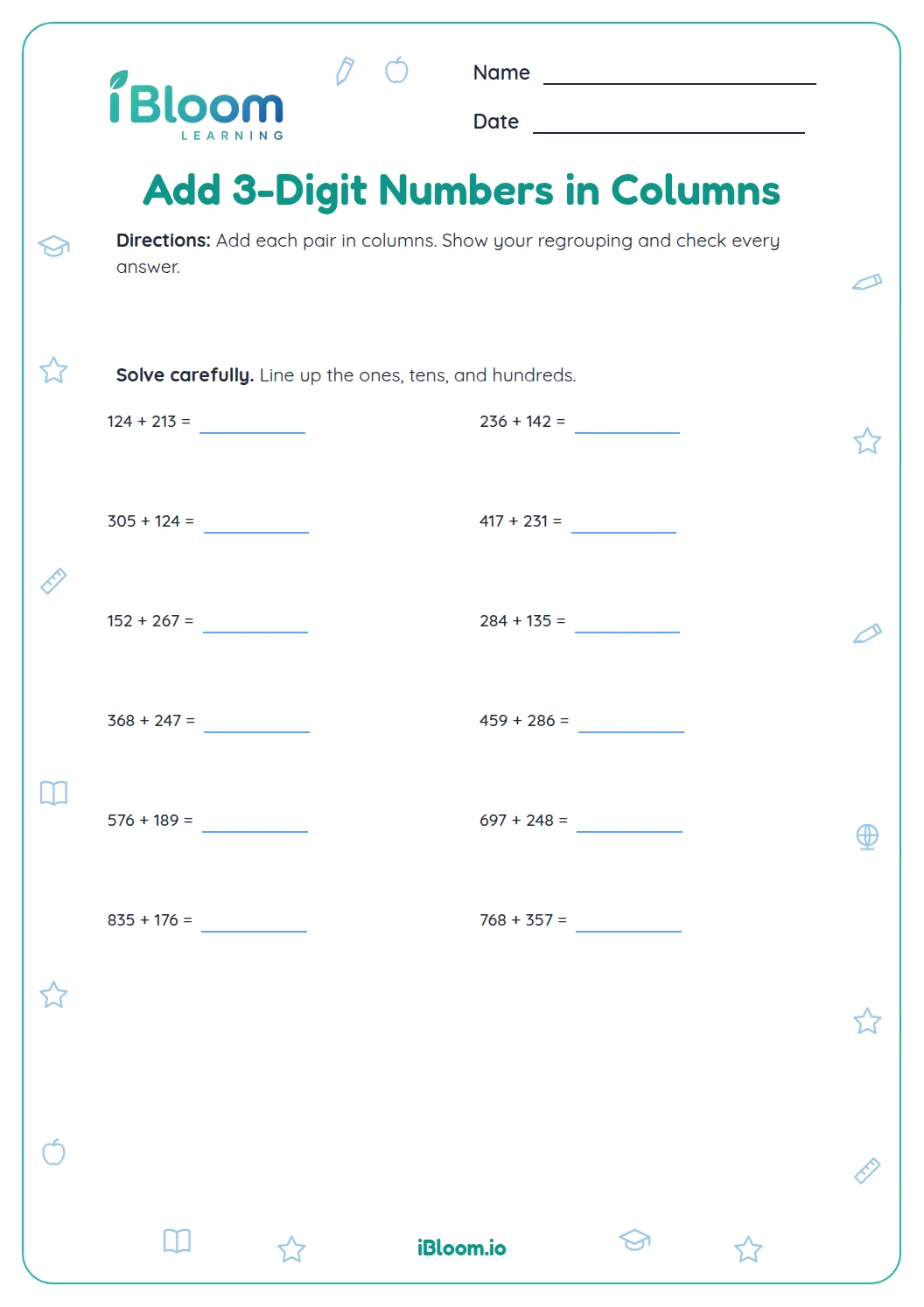
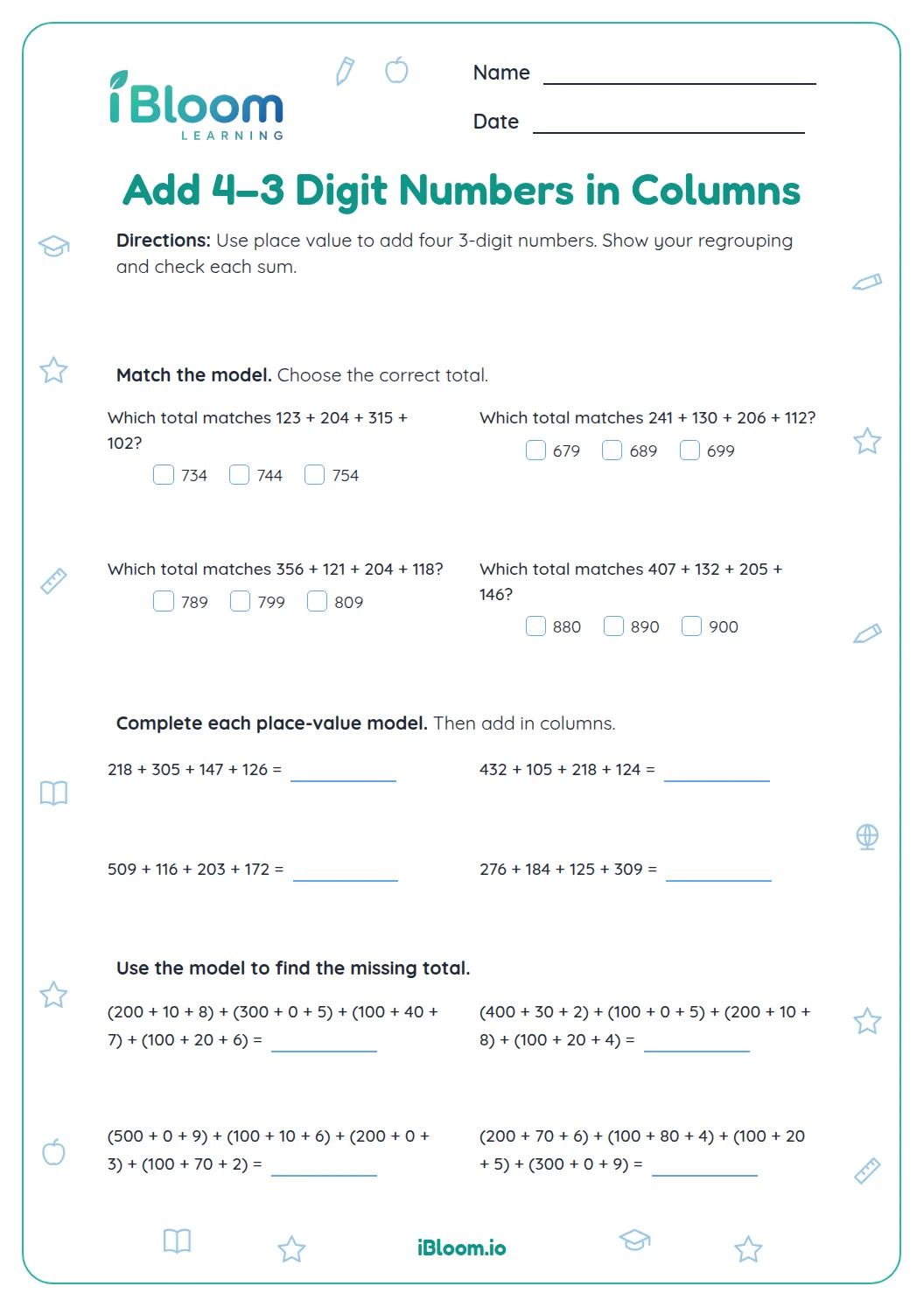
About this worksheet
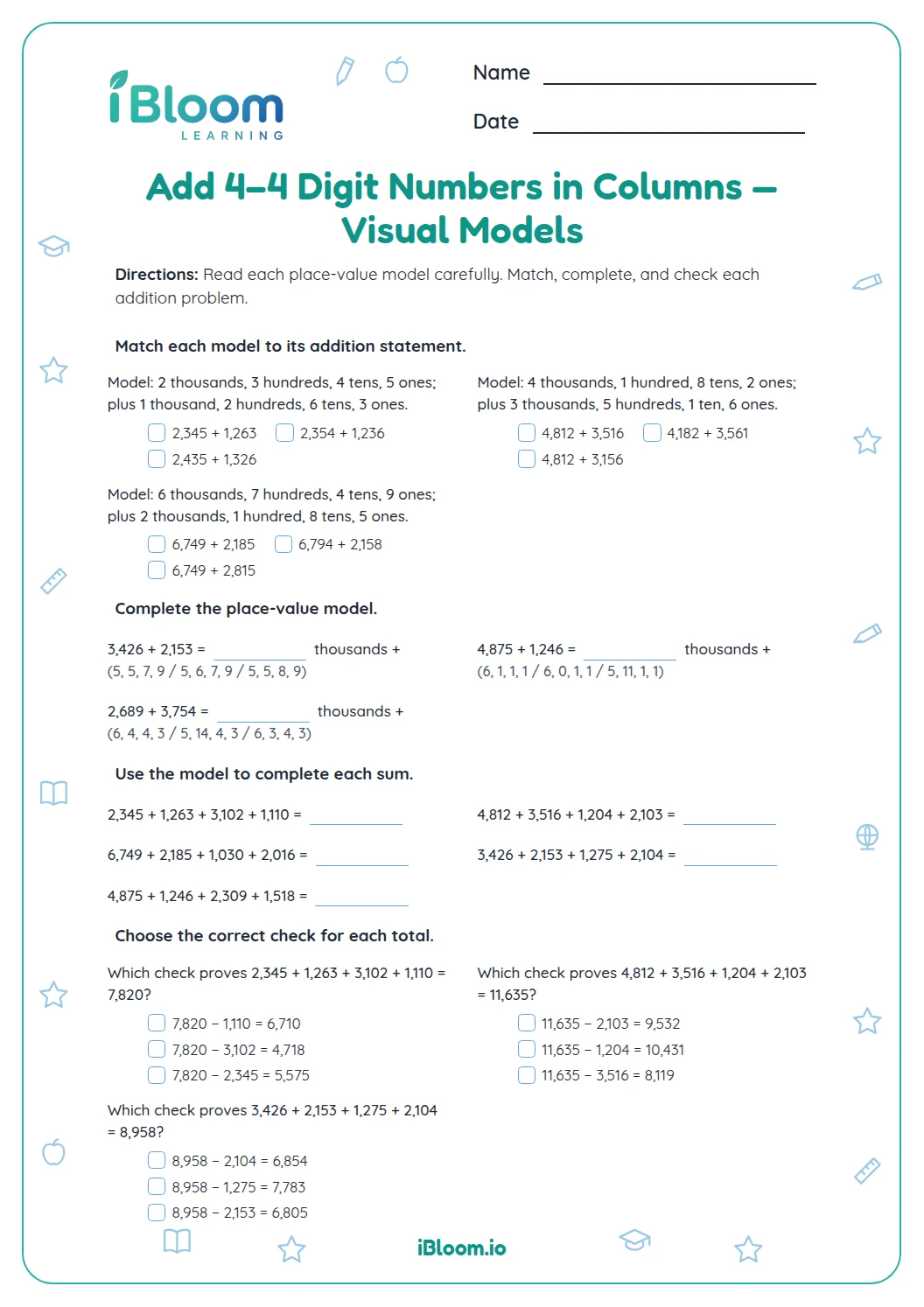
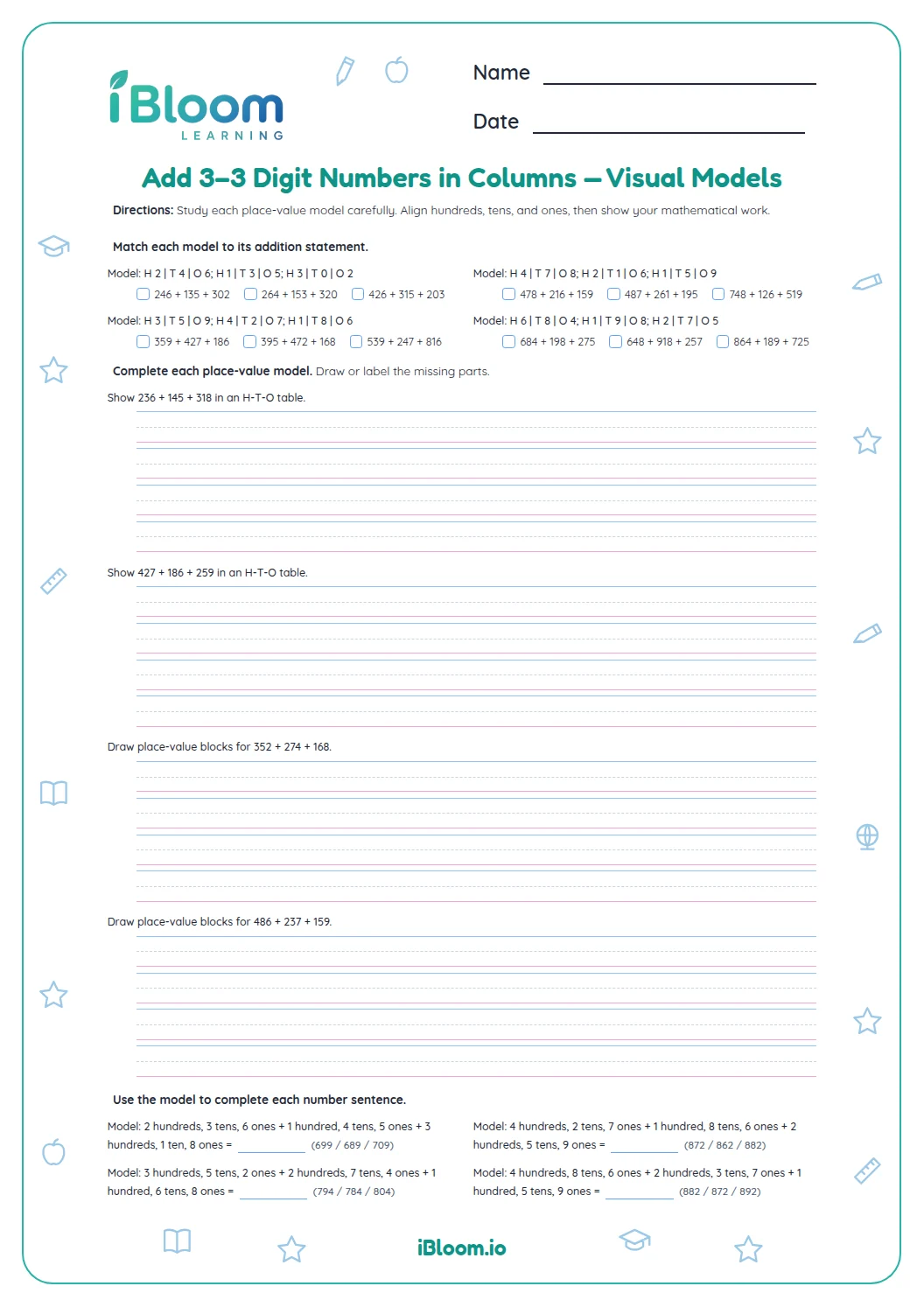
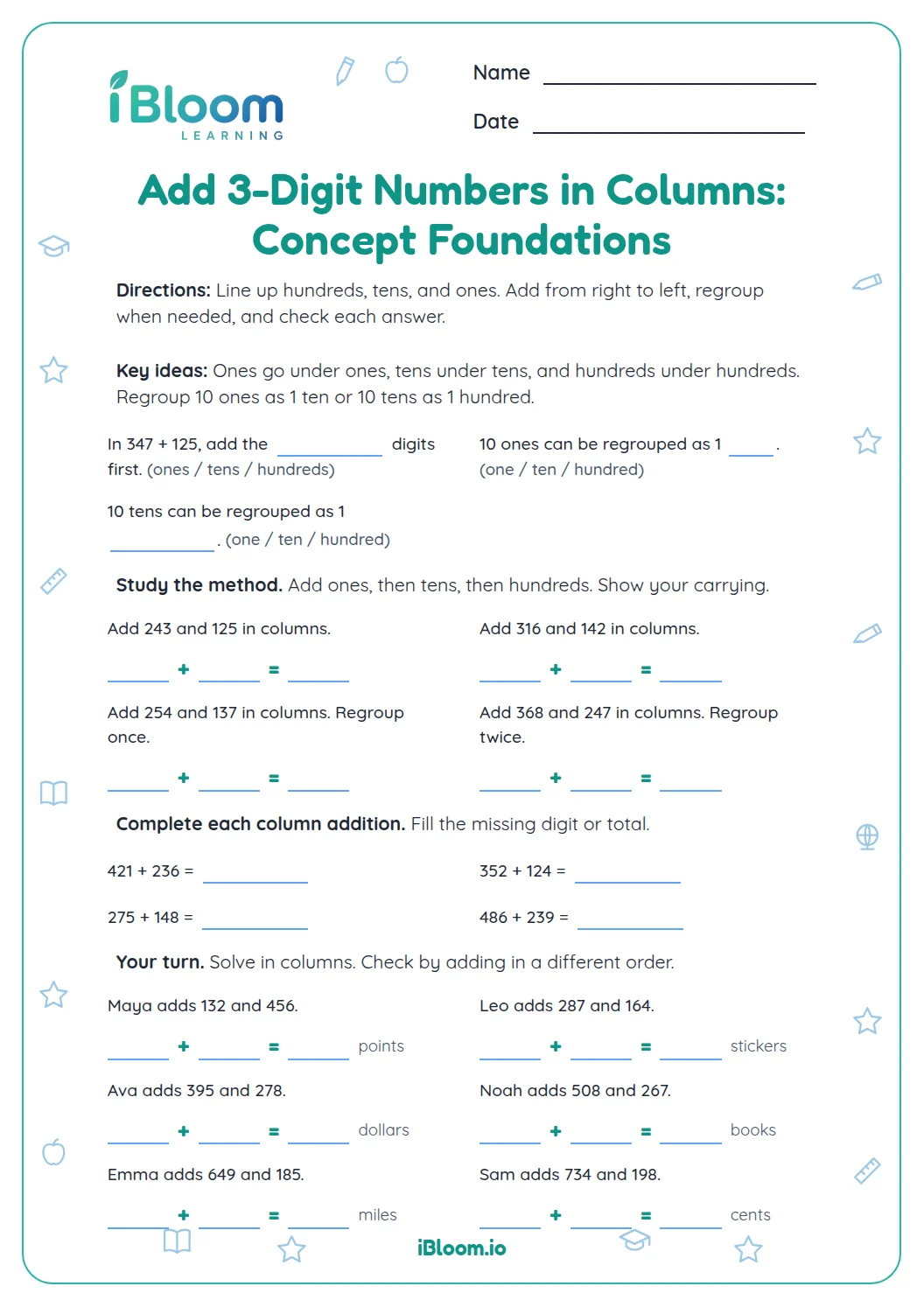
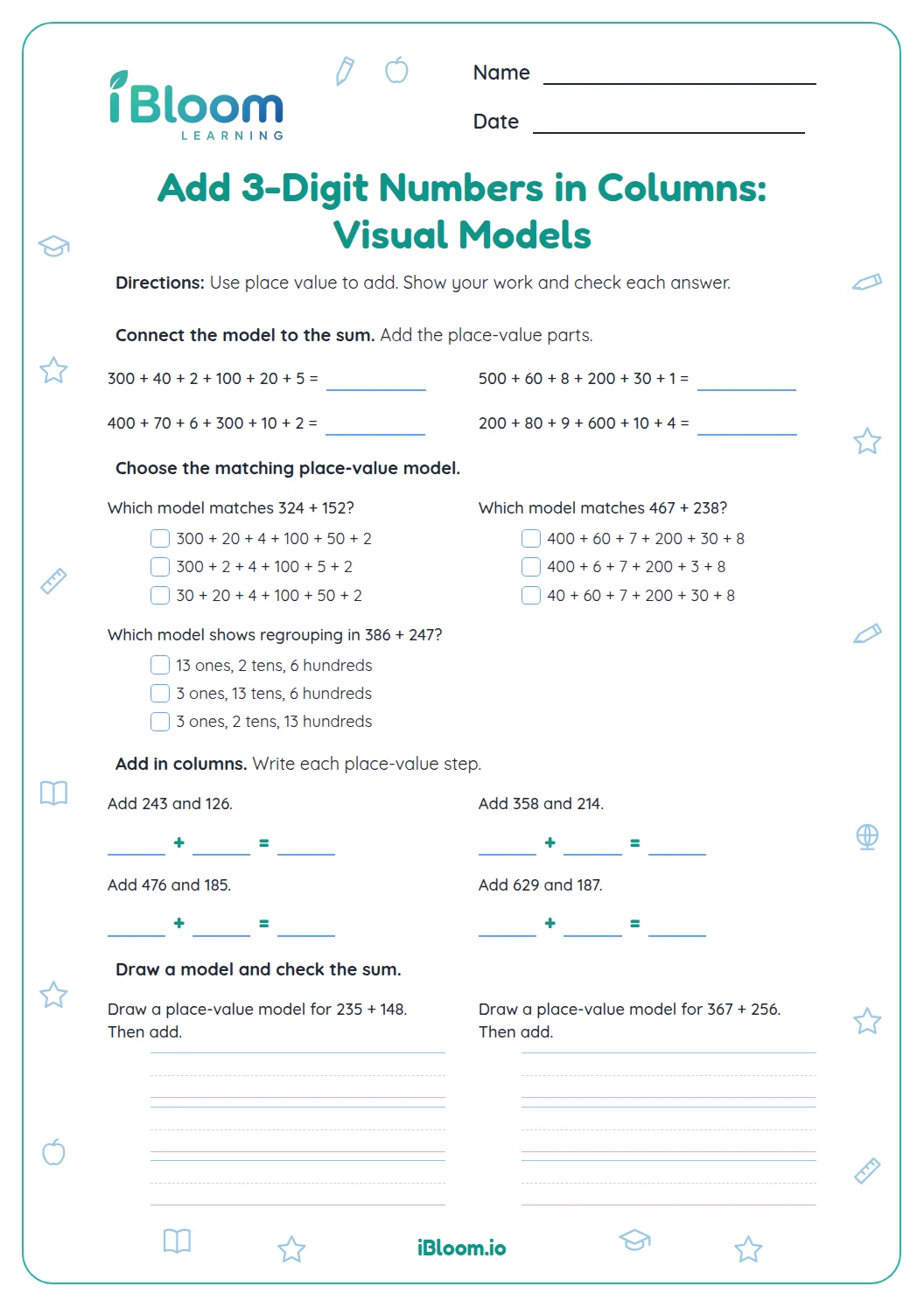
This free printable is for Grade 4 students practicing addition in columns. It has 14 problems, each with 4 4-digit addends and an answer line. Plus signs appear before every addend, and the numbers are arranged vertically so students can line up matching place values as they work. The final four problems provide extra room to show regrouping. A separate answer key lists all 14 sums.
Aligned to 4.NBT.B.4
How do you line up the addends?
Start with the ones digits in one vertical column. Place each tens digit directly above the next tens digit, and do the same for hundreds and thousands. A comma separates thousands in the printed numerals; it does not change the place-value alignment.
For example, question 2 adds 4,176, 2,858, 1,264, 2,245. Align the ones digits first, then the tens and hundreds digits, and thousands digits.
- 14,176 + 2,858 + 1,264 + 2,245
- 2Add each place-value column from right to left.
- 3Check the total: 10,543.
When should you regroup?
Regroup whenever a column totals ten or more. Write the ones digit in that column and add the tens digit to the next column. Keep the carried digit visible so it is included exactly once.
With 4 addends, first total every digit in the same place-value column, then regroup. A column may total more than 19, so write its ones digit and carry all the tens to the next column.
- Ones first, then tens, hundreds, and thousands
- Carry the tens value into the next place
- Re-add the columns to check the sum
What does this worksheet ask students to do?
The sheet has 14 4-digit addition problems in two parts. Part A has the first ten sums; Part B gives the final four extra work space for column setup and regrouping. Each problem asks students to add 4 numbers and write the total.
Every addend has a visible plus sign, including the first number. Students can align the digits by place value, then compare each total with the separate answer key.
How can an adult support the practice?
Before a student starts, ask them to point to the ones, tens, hundreds, and thousands places. If digits do not line up, pause and reset the columns before calculating.
After each sum, choose one column to check aloud: name the digits added, state the total, and explain whether a carry moves to the next place. This keeps the focus on the written method rather than guessing at the final number.
How to use this worksheet
- 1Write the addends in one column, lining up the ones digits.
- 2Add the ones column and write its ones digit in the sum.
- 3Carry any tens into the next column, then add that column.
- 4Continue through the highest place, including each carried value.
- 5Check the total by adding again or estimating the sum.
Common mistakes and quick fixes
The mistake
Digits drift into the wrong place-value columns.
The fix
Start at the right edge and align every ones digit before adding.
The mistake
A carried ten is forgotten in the next column.
The fix
Write the carry above the next place and include it in that column total.
The mistake
The ones digit and tens digit of a column total are both written below.
The fix
Write only the ones digit; carry the tens value to the next place.
This worksheet practices the standard algorithm for multi-digit addition.
Students add multi-digit whole numbers by aligning place values and regrouping.
On this sheet:
Show the official wordingHide the official wording
Fluently add and subtract multi-digit whole numbers using the standard algorithm.
What to practice next
Make more practice
Further reading
Questions parents and teachers ask
How many problems are on this worksheet?
There are 14 problems in two parts. Part A contains the first ten sums, and Part B gives the final four extra room for column setup and regrouping. Every question asks students to add 4 numbers, and the separate answer key lists all 14 totals.
Why does every addend have a plus sign?
A plus sign before the first number as well as the later addends makes the operation clear when students read or copy a problem. The vertical layout also shows where each number belongs. Line up the ones digits first, then match the tens, hundreds, and thousands places before adding.
What does regrouping mean in addition?
Regrouping means exchanging ten units in one place for one unit in the place to its left. For example, ten ones become one ten. Write the ones digit in the current column, carry the tens value, and include it in the next column total.
How can a student check an addition answer?
Add the columns a second time, checking that each carried value was included once. A student can also estimate by rounding each addend to a nearby hundred or thousand, then see whether the exact sum is close to that estimate.
Can students use this as independent practice?
Yes. The directions ask students to set up, solve, and check each sum. An adult can first review how digits line up and where a carried value goes, then let the student complete the remaining problems and use the answer key afterward.
What is included in the answer key?
The separate answer key gives the correct sum for each of the 14 problems. Students can use it after finishing to locate an error, then revisit the column where regrouping or place-value alignment changed the total. It follows the same question order as the worksheet.