

About this worksheet
This free Grade 4 worksheet gives students 16 real-world problems about adding mixed numbers with like denominators. The stories use measurements such as miles, cups, feet, and yards, so students must identify the two amounts, add the whole-number and fractional parts, and regroup when the fractions make a whole. A separate answer key includes units. The practice aligns with CCSS 4.NF.B.3.d for fraction word problems with like denominators.
Aligned to 4.NF.B.3.d
How do you add mixed numbers?
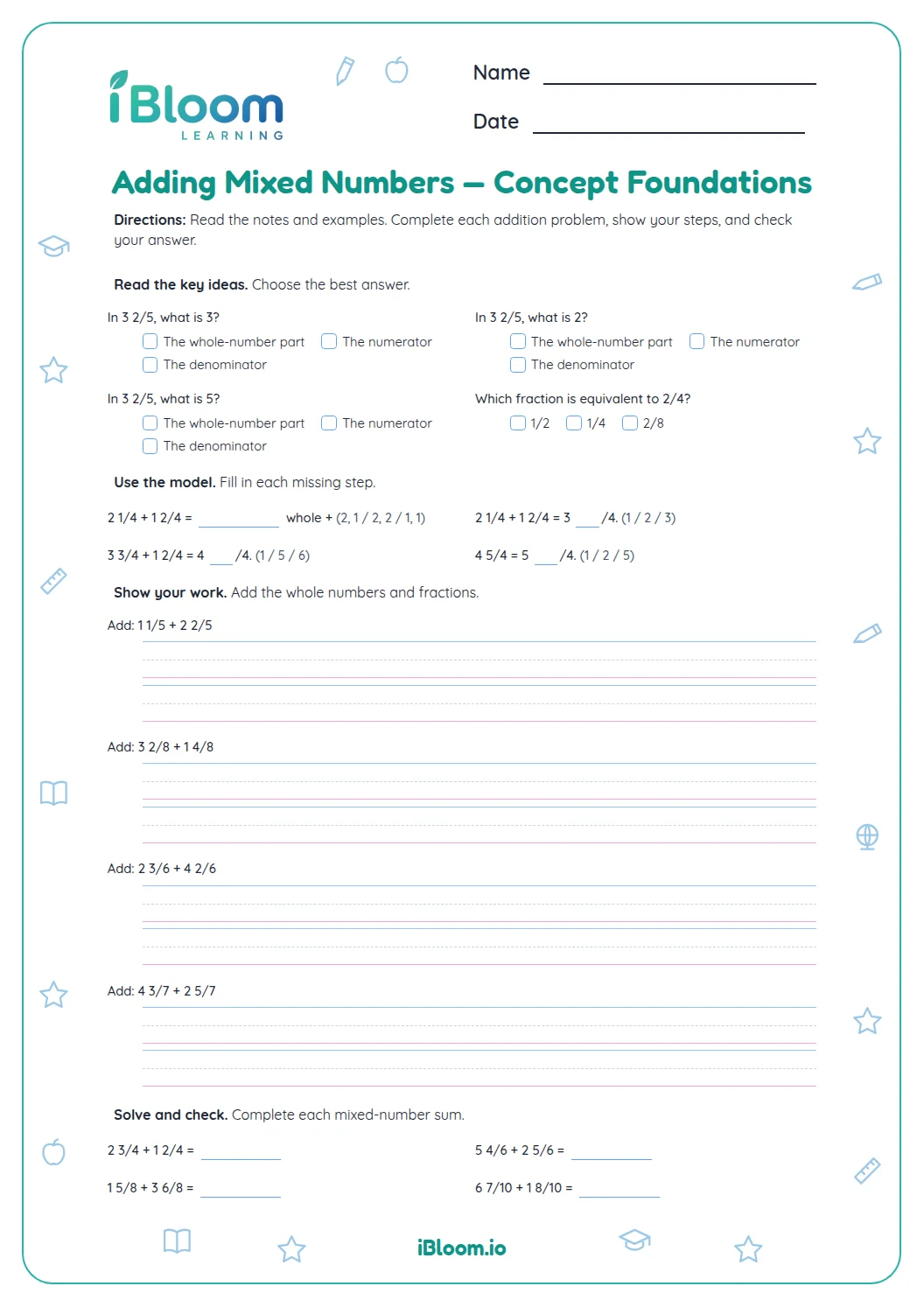
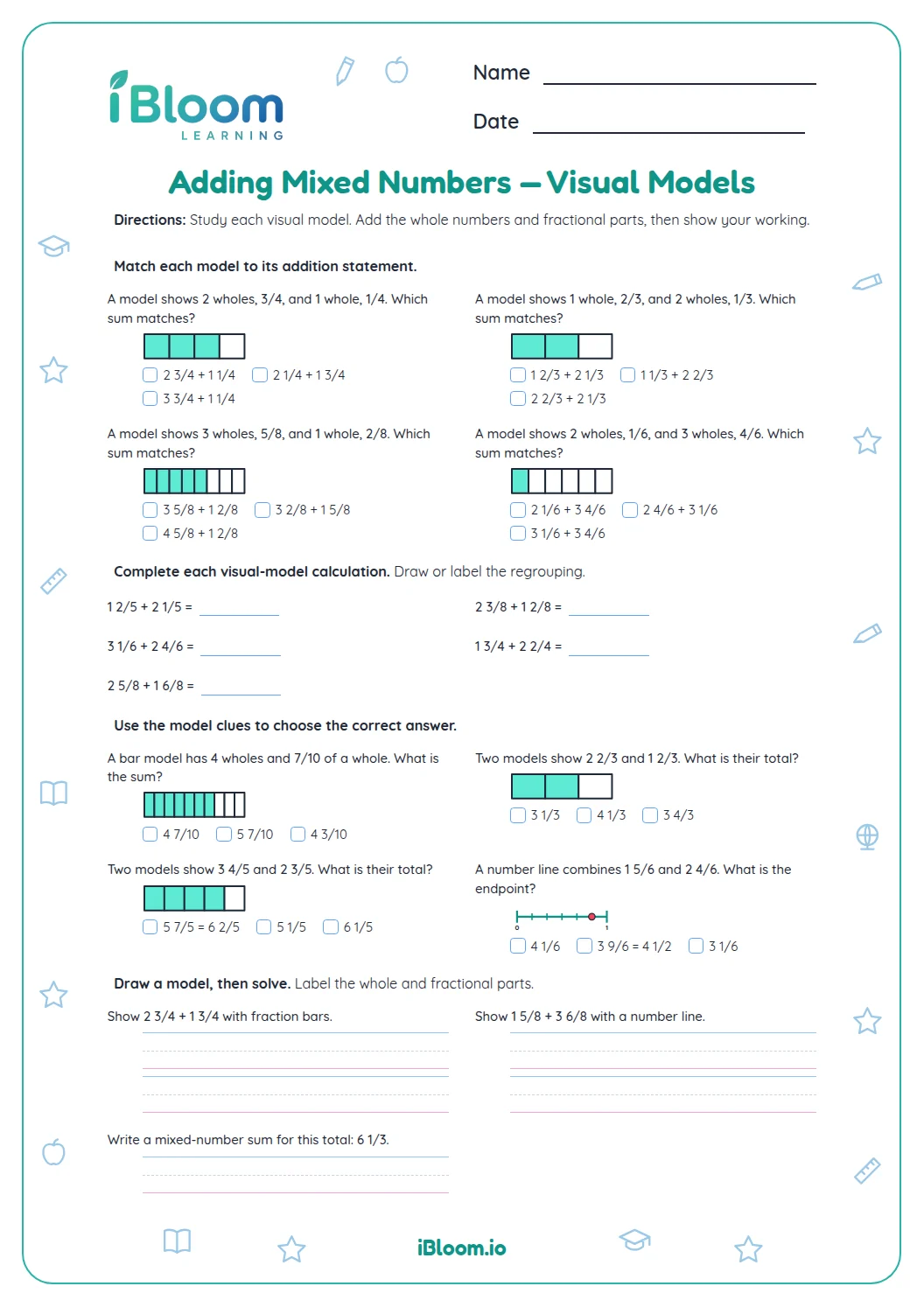
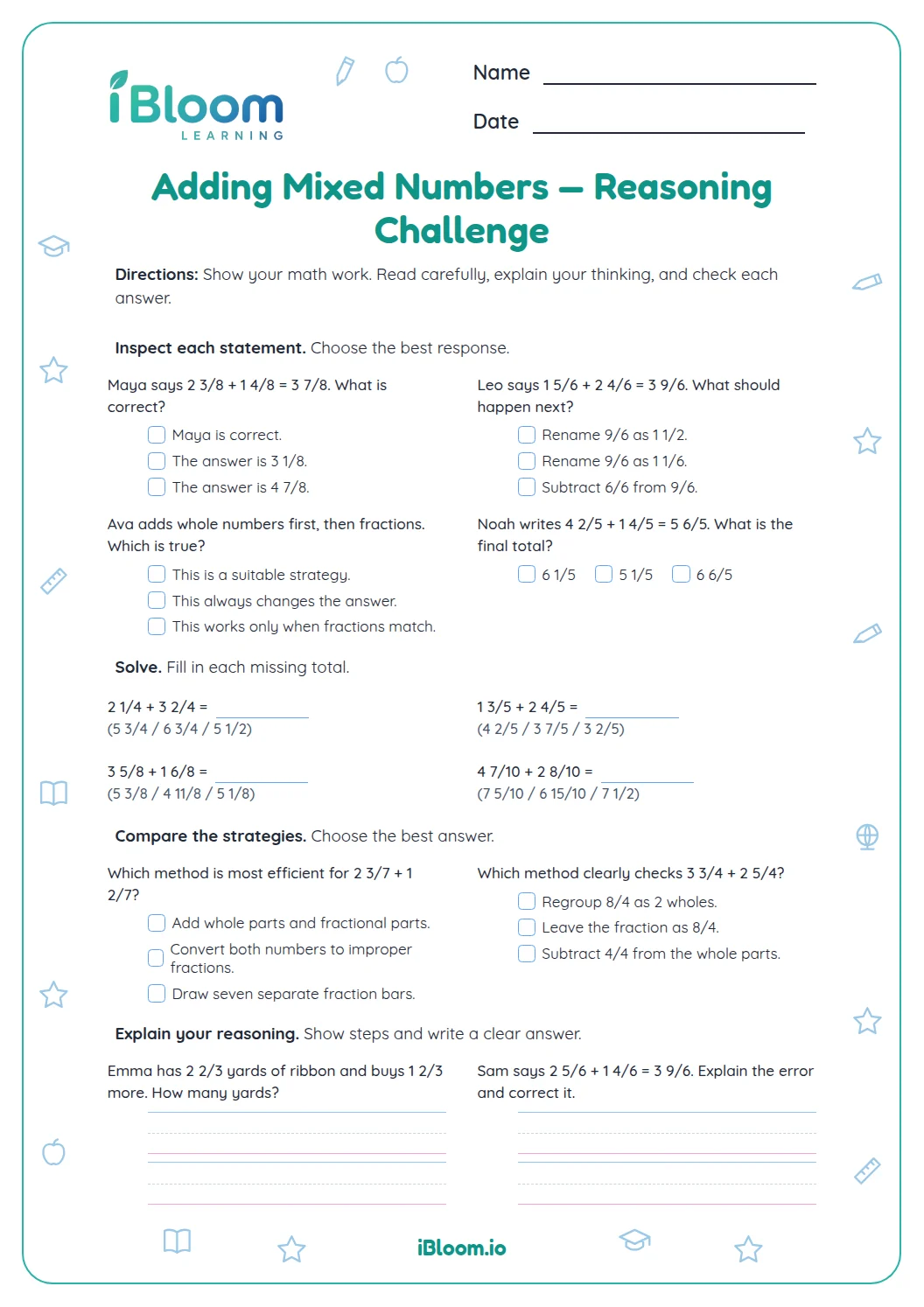
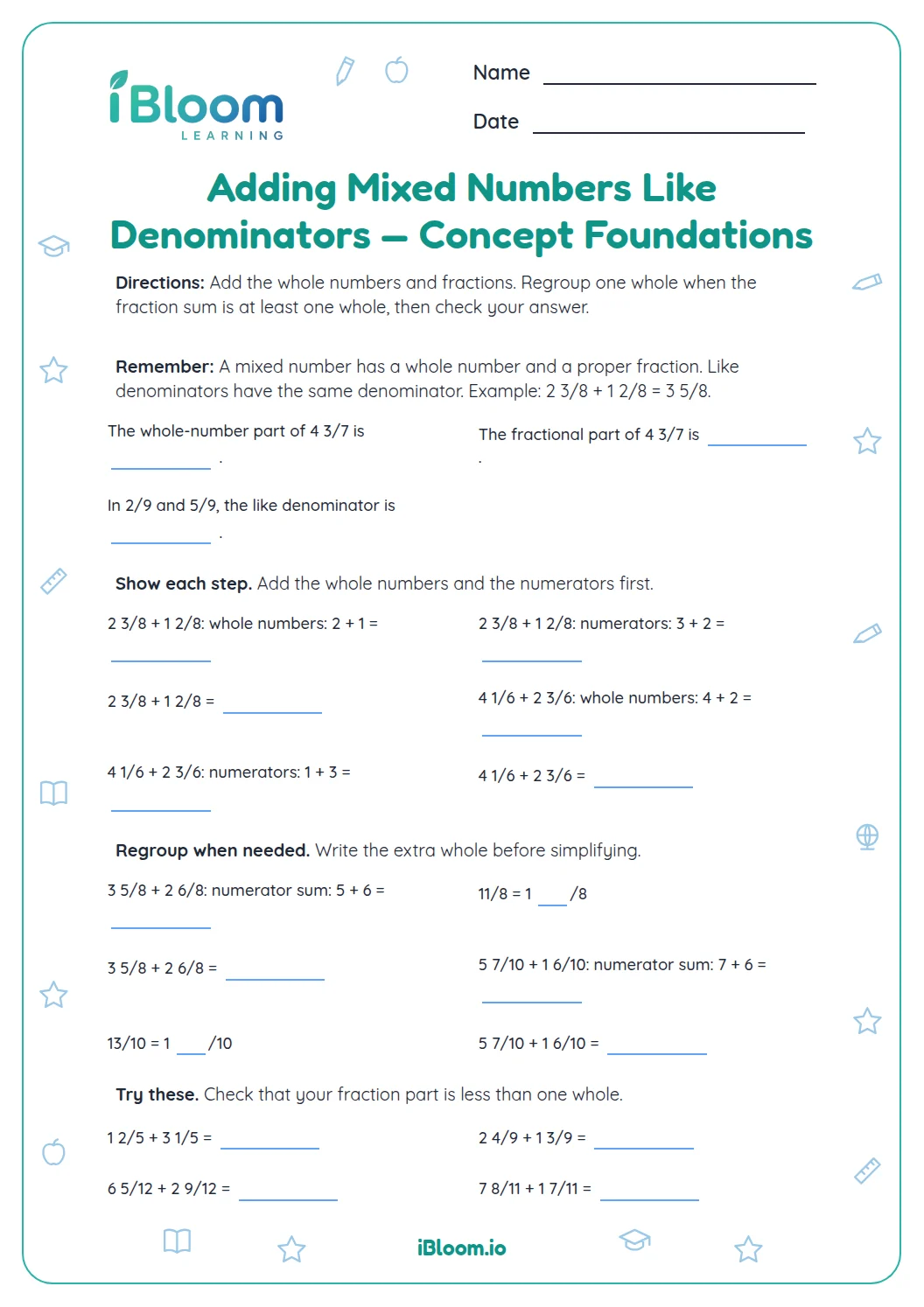
For like denominators, add the numerators and keep the denominator. Add the whole-number parts separately, then regroup if the fraction sum is one whole or more.
In question 1, 2 1/4 + 1 2/4 gives 3 3/4 miles: add 2 + 1 and 1/4 + 2/4.
- 12 1/4 + 1 2/4
- 22 + 1 = 3; 1/4 + 2/4 = 3/4
- 3Total: 3 3/4 miles
When do you regroup?
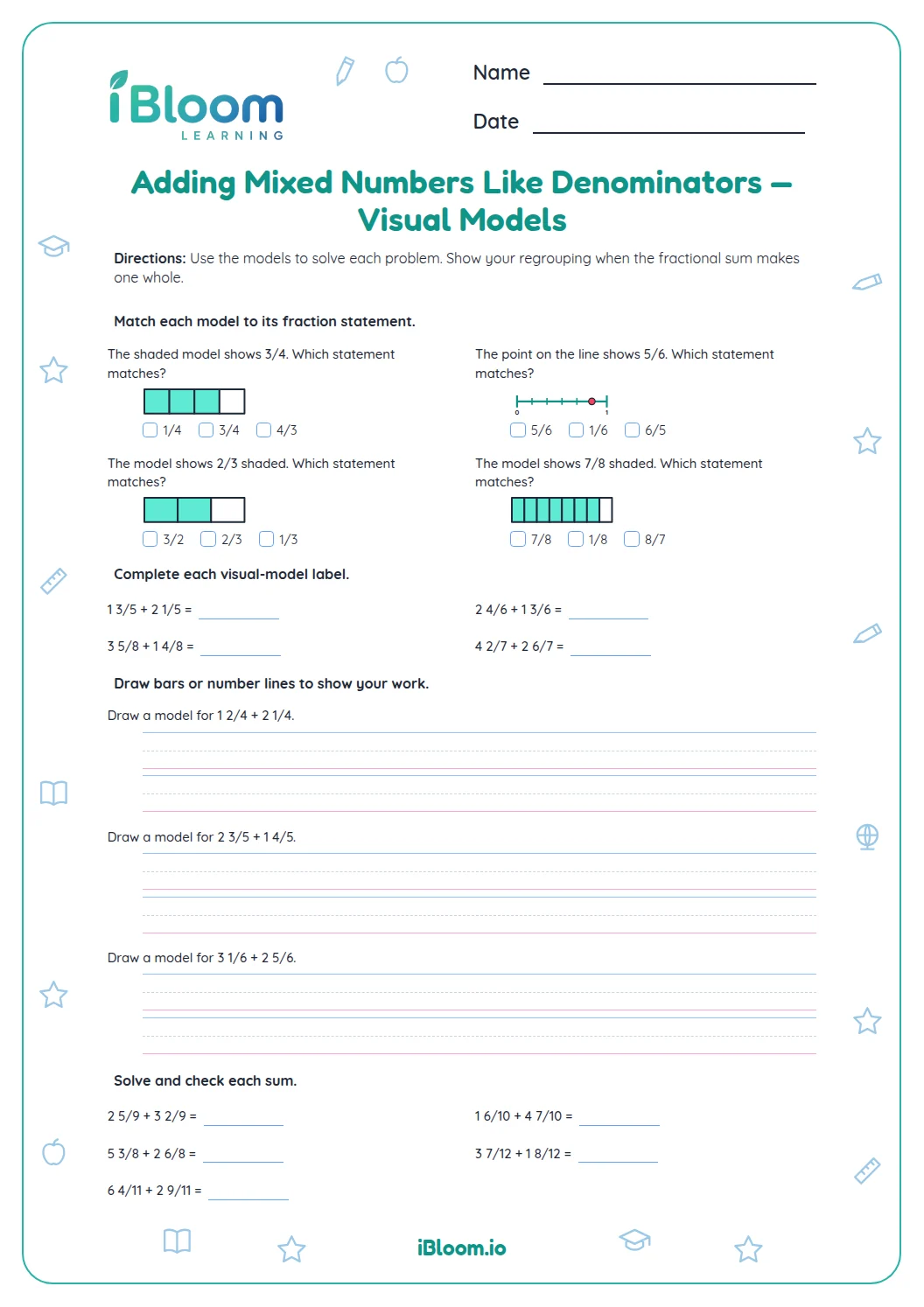
When the fractional parts add to a whole, trade that fraction for 1 and add it to the whole-number total. For example, 3 1/5 + 2 3/5 gives 5 4/5, and 4 1/6 + 2 4/6 gives 6 5/6.
What contexts are included?
Sixteen word problems use distance, length, capacity, and recipe quantities. Each story asks students to add mixed numbers with like denominators; several require regrouping a fraction equal to one whole. Answers keep the unit from the story.
How to use this worksheet
- 1Underline both mixed numbers and circle the unit.
- 2Add the whole-number parts.
- 3Add the numerators and keep the shared denominator.
- 4Regroup one whole if the fractional sum reaches the denominator.
- 5Write the total with the story’s unit and simplify if possible.
Common mistakes and quick fixes
The mistake
Adding denominators as well as numerators
The fix
Keep the common denominator and add only the numerators.
The mistake
Forgetting to regroup a whole
The fix
Trade a numerator group equal to the denominator for 1 whole.
The mistake
Changing the measurement unit
The fix
Label the sum with the unit used in the story.
Common Core alignment
This practice connects to the Common Core standard below.
Add mixed numbers with like denominators, regrouping fractional parts when needed.
On this sheet: Each story asks students to add mixed numbers whose fractional parts have like denominators.
Show the official wordingHide the official wording
Solve word problems involving addition and subtraction of fractions referring to the same whole and having like denominators, e.g., by using visual fraction models and equations to represent the problem.
What to practice next
Make more practice
Further reading
Questions parents and teachers ask
Do the fractions need common denominators?
Each problem already uses like denominators, so students can add the numerators and keep the denominator. Question 1 has fourths in both amounts: 1/4 + 2/4 = 3/4, then 2 + 1 = 3 whole miles. No renaming is needed first.
What if the fraction sum is one whole?
Trade a fraction equal to one whole for 1 and add it to the whole-number total. In question 3, 1/5 + 3/5 = 4/5, which is less than one whole, so 3 1/5 + 2 3/5 = 5 4/5 feet.
How do I know which operation to use?
Every story asks for a combined amount or total, so add the two quantities. For example, question 6 combines ribbon lengths of 2 5/8 yards and 3 1/8 yards. Add the whole parts and eighths, then label the total in yards.
Should students simplify the fractional answer?
Simplify when the numerator and denominator have a common factor. For example, 8/10 can be written as 4/5. The key uses simplified forms where appropriate, including 5 4/5 miles for question 5, so the whole and fractional parts remain clear.
Does the answer key include measurement units?
Yes. The questions ask for totals in units such as miles, cups, feet, and yards, and the key includes the matching unit. No target unit is printed after an answer blank on these word problems, so retaining it makes the answer complete.
How can students check a mixed-number sum?
Add the whole-number parts and fraction parts separately, then check whether the fraction is one whole or more. For question 11, 5/8 + 6/8 = 11/8 = 1 3/8, so the whole-number sum increases by 1 and the final total is 4 3/8 feet.