


About this worksheet
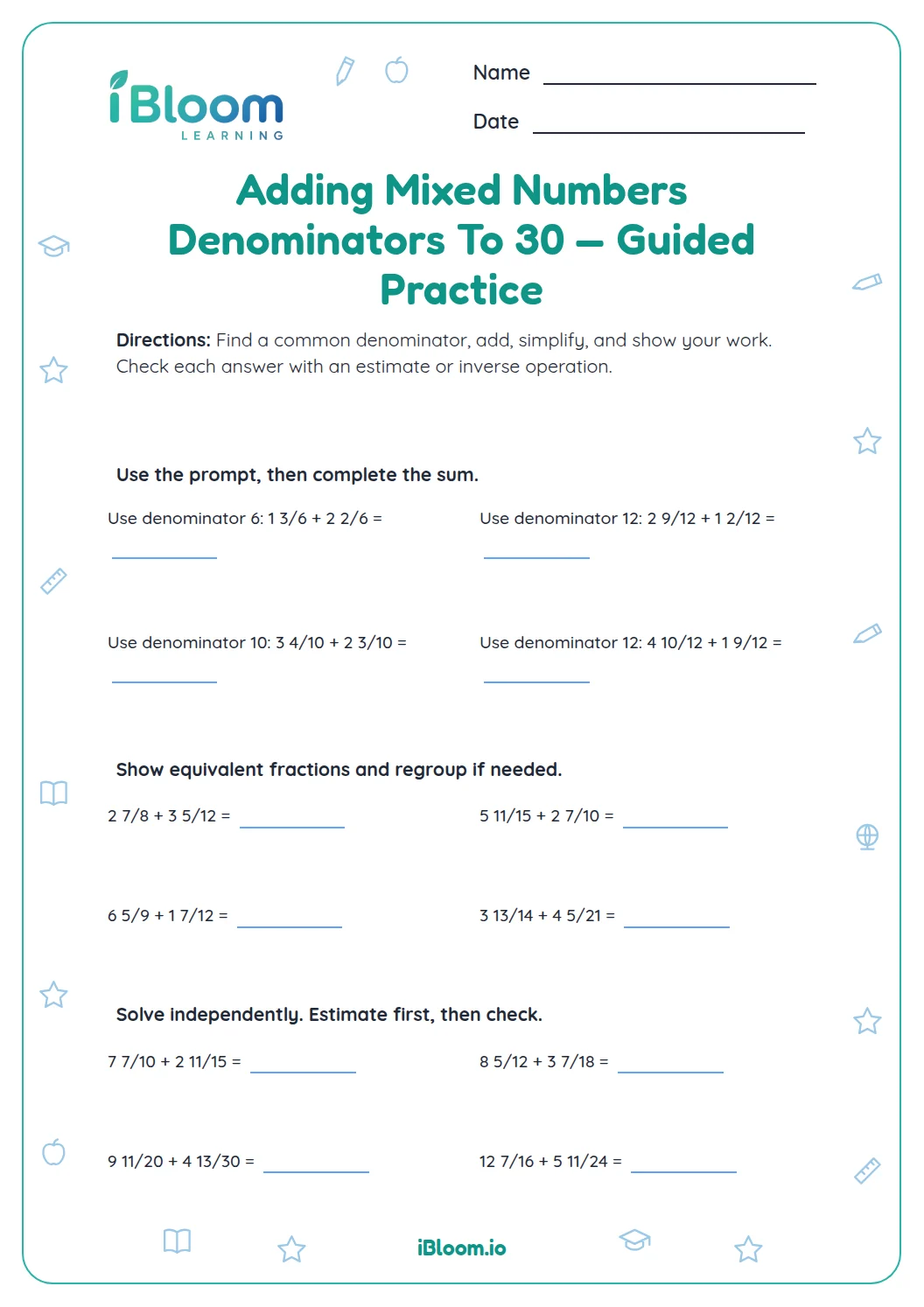
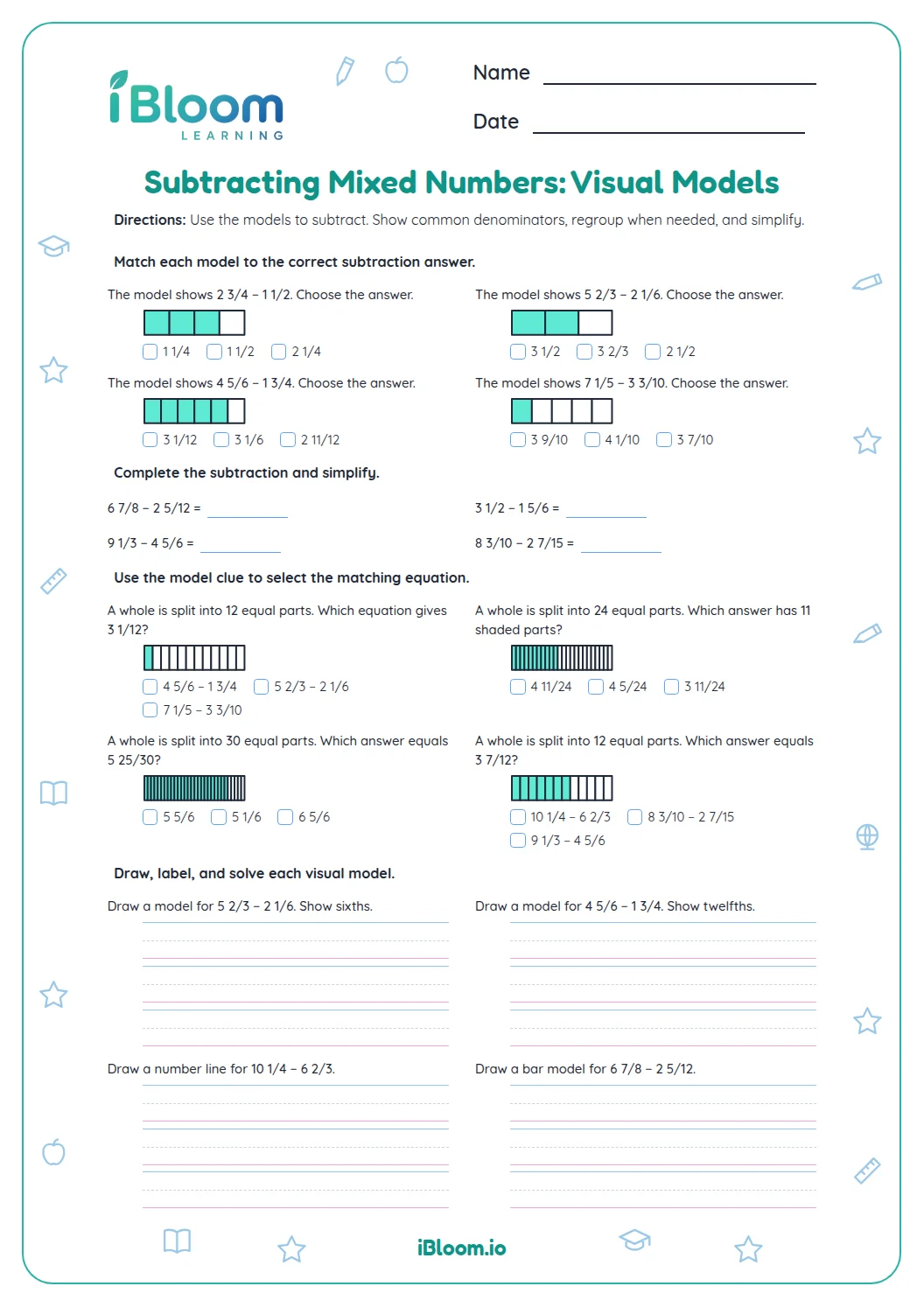
This free printable Grade 6 worksheet gives students 16 varied questions on adding and subtracting mixed numbers with unlike denominators. The practice moves from foundational choices to independent calculations and short real-world situations. It aligns with Common Core 5.NF.A.1. A separate answer key supports checking each calculation and unit.
Aligned to 5.NF.A.1
How do common denominators help with mixed numbers?
Find a denominator both fractional parts can use, then add or subtract the numerators while keeping that denominator. In q5, 5/12 and 7/18 become 15/36 and 14/36, so 1 5/12 + 2 7/18 = 3 29/36.
When a fractional sum reaches one whole, regroup it. During subtraction, rename a whole as fractional pieces when the top fraction is too small. Keep the story unit beside the result.
How can you tell whether to add or subtract?
A total or combined length calls for addition. A remaining amount or missing portion calls for subtraction. Before calculating, underline the action in the story and estimate the size of the result.
For q7, 6 11/24 − 2 5/8 becomes 6 11/24 − 2 15/24. Regroup one whole to get 5 35/24 − 2 15/24 = 3 20/24, or 3 5/6.
Common mistakes and quick fixes
The mistake
Adding denominators
The fix
Find a common denominator and add only the numerators.
The mistake
Ignoring the story action
The fix
Decide whether the story asks for a total or a remaining amount.
The mistake
Leaving an improper fraction in a mixed number
The fix
Regroup one whole and simplify the fractional part.
This sheet applies fraction and measurement reasoning in familiar problem settings.
Use adding and subtracting mixed numbers with unlike denominators. in each item.
On this sheet:
Show the official wordingHide the official wording
Add and subtract fractions with unlike denominators (including mixed numbers) by replacing given fractions with equivalent fractions in such a way as to produce an equivalent sum or difference of fractions with like denominators.
What to practice next
Make more practice
Further reading
Questions parents and teachers ask
How many questions are included?
The worksheet contains 16 questions arranged in three parts. Students begin with focused practice, find missing values next, and finish with short situations that ask them to apply the same skill. Show the factor, calculate, and check that the final unit and size make sense.
Does the printable include an answer key?
Yes. The printable includes a separate answer key. Students can complete one part at a time, then compare their work and revisit any step where the units or operation need attention. Show the factor, calculate, and check that the final unit and size make sense.
How should students decide which operation to use?
First compare the size of the units. Moving to a smaller unit makes the numerical measure larger, while moving to a larger unit makes it smaller. The equal-measure relationship shows whether to multiply or divide. Show the factor, calculate, and check that the final unit and size make sense.
What if the units in a problem are different?
Convert one measure so both quantities use a common unit before adding, subtracting, or comparing. Keeping the unit written beside each step helps students see whether the conversion is moving in the correct direction. Show the factor, calculate, and check that the final unit and size make sense.
What grade is this worksheet for?
This worksheet is written for Grade 6 math. It uses customary-unit conversions and related number reasoning with a range of direct and applied questions, followed by a key for checking answers. Show the factor, calculate, and check that the final unit and size make sense.
Do students need to simplify answers?
Yes. When a fractional part can be reduced, express it in simplest form. For example, 20/24 is 5/6, which makes the remaining mixed number easier to read and compare. Show the factor, calculate, and check that the final unit and size make sense.