




About this worksheet
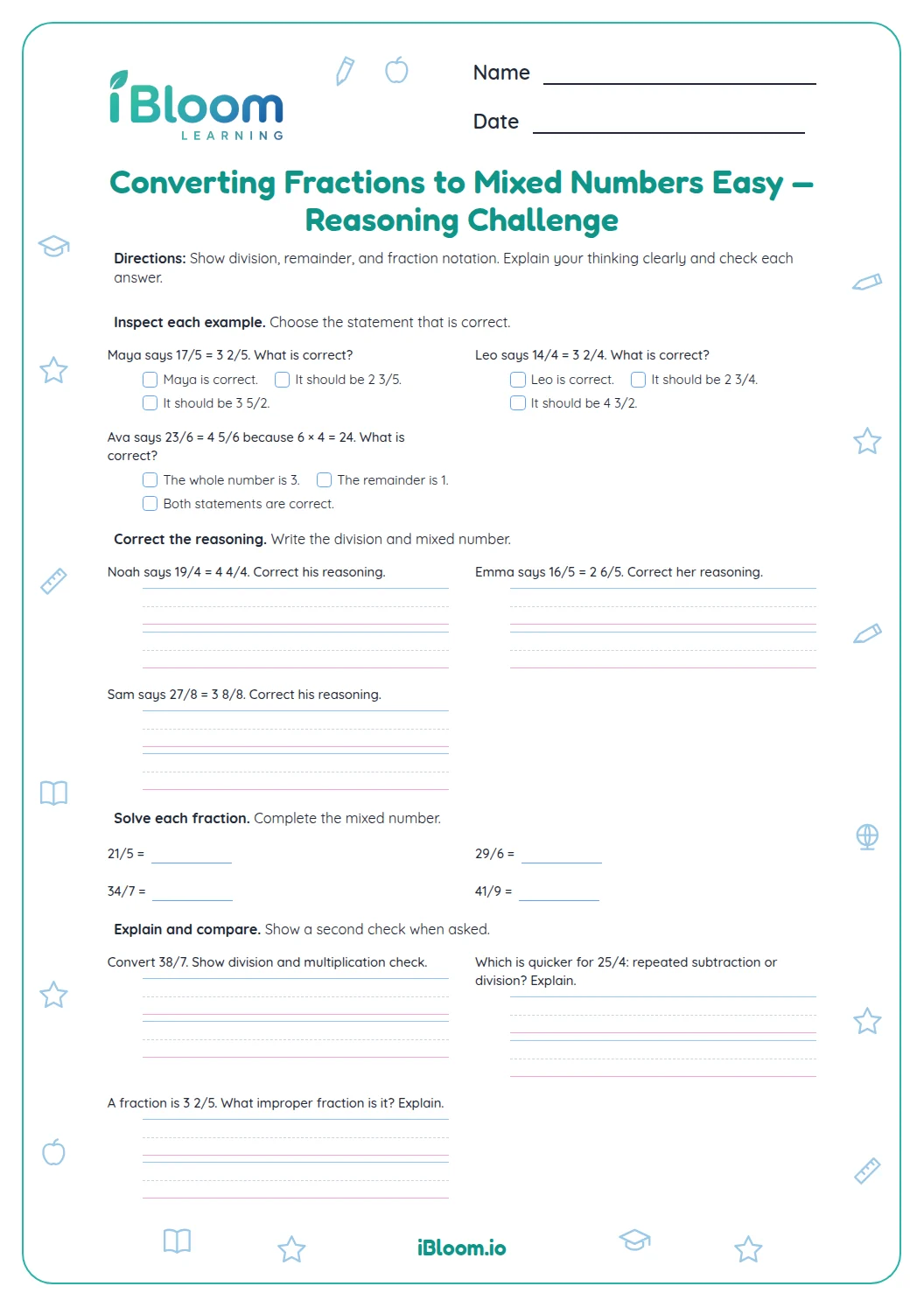
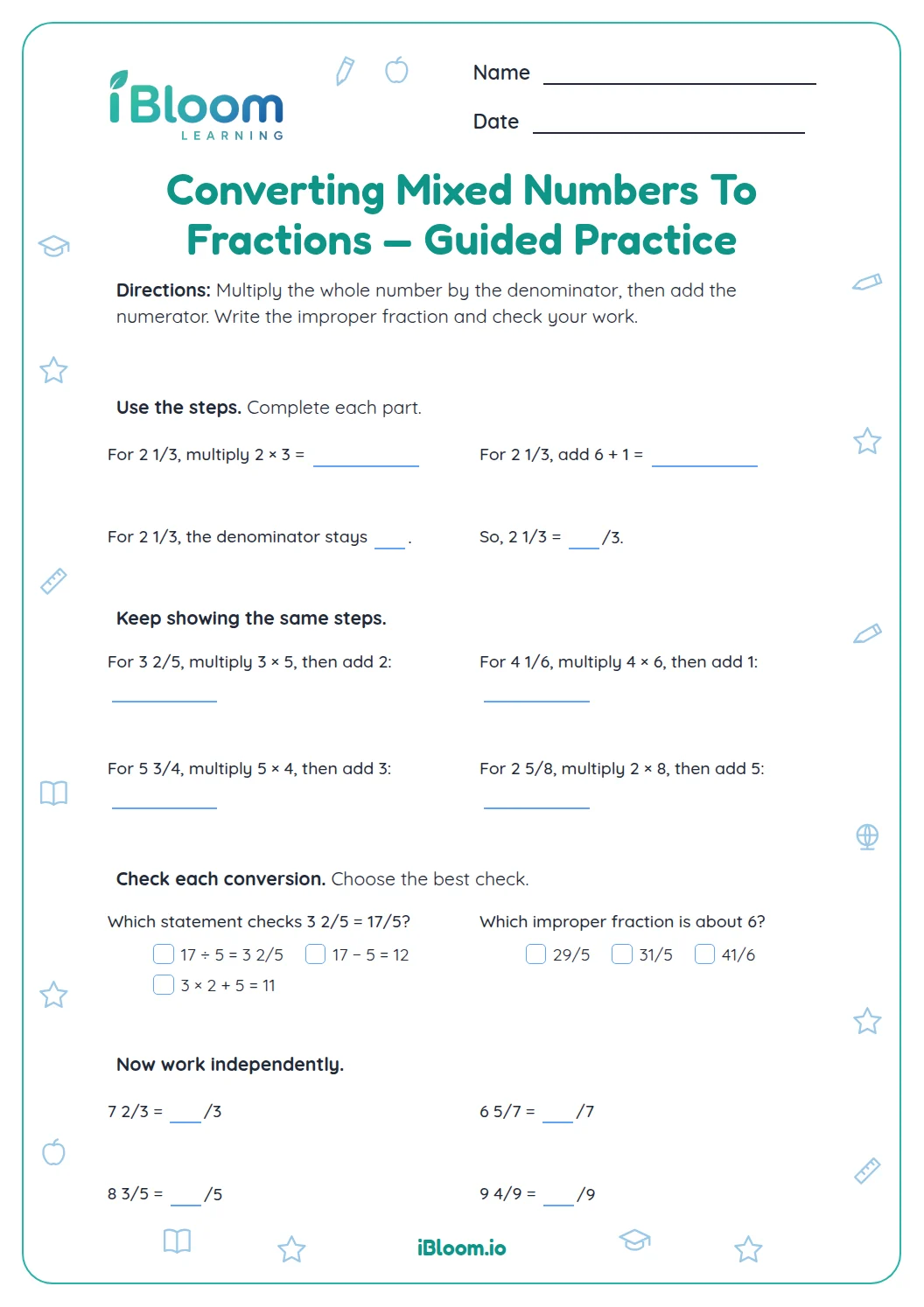
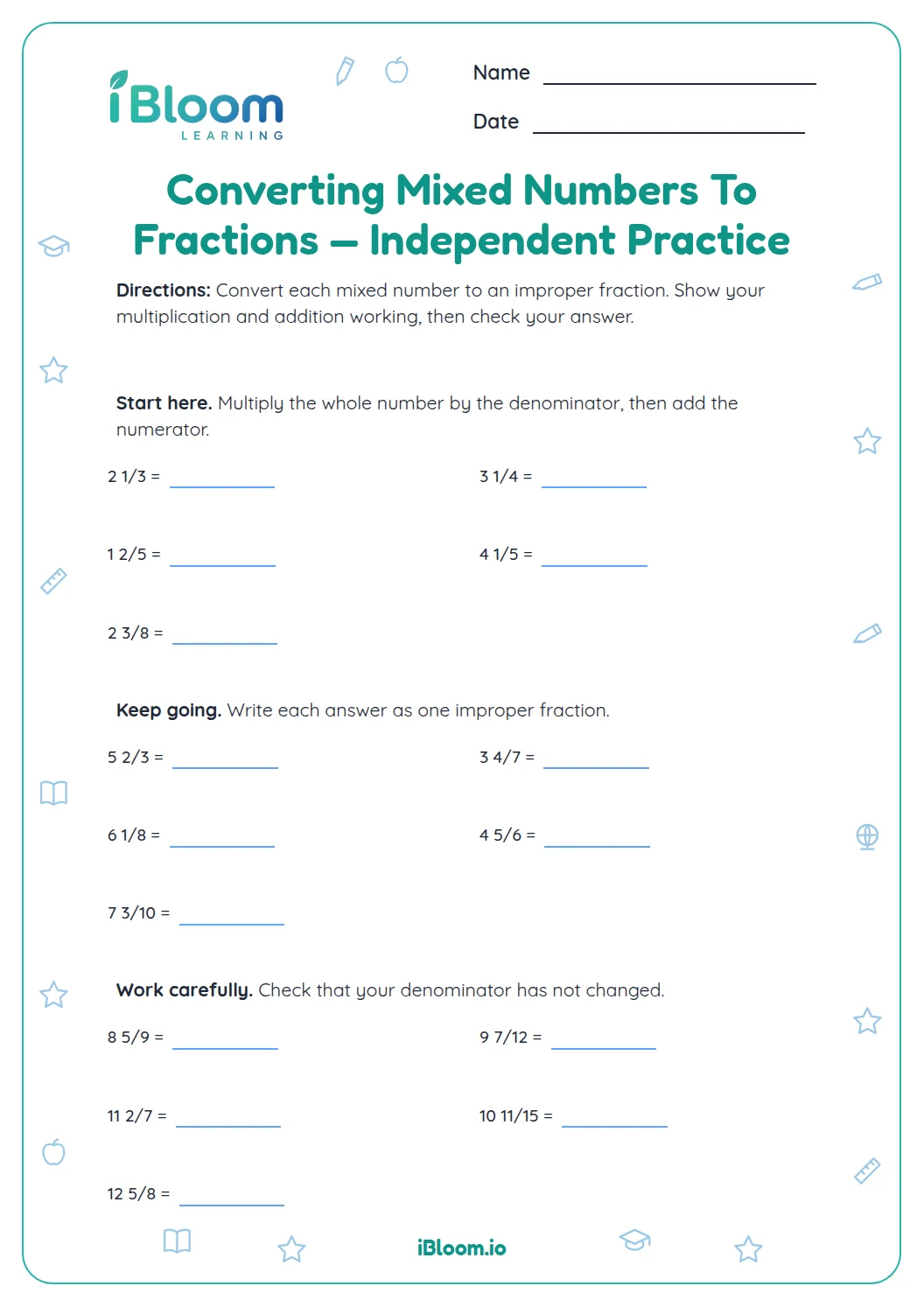
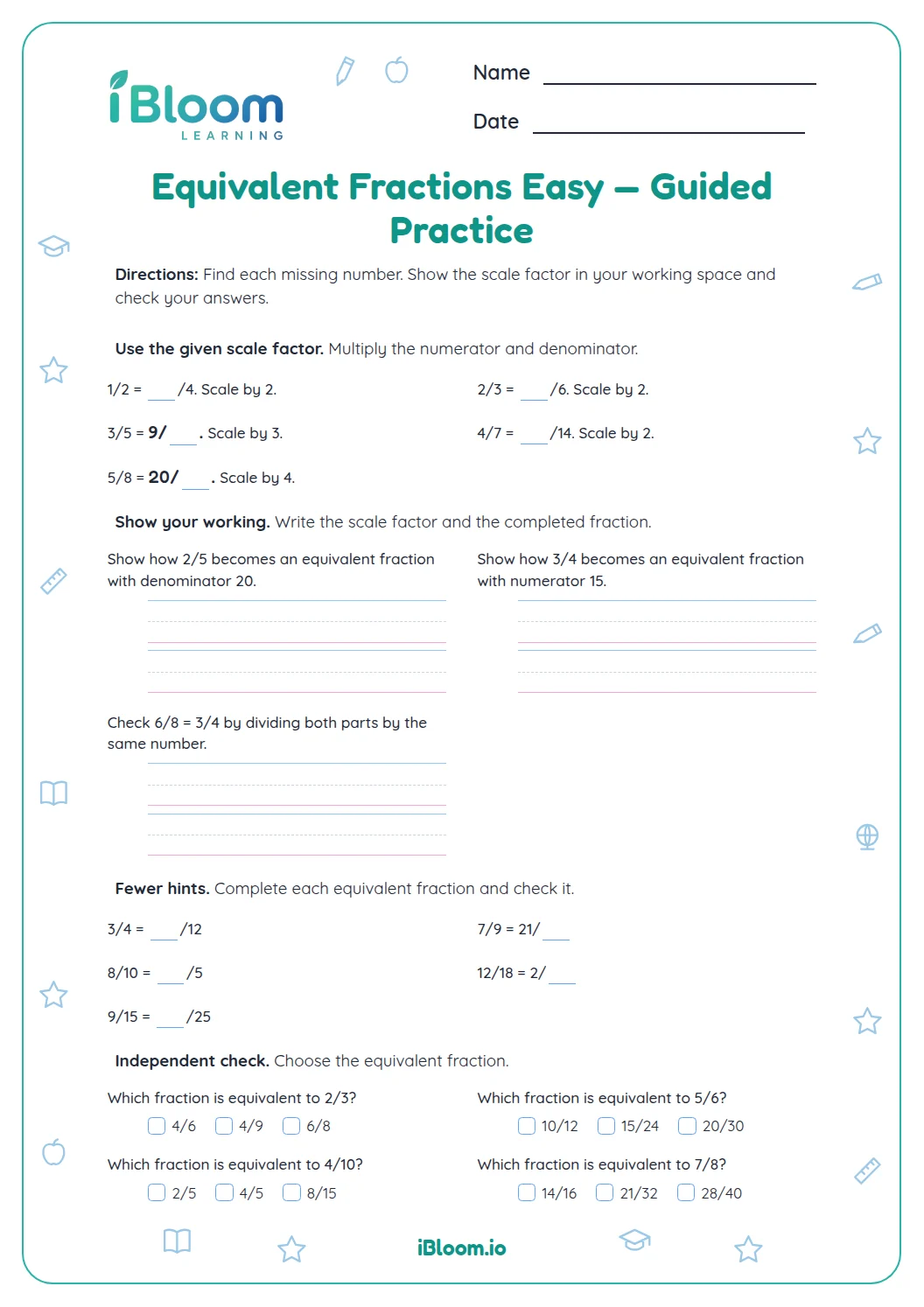
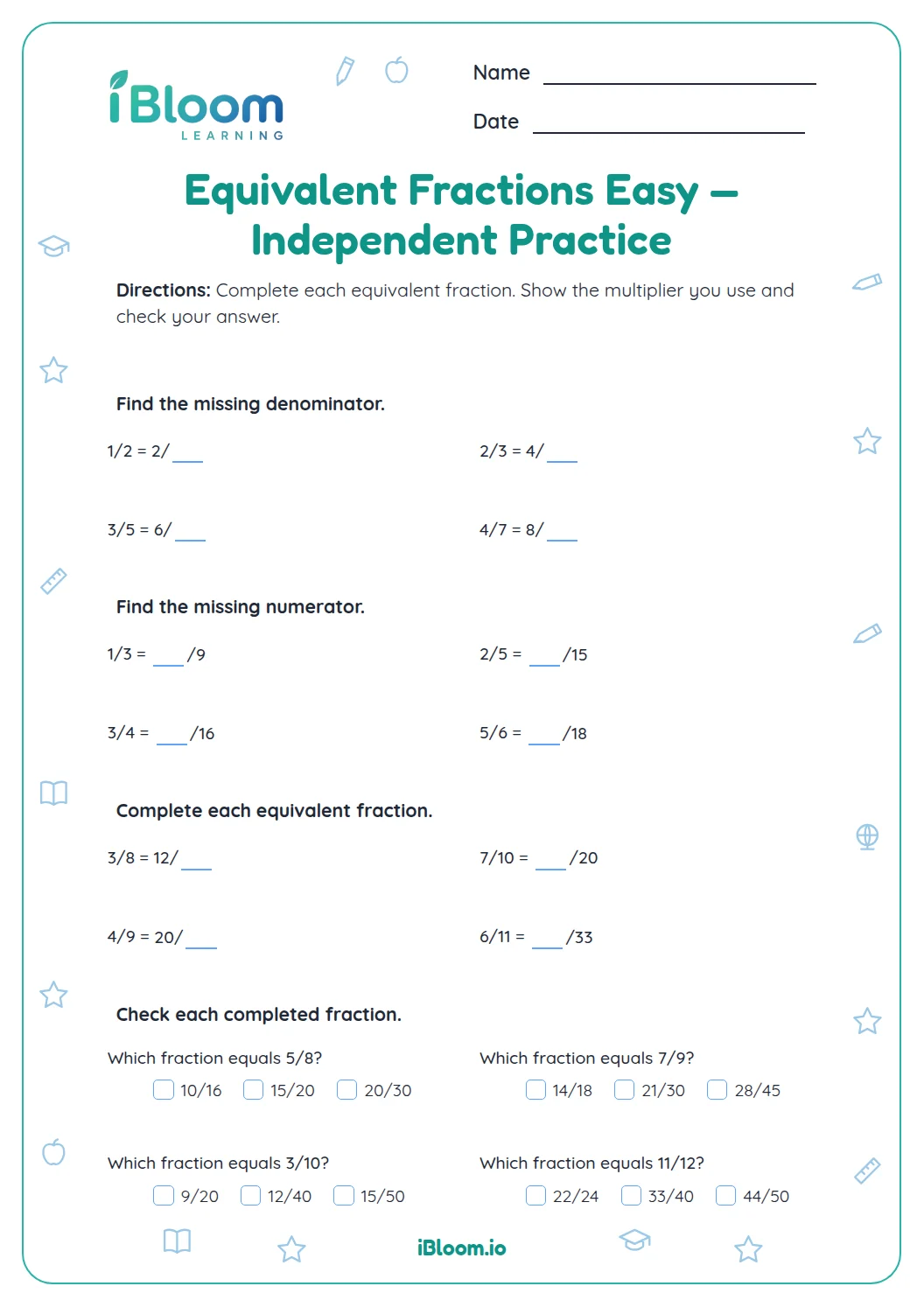
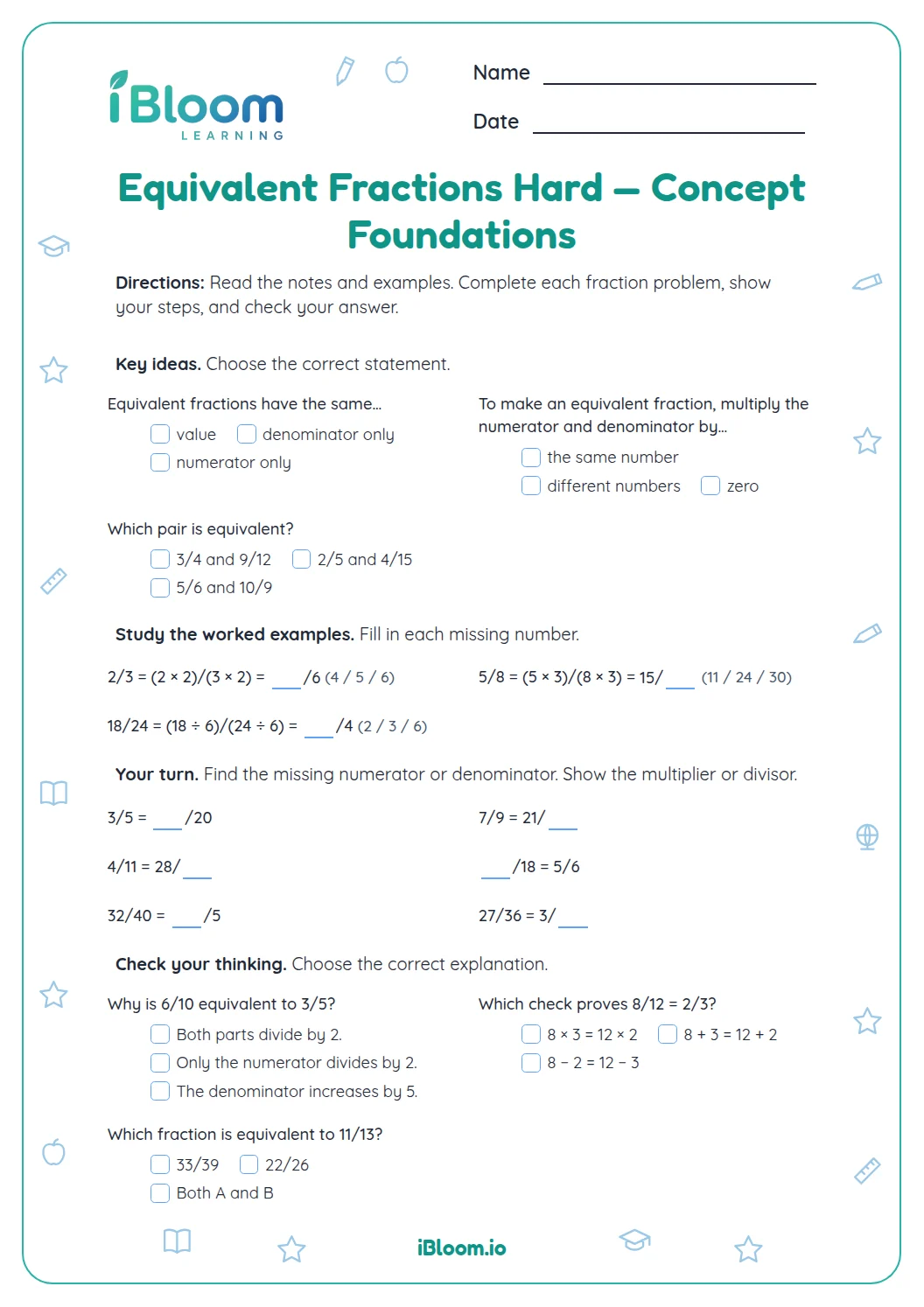
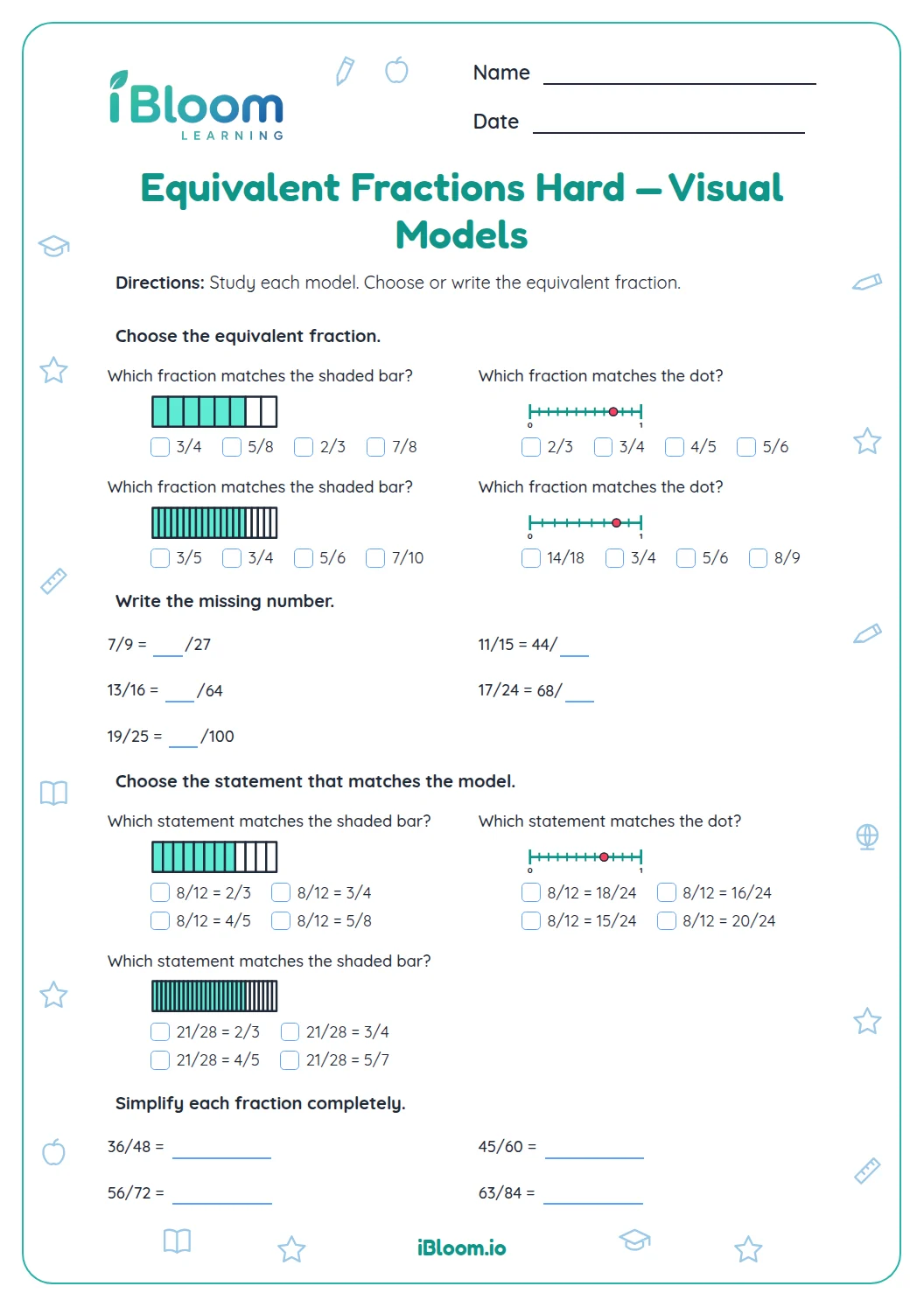
This free printable Grade 6 worksheet gives students 14 questions on fraction conversion. It moves from match the model into check the conversion, with a separate answer key. Children practice choosing common units, tracking whole groups and simplifying each result. The examples and checks are specific to this skill and align with Common Core 5.NF.B.3.
Aligned to 5.NF.B.3
How do you solve fraction conversion problems?
Begin by identifying the size of the fractional parts. Use division: the quotient counts whole groups, and the remainder stays over the original denominator.
For example, Choose the mixed number shown. gives 1 3/4. Keep the whole-number and fractional steps visible, then simplify the fraction.
- 1Choose the mixed number shown.
- 2Answer: 1 3/4
- 3Divide the numerator by the denominator.
- 4Write quotient as the whole number and remainder over the denominator.
What does each part ask students to do?
The 16 questions progress through match the model, complete each statement, convert to a mixed number, check the conversion. The first part builds fluency; later parts ask students to apply or check the same skill.
- Part A: Match the model — 4 questions
- Part B: Complete each statement — 4 questions
- Part C: Convert to a mixed number — 4 questions
- Part D: Check the conversion — 4 questions
How can students check an answer?
Check a conversion by multiplying the whole-number quotient by the denominator and adding the remainder. The result should equal the original numerator.
How to use this worksheet
- 1Read the direction at the start of each part.
- 2Work one question at a time and show the fraction steps.
- 3Simplify every final fractional part.
- 4Check subtraction by adding back; check conversion by multiplying and adding the remainder.
- 5Use the answer key to find any step that needs another try.
Common mistakes and quick fixes
The mistake
Treating the remainder as the whole-number part.
The fix
The quotient counts whole groups; the remainder stays over the original denominator.
The mistake
Using the numerator as the remainder without dividing.
The fix
Divide first and check that the remainder is smaller than the denominator.
The mistake
Leaving a fractional part unreduced.
The fix
Find a common factor of the remainder and denominator and divide both.
Common Core alignment
This worksheet practices fraction work described in the Common Core standard below.
Use division to express a fraction as a sum of a whole number and a fraction.
On this sheet: The quotient and remainder express each improper fraction as whole groups and a fractional part.
Show the official wordingHide the official wording
Interpret a fraction as division of the numerator by the denominator (a/b = a ÷ b). Solve word problems involving division of whole numbers leading to answers in the form of fractions or mixed numbers, e.g., by using visual fraction models or equations to represent the problem.
What to practice next
Make more practice
Further reading
Questions parents and teachers ask
What skill does this visual models page practice?
It practices fraction conversion through 14 questions that build from straightforward work to checks and applications. Students can show each step on the printed page, then compare with the separate answer key. The question formats are chosen to match the specific skill named in the worksheet title.
Why should students find a common denominator?
Fractions must name equal-sized parts before their numerators can be subtracted. Rewriting each fraction with an equivalent fraction preserves its value while making the pieces comparable. The practice set gives students repeated opportunities to identify a shared denominator and simplify the result.
How should a student check a subtraction answer?
Add the difference to the amount that was subtracted. The sum should equal the starting mixed number or fraction. If it does not, check the common denominator and any regrouping step, then simplify the final result. This reverse operation provides a quick way to catch a regrouping or arithmetic slip before marking the page.
How does division make an improper fraction a mixed number?
Divide the numerator by the denominator. The quotient tells how many whole groups fit, and the remainder is written over the same denominator as the fractional part. Reduce that fraction when the numerator and denominator share a factor.
What is included with the printable?
The page includes a student worksheet and a separate answer key. The key lists a concise answer for every question so an adult can check work or a student can review missed items after completing the practice. It is designed for independent review or adult guided practice.
Can students write equivalent answers?
Yes, when an answer represents the same value and is simplified as requested. For example, equivalent fractions name the same amount, though the worksheet key shows the simplest form for quick checking. Mixed-number answers should keep a proper fractional part.