



About this worksheet
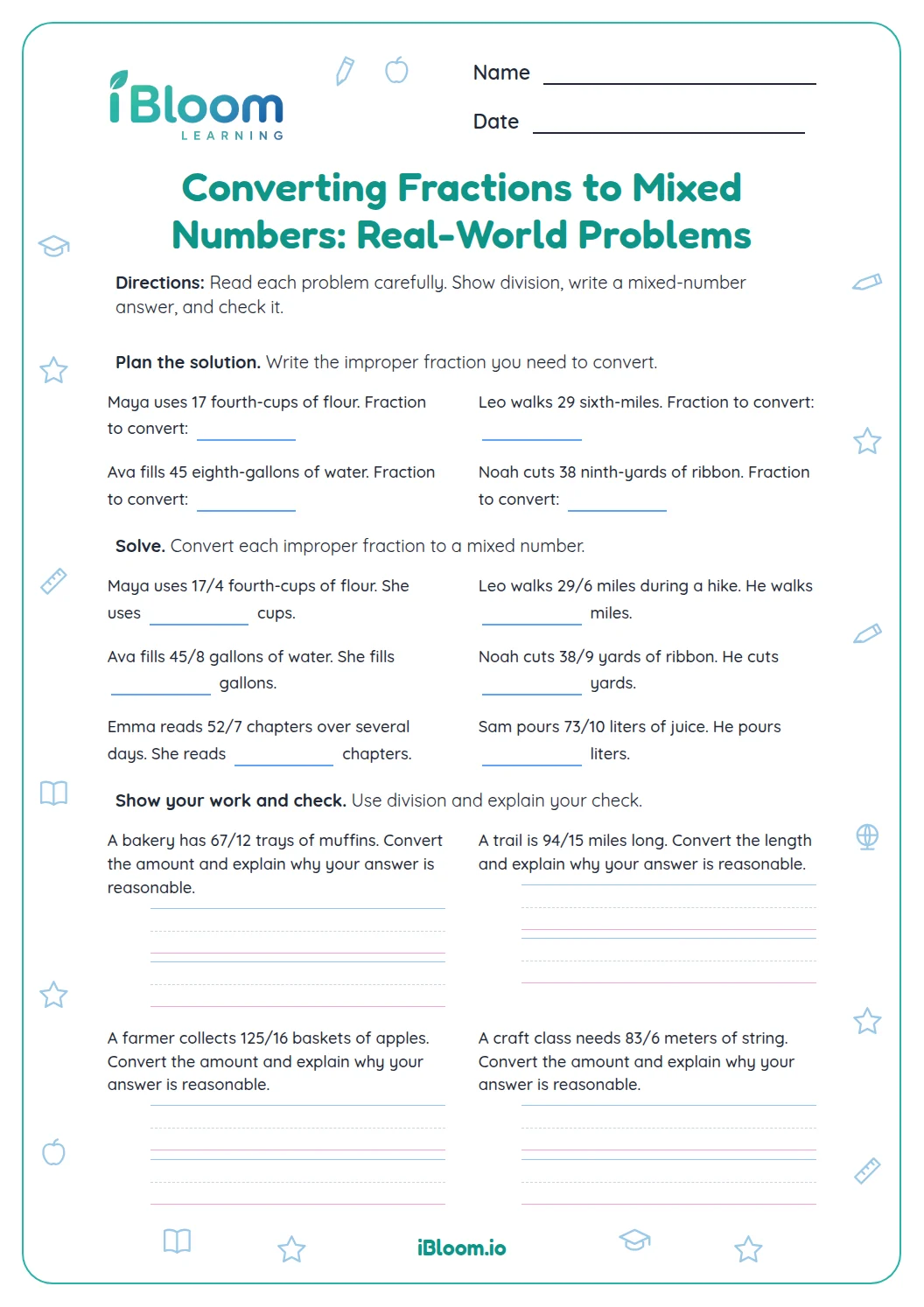
This Grade 6 printable gives students 15 improper-fraction conversion problems in three parts. Students separate quotient and remainder, write simplified mixed numbers, and check conversions with multiplication and addition. A separate answer key keeps the requested values in the same order. The work practices interpreting fractions as division, described by Common Core standard 5.NF.B.3.
Aligned to 5.NF.B.3
How do you turn an improper fraction into a mixed number?
This Grade 6 printable gives students 15 improper-fraction conversion problems in three parts. Students separate quotient and remainder, write simplified mixed numbers, and check conversions with multiplication and addition. A separate answer key keeps the requested values in the same order. The work practices interpreting fractions as division, described by Common Core standard 5.NF.B.3.
Follow the part directions and keep each response in its matching blank. Use the answer key after completing the questions.
- 123 ÷ 6 = 3 remainder 5
- 223/6 = 3 5/6
What will students practice?
The 15 questions are grouped into three parts that move from the opening task to independent practice.
- Part A: 5 quotient-and-remainder items
- Part B: 5 mixed-number conversions
- Part C: 5 conversion checks
How can a student check the work?
Use quotient × denominator + remainder to recover the original numerator. Then make sure the remainder fraction is simplified where required.
How to use this worksheet
- 1Read the direction for each part: find quotient and remainder, write mixed numbers, then check each conversion.
- 2Write each requested value in its own answer space.
- 3Divide the numerator by the denominator to find quotient and remainder.
- 4Simplify when needed, then check your response with the answer key.
Common fraction mistakes and quick fixes
The mistake
Swapping the quotient and remainder.
The fix
The quotient is the whole-number part; the remainder is the leftover numerator.
The mistake
Keeping the original numerator as the mixed-number fraction part.
The fix
Use the remainder over the original denominator.
The mistake
Leaving a reducible fractional part.
The fix
Simplify the remainder fraction when possible.
Common Core alignment
This worksheet practices the fraction skills described in the standards below.
Interpret a fraction as division and write quotients as mixed numbers.
On this sheet: Each improper fraction is interpreted as numerator divided by denominator and written as a mixed number.
Show the official wordingHide the official wording
Interpret a fraction as division of the numerator by the denominator (a/b = a ÷ b). Solve word problems involving division of whole numbers leading to answers in the form of fractions or mixed numbers, e.g., by using visual fraction models or equations to represent the problem.
What to practice next
Make more practice
Further reading
Questions parents and teachers ask
How many questions are included?
There are 15 questions in three parts, plus a separate answer key. Students first identify quotients and remainders, then write mixed numbers, and finally use a multiplication-and-addition check. The first five questions ask for quotient and remainder; later sections build the full mixed-number form.
How do quotient and remainder make a mixed number?
The quotient becomes the whole number. The remainder becomes the numerator of the fractional part, while the original denominator stays in place. For 23 ÷ 6, the quotient is 3 and the remainder is 5, so 23/6 is 3 5/6. This gives a concrete check that the whole-number and fractional parts reconstruct the starting fraction.
Should the fractional part be simplified?
Yes, simplify the fractional part when its numerator and denominator share a factor. The worksheet asks for simplest form in its conversion section, and the answer key shows reduced results. Reducing the fractional part does not change the value of the mixed number.
Is an answer key included?
Yes. The key lists the quotient and remainder separately when requested, then gives the mixed-number conversions and check values in order. The final section also shows the multiplication-and-addition check alongside each conversion. The final section also shows the multiplication-and-addition check alongside each conversion. The values appear in the question order.
How does the conversion check work?
Multiply the quotient by the denominator and add the remainder. The result should equal the original numerator; for 23/6, 3 × 6 + 5 = 23. For instance, 3 × 6 + 5 returns 23, confirming the quotient and remainder for 23/6.