



About this worksheet
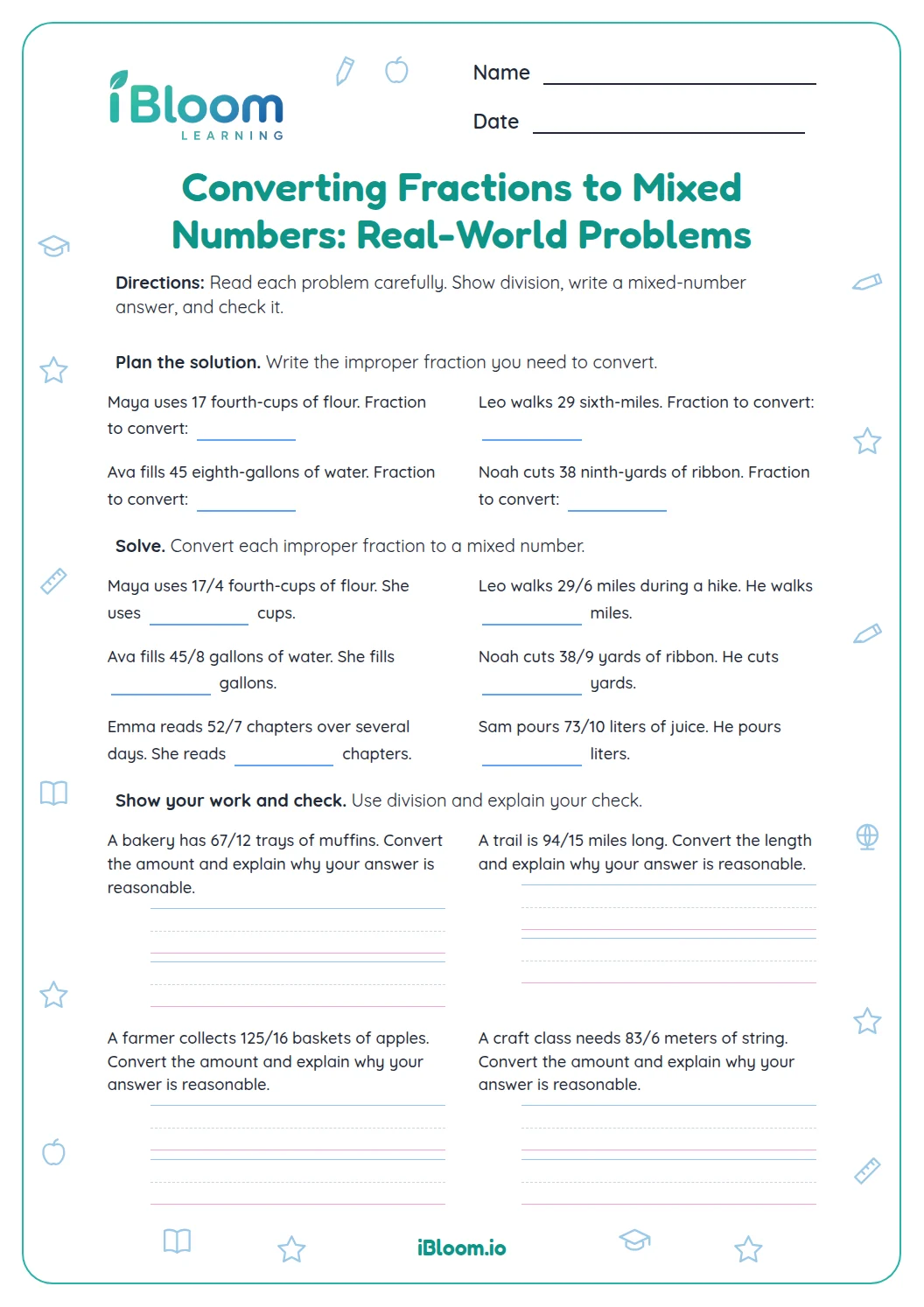
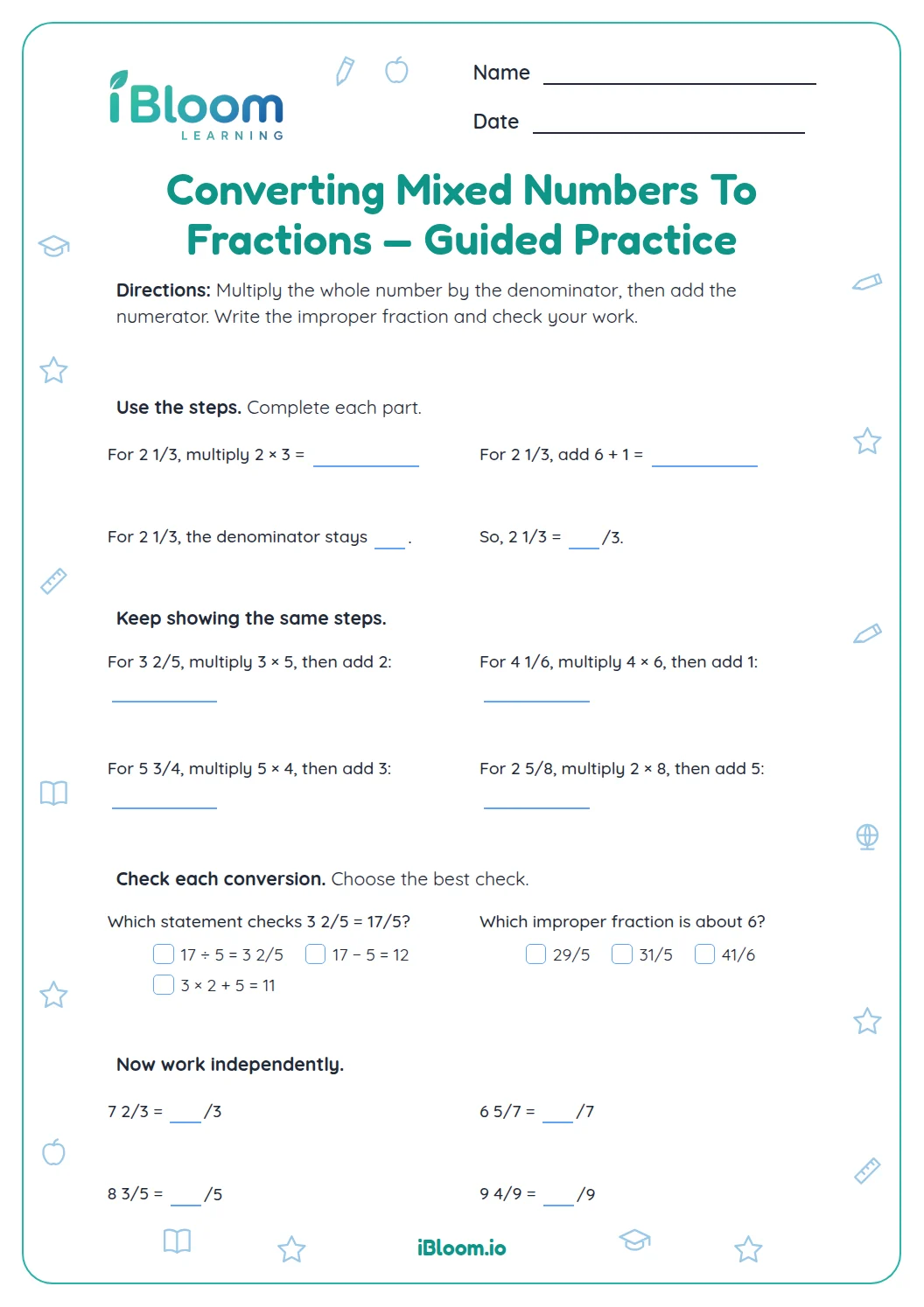
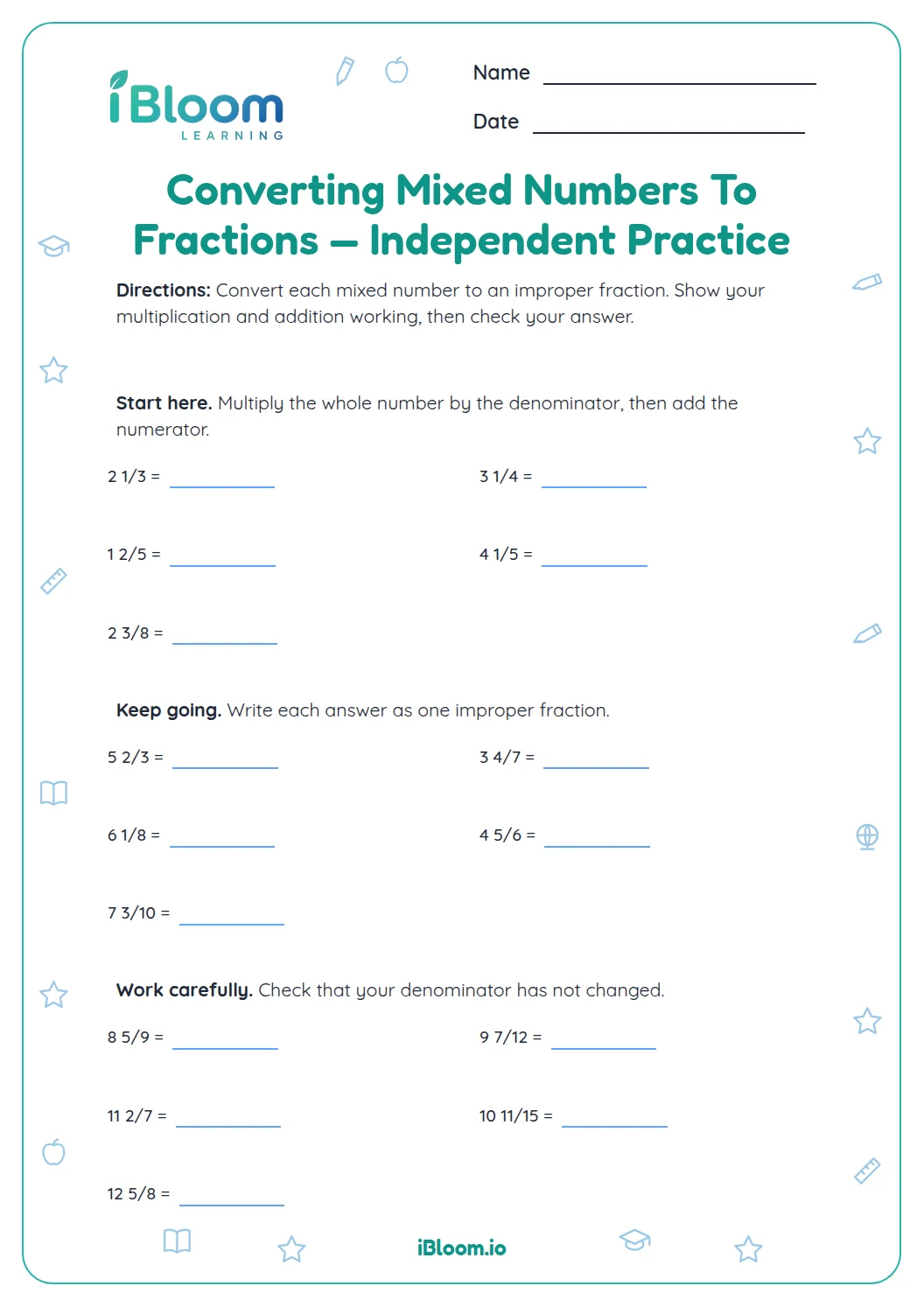
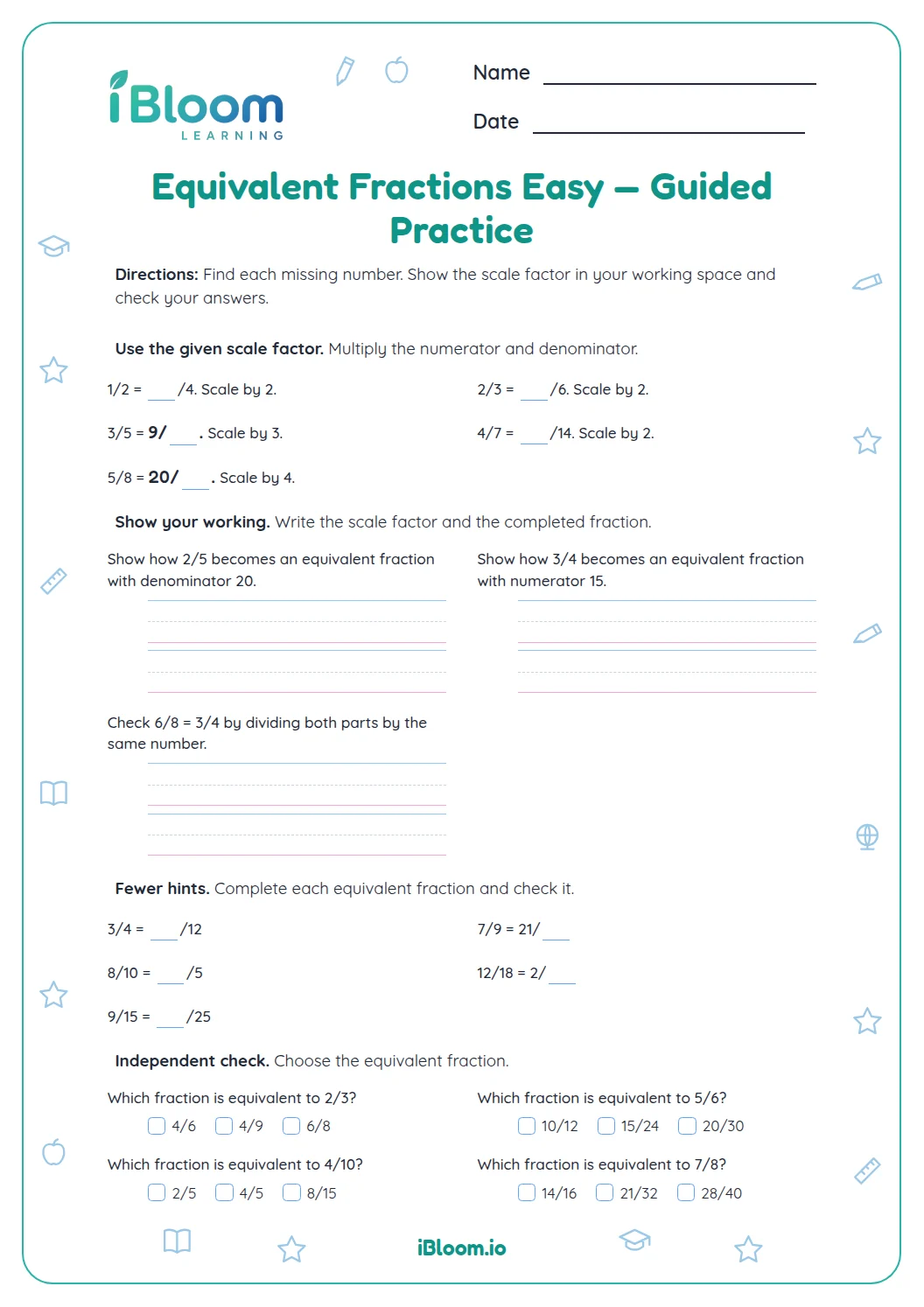
This Grade 6 visual worksheet gives students 15 conversion problems in three parts. Shaded bars represent improper fractions; students read the wholes and leftover parts, choose matching mixed numbers, and convert additional fractions. A separate answer key follows the student page. The work practices interpreting fractions as division, described by Common Core standard 5.NF.B.3.
Aligned to 5.NF.B.3
How do fraction bars show a mixed number?
This Grade 6 visual worksheet gives students 15 conversion problems in three parts. Shaded bars represent improper fractions; students read the wholes and leftover parts, choose matching mixed numbers, and convert additional fractions. A separate answer key follows the student page. The work practices interpreting fractions as division, described by Common Core standard 5.NF.B.3.
Follow the part directions and keep each response in its matching blank. Use the answer key after completing the questions.
- 1The bars show 17/5: 3 whole bars and 2/5 of another.
- 217/5 = 3 2/5
What will students practice?
The 15 questions are grouped into three parts that move from the opening task to independent practice.
- Part A: 5 fraction-bar readings
- Part B: 5 mixed-number choices
- Part C: 5 independent conversions
How can a student check the work?
Count every complete bar first, then count the shaded pieces in the last bar. Compare your mixed number with the original improper fraction.
How to use this worksheet
- 1Read the direction for each part: read each fraction model, match each fraction, then convert independently.
- 2Write each requested value in its own answer space.
- 3Count full shaded bars before naming the leftover fraction.
- 4Simplify when needed, then check your response with the answer key.
Common fraction mistakes and quick fixes
The mistake
Swapping the quotient and remainder.
The fix
The quotient is the whole-number part; the remainder is the leftover numerator.
The mistake
Keeping the original numerator as the mixed-number fraction part.
The fix
Use the remainder over the original denominator.
The mistake
Leaving a reducible fractional part.
The fix
Simplify the remainder fraction when possible.
Common Core alignment
This worksheet practices the fraction skills described in the standards below.
Interpret a fraction as division and write quotients as mixed numbers.
On this sheet: Each improper fraction is interpreted as numerator divided by denominator and written as a mixed number.
Show the official wordingHide the official wording
Interpret a fraction as division of the numerator by the denominator (a/b = a ÷ b). Solve word problems involving division of whole numbers leading to answers in the form of fractions or mixed numbers, e.g., by using visual fraction models or equations to represent the problem.
What to practice next
Make more practice
Further reading
Questions parents and teachers ask
How many questions are included?
There are 15 questions across three parts, with a separate answer key. Five questions use shaded bars, five ask students to match fractions with mixed numbers, and five provide independent conversion practice. The five model questions come first, followed by choices and independent conversion questions.
What do the shaded bars represent?
Each fully shaded bar represents one whole. The shaded portion of the next bar represents the fractional part, so the model shows a mixed number directly. Each shaded row is partitioned into equal pieces, with full rows representing whole units.
How do I read the leftover part?
Count the equal sections in the next bar and note how many are shaded. Those counts form the numerator and denominator of the fractional part. For example, two full bars and five of six pieces make 2 5/6.
Is an answer key included?
Yes. The answer key follows the question order and shows the mixed number represented by each bar along with the later conversions. The key pairs each model or fraction with its correct mixed-number value. The key pairs each model or fraction with its correct mixed-number value in the same order as the questions.
What should students do after the model questions?
After reading the models, students match improper fractions to mixed numbers and then convert fractions without a bar drawing. This moves practice from visual reading to independent conversion. The last five prompts still display the improper fraction, so students have the information needed to convert.