




About this worksheet
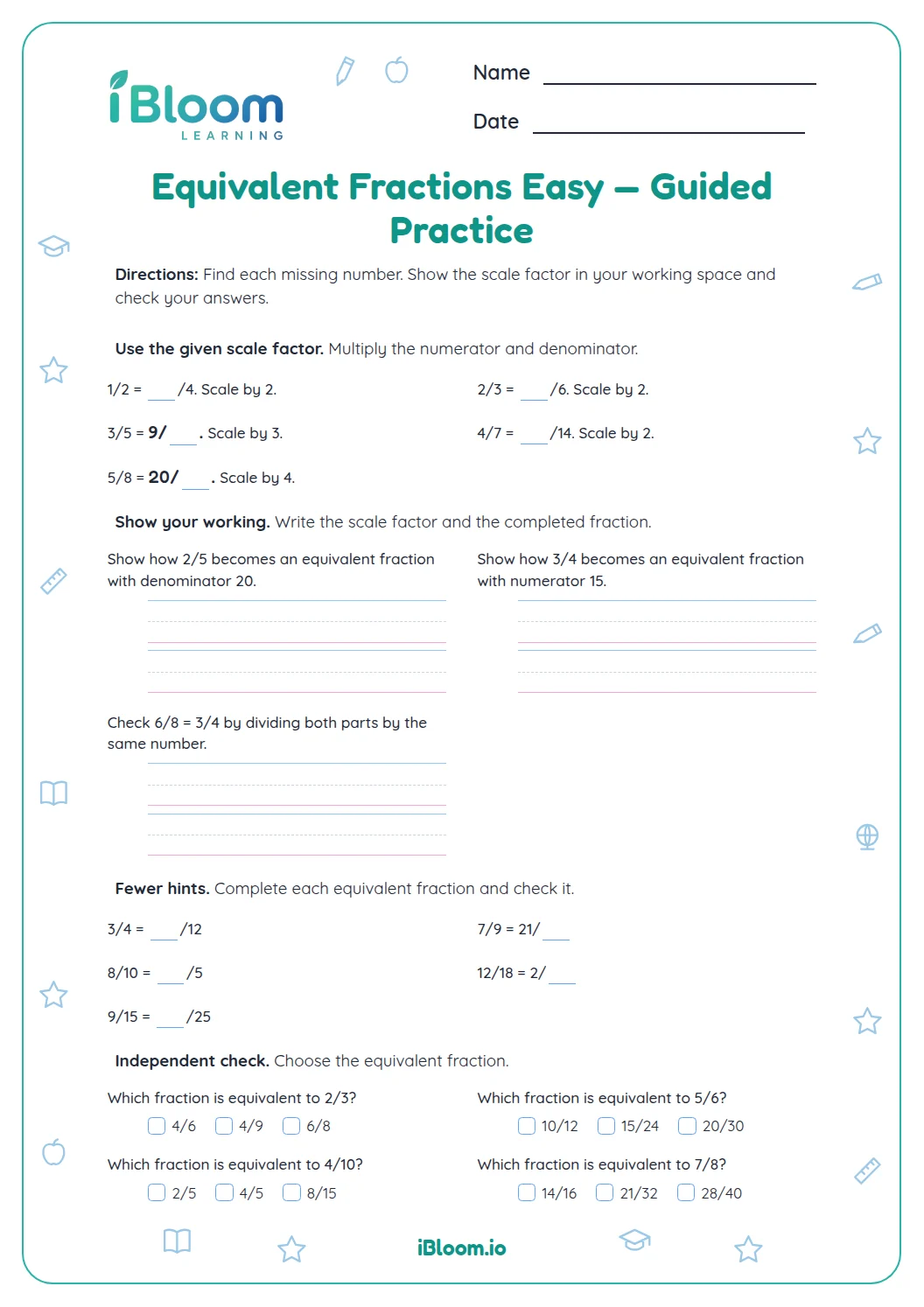
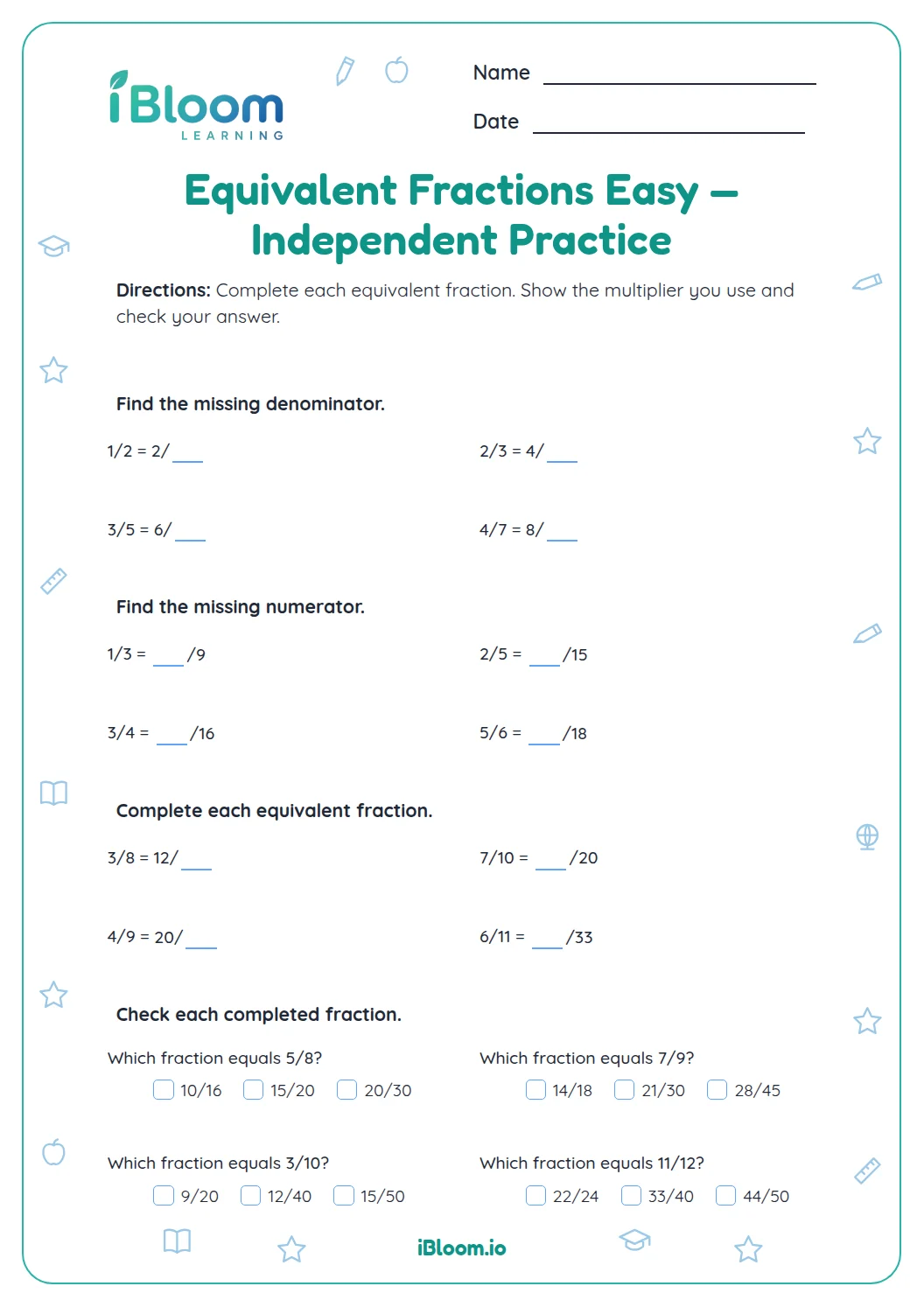
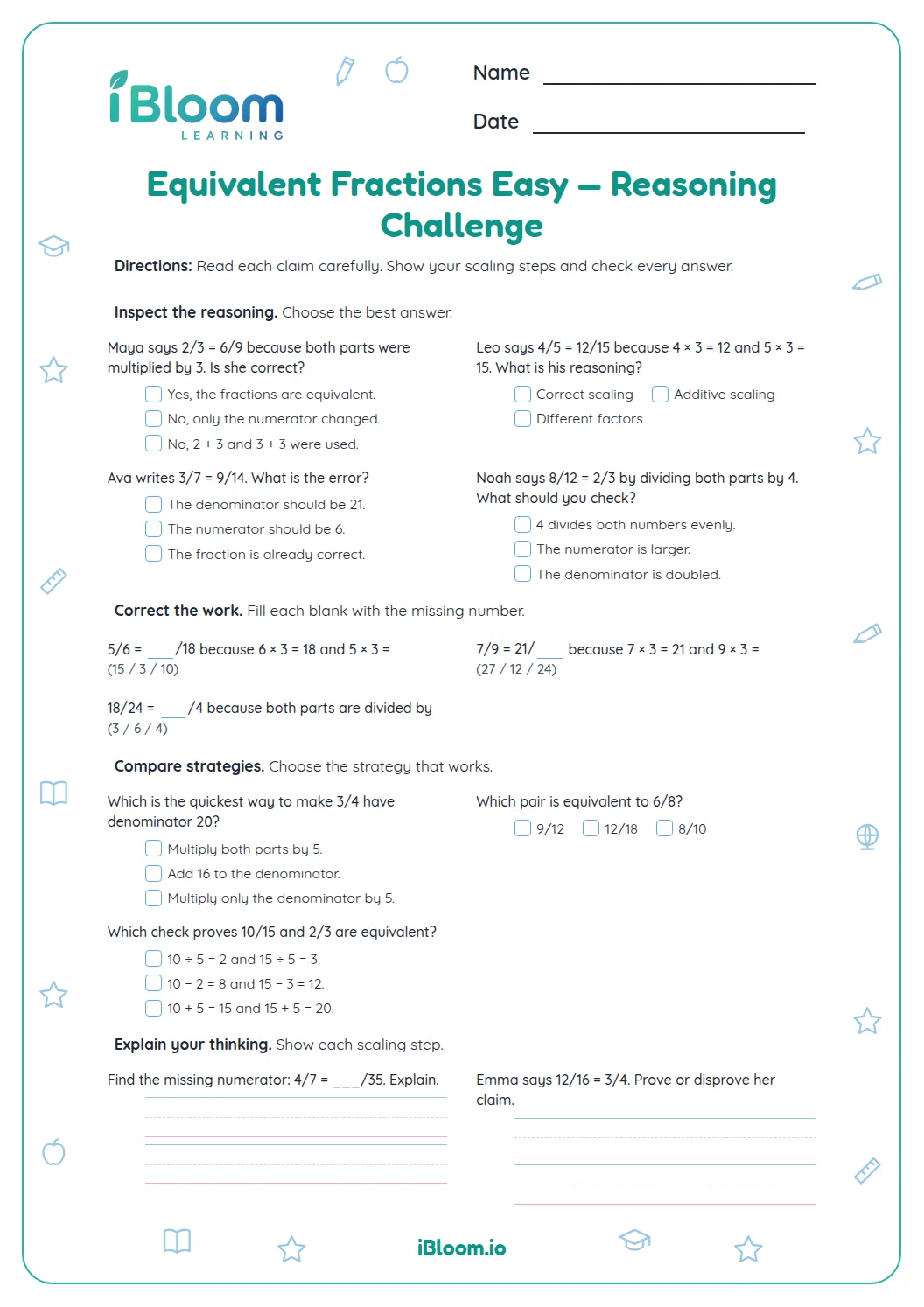
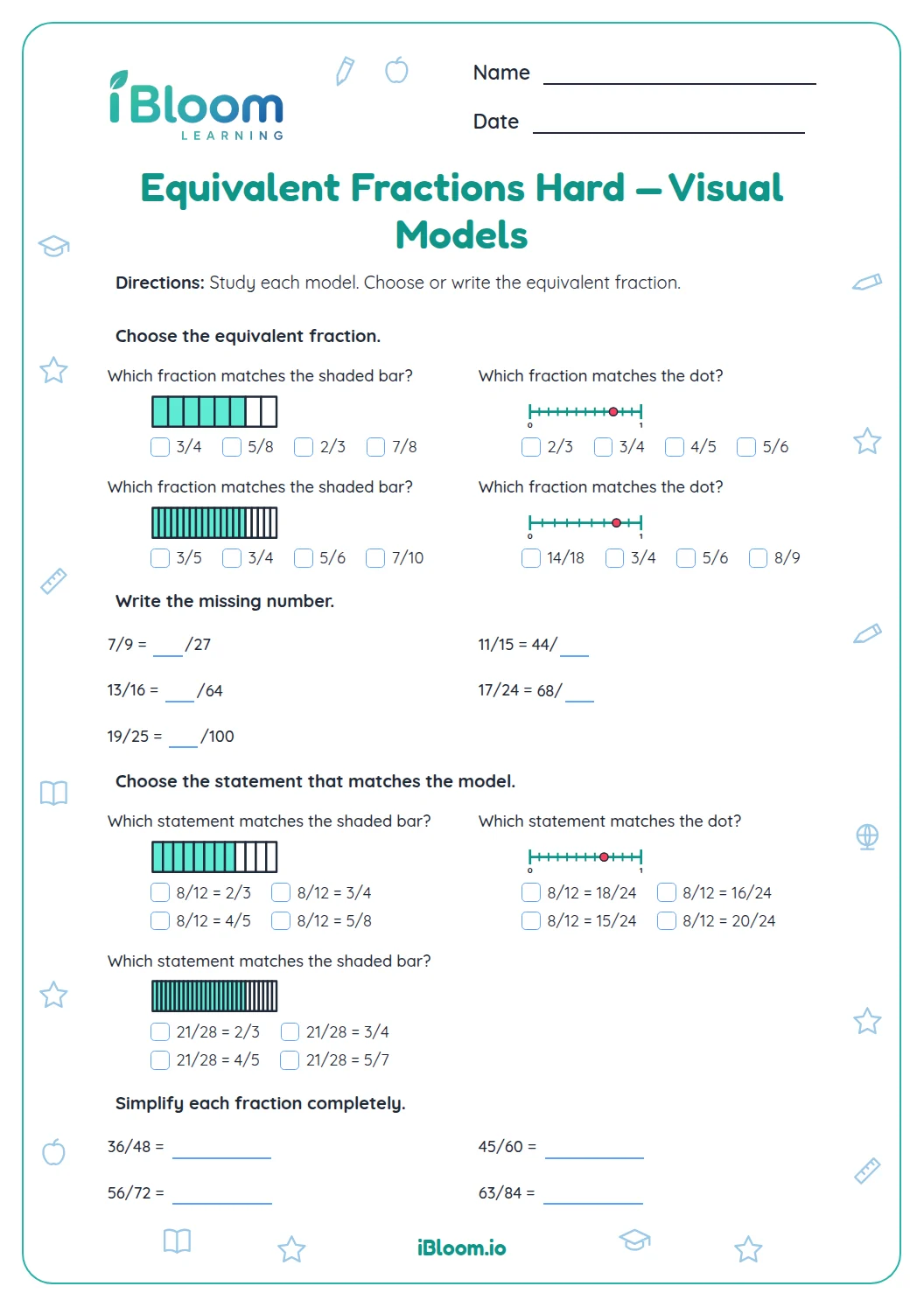
This Grade 6 visual worksheet gives students 15 equivalent-fraction problems in three parts. Students read shaded bars, identify matching fractions, complete missing numerators, and select equivalent pairs. A separate answer key follows the student questions. The work practices recognizing and generating equivalent fractions, described by Common Core standard 4.NF.A.1.
Aligned to 4.NF.A.1
How can a bar model show equivalent fractions?
This Grade 6 visual worksheet gives students 15 equivalent-fraction problems in three parts. Students read shaded bars, identify matching fractions, complete missing numerators, and select equivalent pairs. A separate answer key follows the student questions. The work practices recognizing and generating equivalent fractions, described by Common Core standard 4.NF.A.1.
Follow the part directions and keep each response in its matching blank. Use the answer key after completing the questions.
- 1One of two equal parts is shaded: 1/2.
- 2Three of six equal parts is the same amount: 3/6.
What will students practice?
The 15 questions are grouped into three parts that move from the opening task to independent practice.
- Part A: 5 bar-model choices
- Part B: 5 missing-numerator problems
- Part C: 5 equivalent-pair choices
How can a student check the work?
Compare the shaded amount, not just the number of pieces. Equivalent bars may divide the same whole into different-sized pieces.
How to use this worksheet
- 1Read the direction for each part: read the fraction bars, complete each fraction, then choose equivalent pairs.
- 2Write each requested value in its own answer space.
- 3Compare the shaded amounts, even when the bars have different partitions.
- 4Simplify when needed, then check your response with the answer key.
Common fraction mistakes and quick fixes
The mistake
Changing only one term when scaling a fraction.
The fix
Multiply both numerator and denominator by the same factor.
The mistake
Treating a larger denominator as a larger fraction.
The fix
Compare the value of the whole shaded amount.
The mistake
Filling the wrong fraction blank.
The fix
Check whether the blank is the numerator or denominator before solving.
Common Core alignment
This worksheet practices the fraction skills described in the standards below.
Use fraction models to show why equivalent fractions have the same value.
On this sheet: Shaded bars show equivalent fractions and students generate equivalent fractions by scaling both terms.
Show the official wordingHide the official wording
Explain why a fraction a/b is equivalent to a fraction (n × a)/(n × b) by using visual fraction models, with attention to how the number and size of the parts differ even though the two fractions themselves are the same size. Use this principle to recognize and generate equivalent fractions.
What to practice next
Make more practice
Further reading
Questions parents and teachers ask
How many questions are included?
There are 15 questions in three parts, plus a separate key. Students read shaded fraction bars, complete missing numerators, and choose pairs of equivalent fractions. Each part has five questions, moving from visual recognition to number work and then comparison.
How do the fraction bars help?
The bar displays a shaded amount divided into equal parts. Students compare that amount with the fraction choices to find a different fraction name for the same portion. The first three prompts explicitly name the fractions while the bars show the starting amount.
How can I complete a missing numerator?
Use the shaded amount to identify the fraction value, then scale its numerator and denominator to match the stated denominator. The resulting numerator fills the blank. For 1/2 = ___/12, six of twelve equal parts match one half of the whole.
Is an answer key included?
Yes. The key gives the correct matching fractions, missing numerators, and equivalent pairs in question order. The key also identifies which choice matches each printed fraction or shaded amount. The key also identifies which choice matches each printed fraction or shaded amount, following the same order as the worksheet.
What makes two fractions equivalent?
Two fractions are equivalent when they represent the same amount. They may use different numbers of equal parts, but the same proportion of the whole is named. For example, 6/8 and 3/4 are equivalent because each describes three-fourths of one whole.