



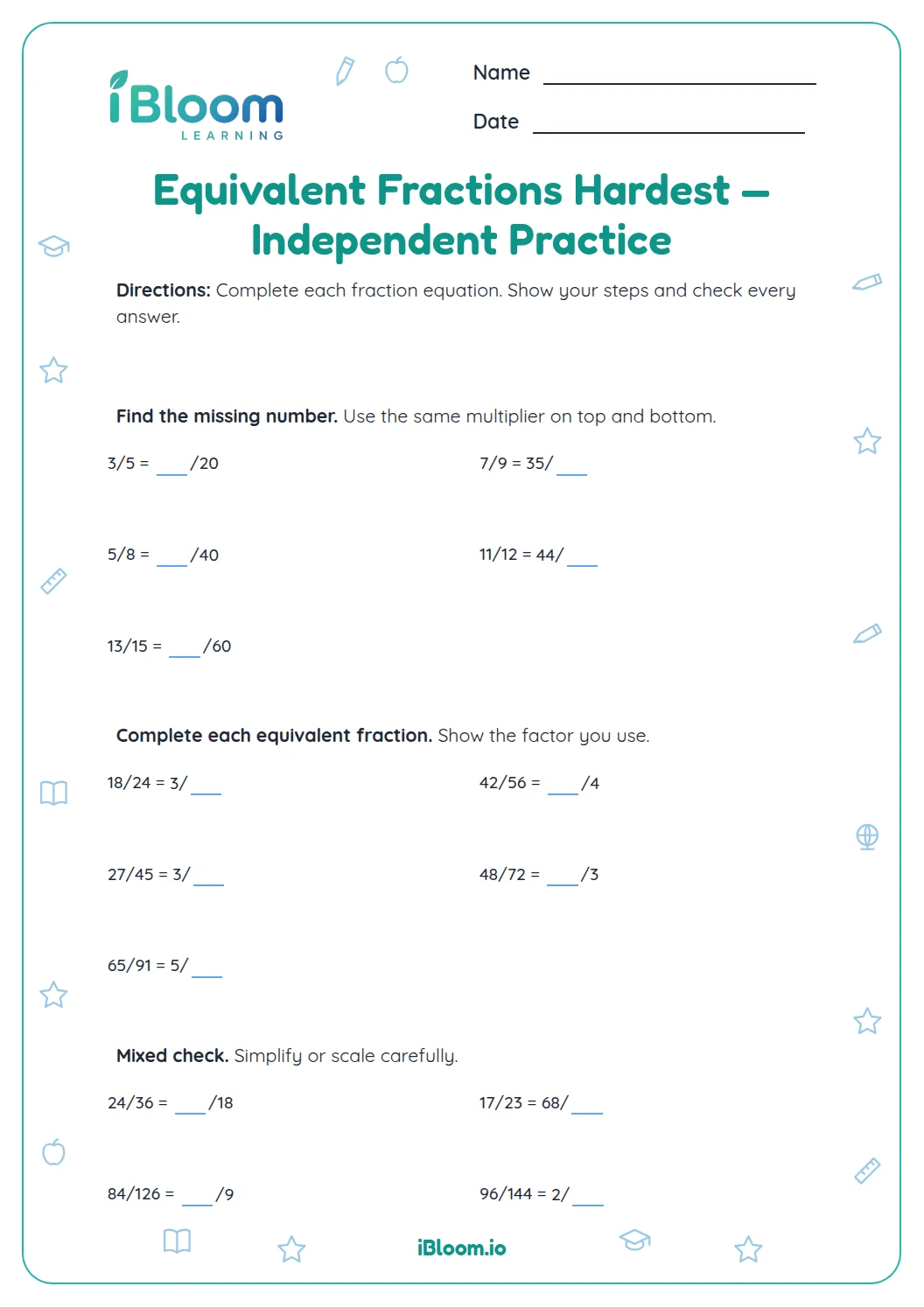


About this worksheet
Students use equivalent fractions in contexts involving a hike, a pizza, a savings goal, a recipe, a map, and measured amounts. The first questions ask for separate numerator and denominator values; later items scale to a requested denominator or find a fraction of a quantity. The key includes units where the situation asks for a measurement.
Aligned to 5.NF.B.4
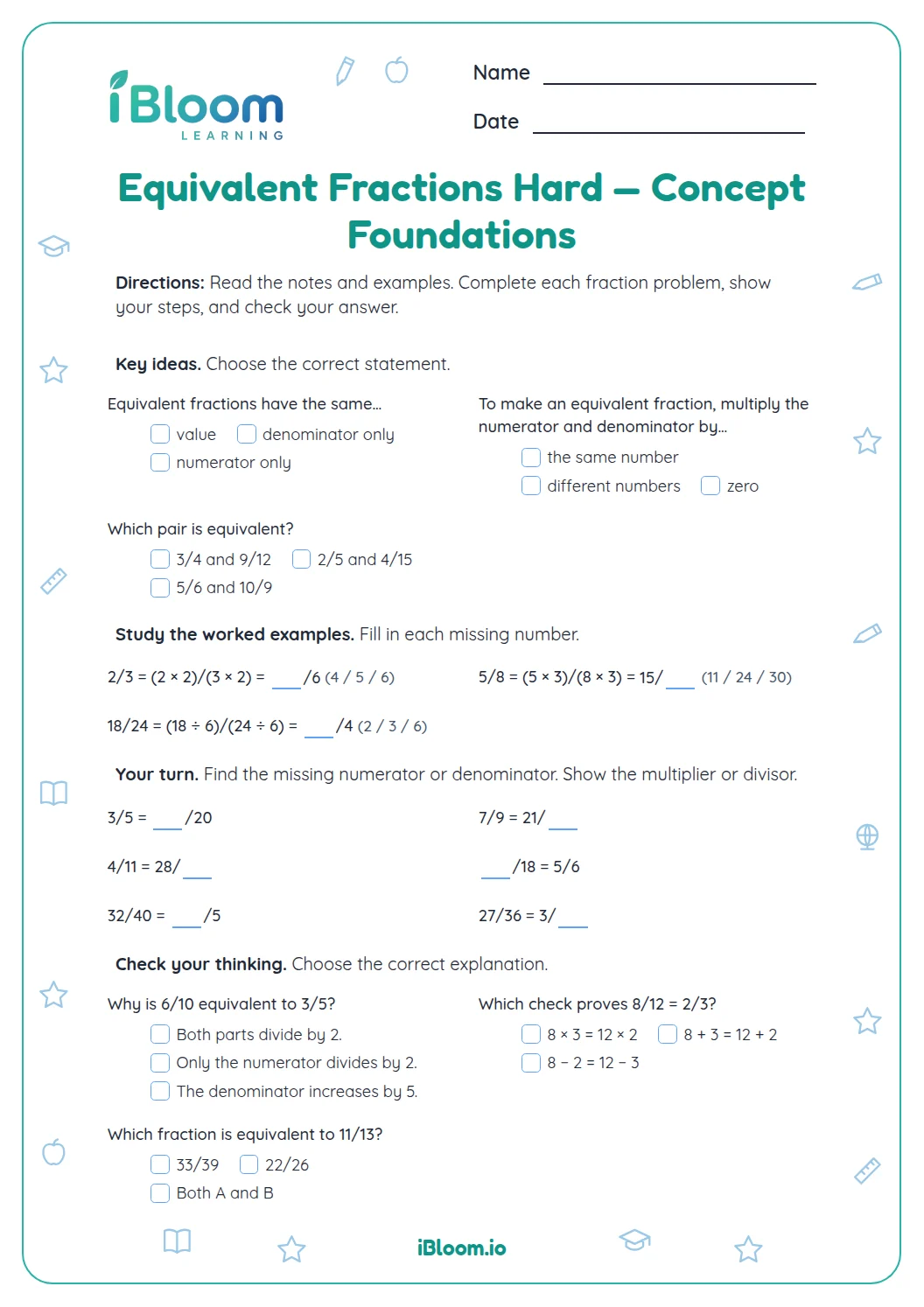
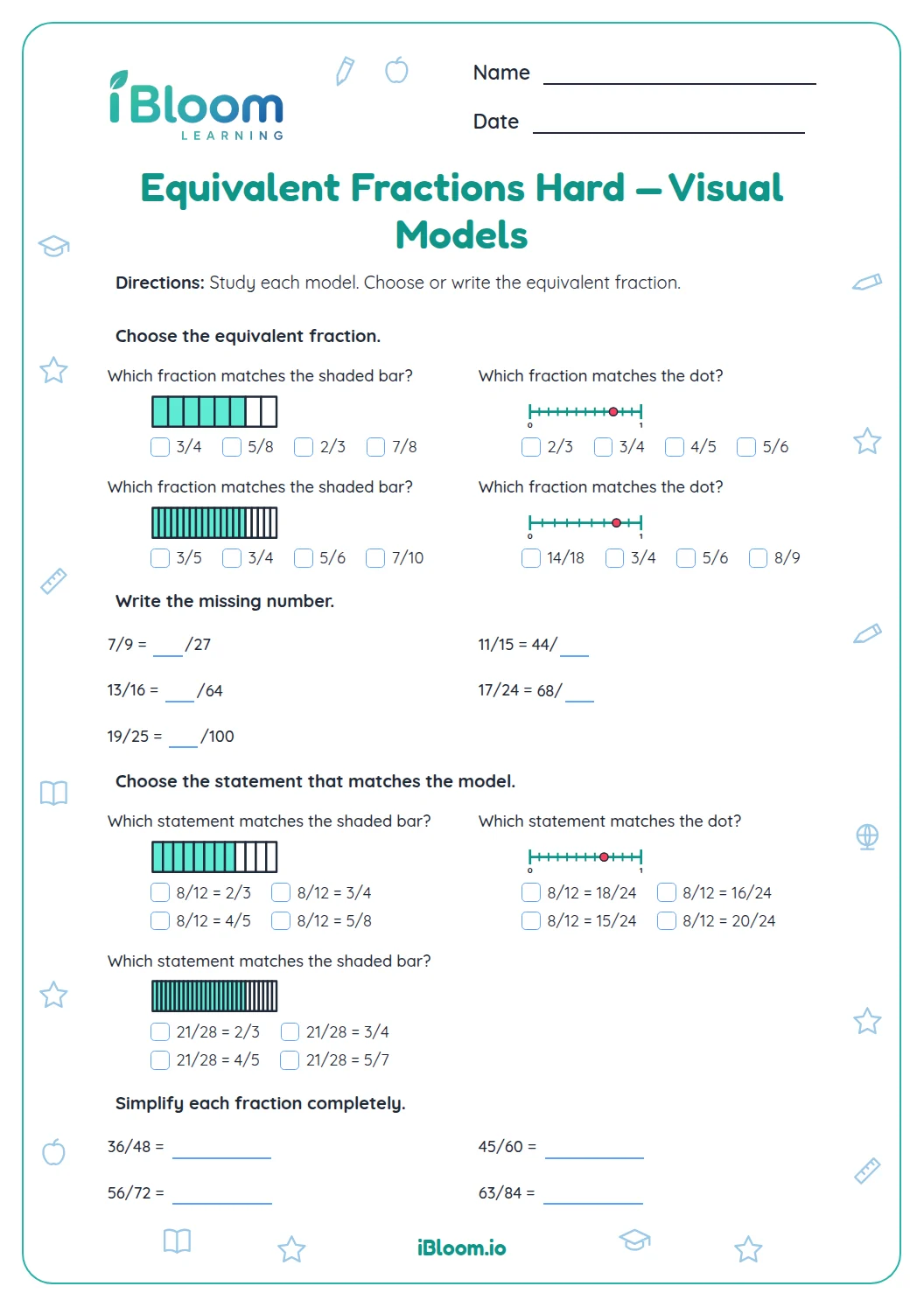
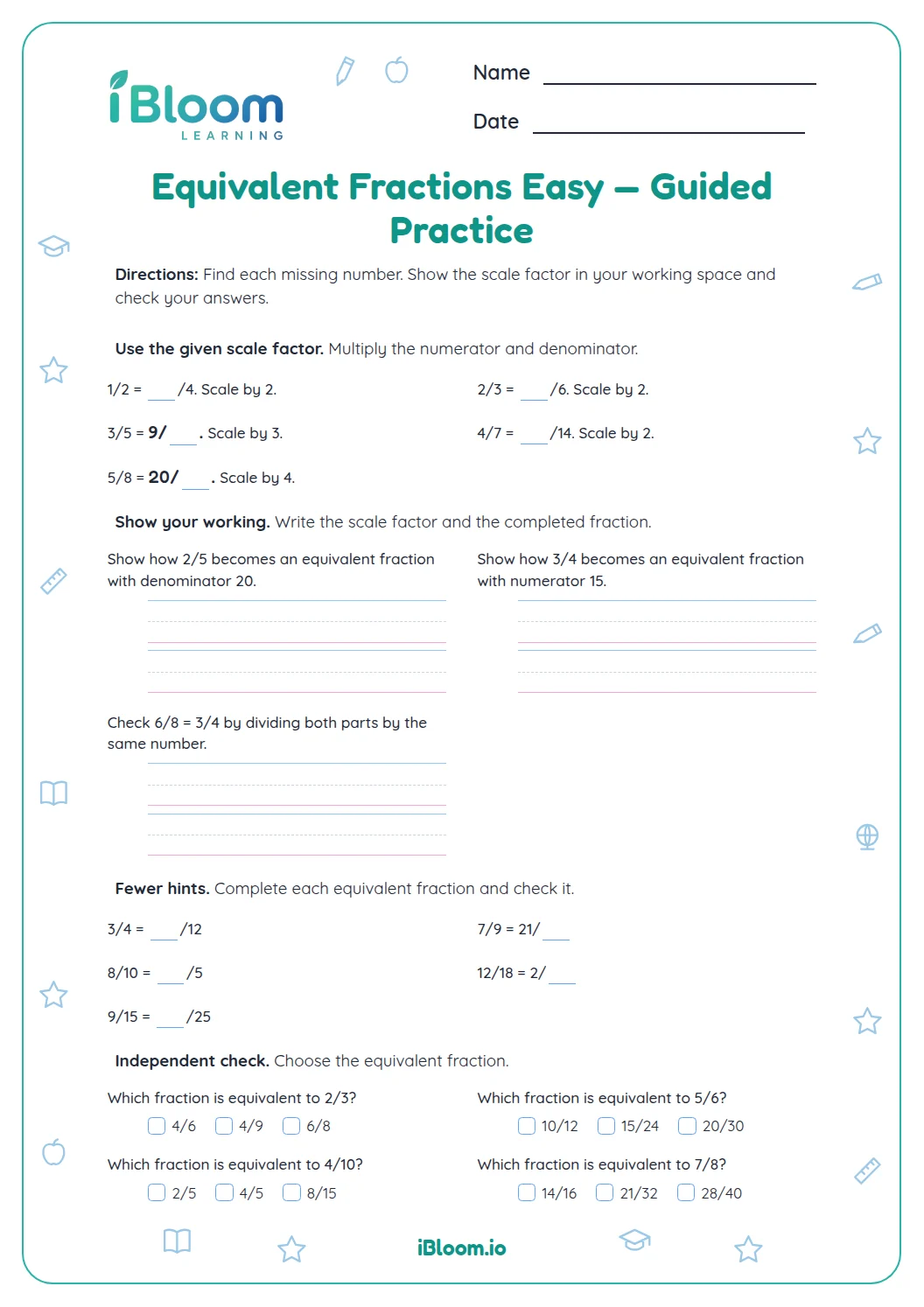
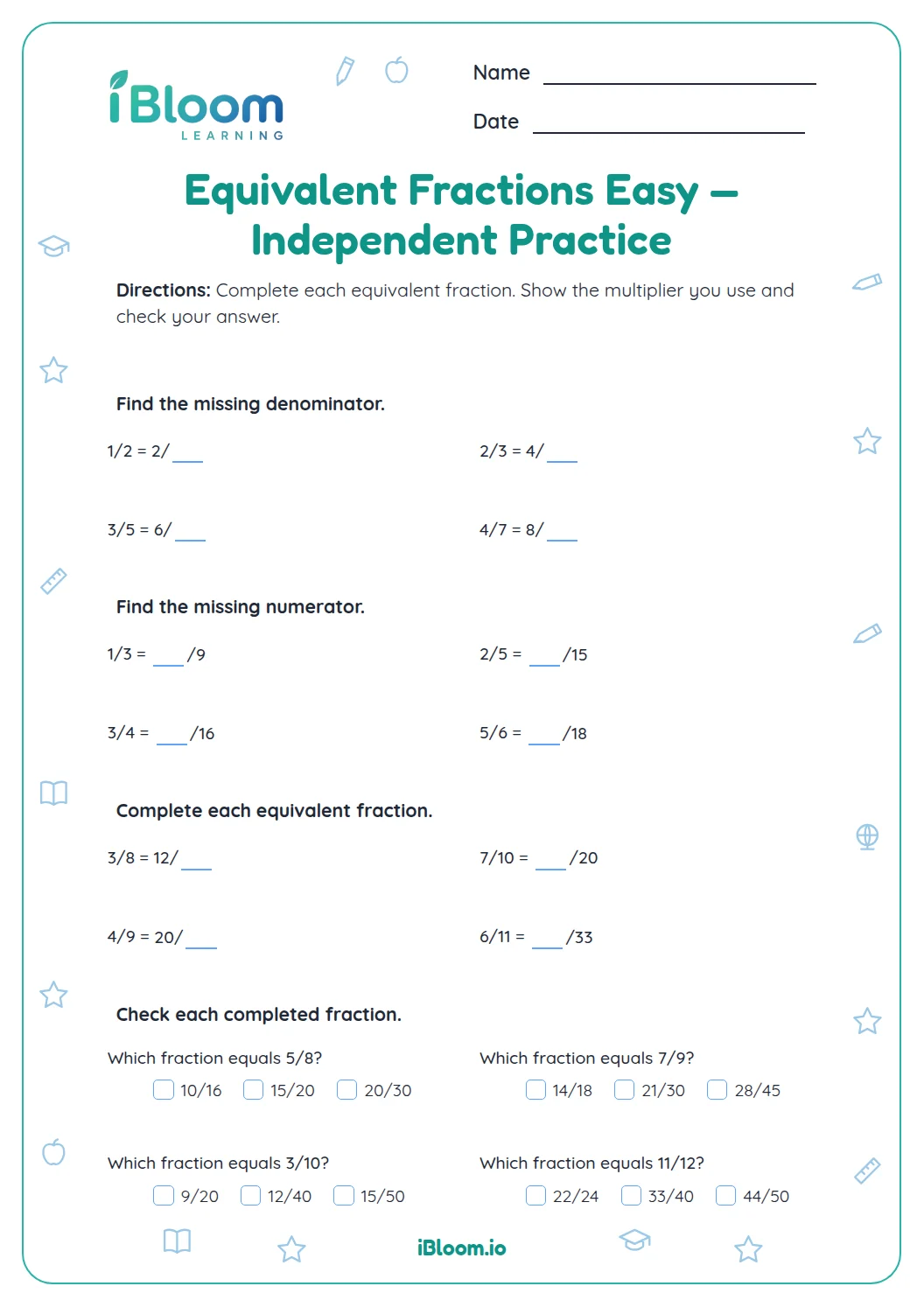
How do you make an equivalent fraction?
Multiply or divide the numerator and denominator by the same nonzero number. In question 5, to change 2/3 into twelfths, multiply both terms by 4.
- 12 × 4 = 8
- 23 × 4 = 12
- 32/3 = 8/12
How do you find a fraction of a quantity?
A fraction of a quantity can be found by dividing the whole into equal groups and taking the requested number of groups. For question 9, 3/5 of 40 centimeters is 24 centimeters.
How to use this worksheet
- 1For a simplest-form question, divide the numerator and denominator by the same factor.
- 2For a target denominator, find the scale factor from the original denominator.
- 3Apply that factor to the numerator as well.
- 4For a fraction-of-an-amount problem, divide the whole by the denominator and multiply by the numerator.
- 5Keep the unit from the situation in the answer.
Common mistakes and fixes
The mistake
Changing only the denominator.
The fix
Multiply or divide numerator and denominator by the same factor.
The mistake
Confusing the part with the whole.
The fix
Identify which amount is the whole before applying the fraction.
The mistake
Dropping the unit.
The fix
Include miles, centimeters, cups, or another unit named in the problem.
Common Core alignment
This worksheet gives students practice with the fraction skills described below.
Apply multiplication to find fractions of quantities.
On this sheet: Students find fractional parts of lengths, capacities, areas, and counts in the application questions.
Show the official wordingHide the official wording
Apply and extend previous understandings of multiplication to multiply a fraction or whole number by a fraction.
What to practice next
Make more practice
Further reading
Questions parents and teachers ask
Why does 21/30 simplify to 7/10?
Divide both 21 and 30 by 3. The quotient 7/10 names the same part of the trail because the numerator and denominator were scaled by the same factor. Students can check that the calculation matches the values and directions printed in this worksheet before using the separate key to review the result.
How do you make 2/3 have denominator 12?
The denominator 3 is multiplied by 4 to make 12. Multiply the numerator by 4 as well, giving 8/12, an equivalent fraction. Students can check that the calculation matches the values and directions printed in this worksheet before using the separate key to review the result.
How do you find 3/5 of 40 centimeters?
Divide 40 by 5 to find that one fifth is 8 centimeters. Take three groups of 8 centimeters: 24 centimeters. Students can check that the calculation matches the values and directions printed in this worksheet before using the separate key to review the result.
Why include units in the answer key?
Units clarify what the number measures. For example, question 9 asks for a length, so the answer is 24 cm rather than just 24. Students can check that the calculation matches the values and directions printed in this worksheet before using the separate key to review the result.
What does an equivalent fraction represent?
It represents the same amount using a different number of equal parts. For example, 2/3 and 8/12 are equivalent because both numerator and denominator were multiplied by 4. Students can check that the calculation matches the values and directions printed in this worksheet before using the separate key to review the result.