



About this worksheet
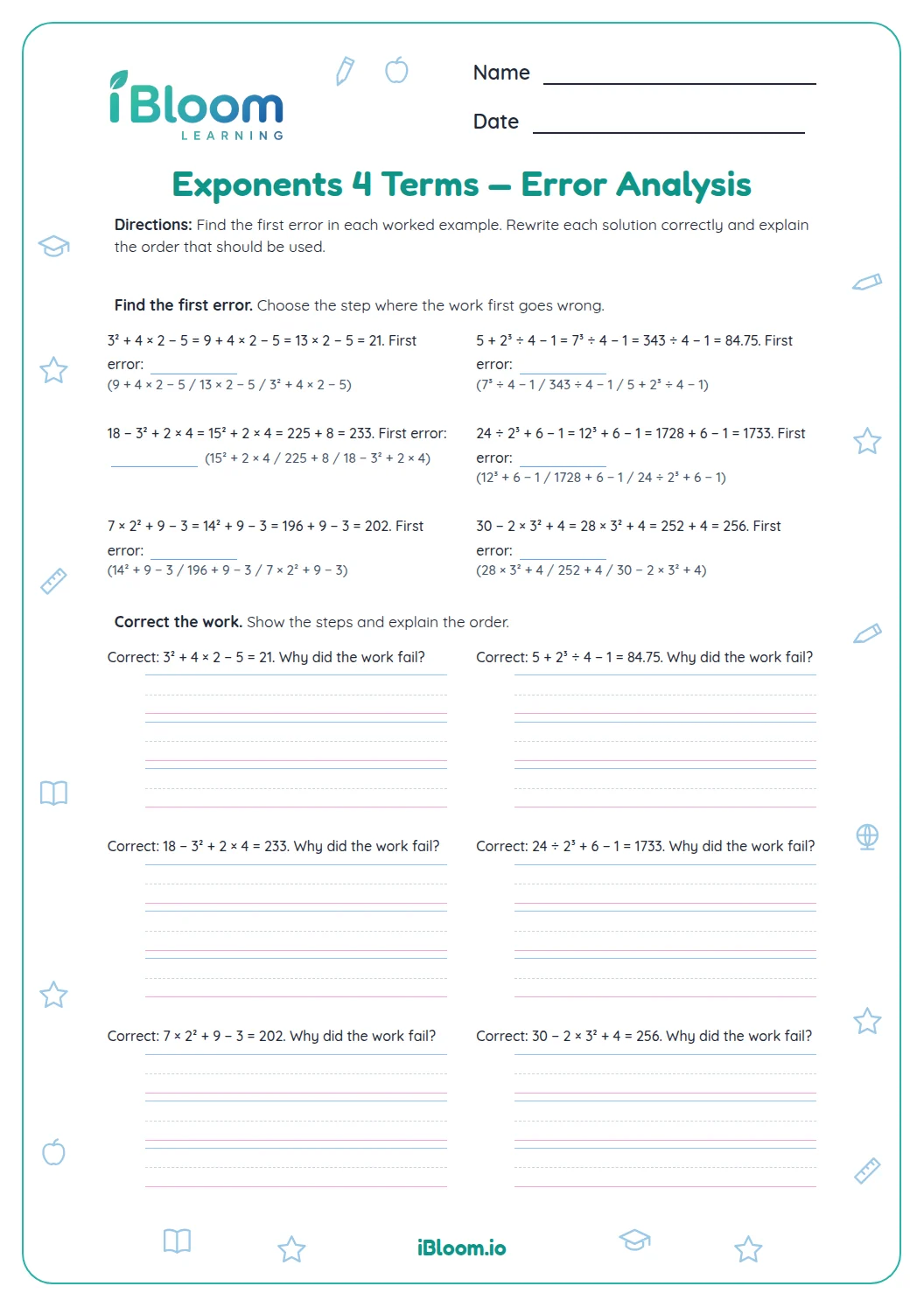
This printable math sheet practices exponents inside four-term numerical expressions. Students first choose the operation to begin with, then evaluate expressions that include powers, multiplication or division, and addition or subtraction. Powers are printed with superscript exponents for easy reading. It is designed for Grades 5–6, aligns with CCSS 5.OA.A.1, and includes 16 questions plus a separate answer key.
What comes before multiplication and division?
Evaluate powers before multiplication, division, addition, or subtraction. Then handle multiplication and division from left to right, followed by addition and subtraction from left to right.
- 13² + 4 × 2 − 5
- 2Evaluate the power: 3² = 9.
- 3Then multiply: 9 + 8 − 5 = 12.
What kinds of questions are included?
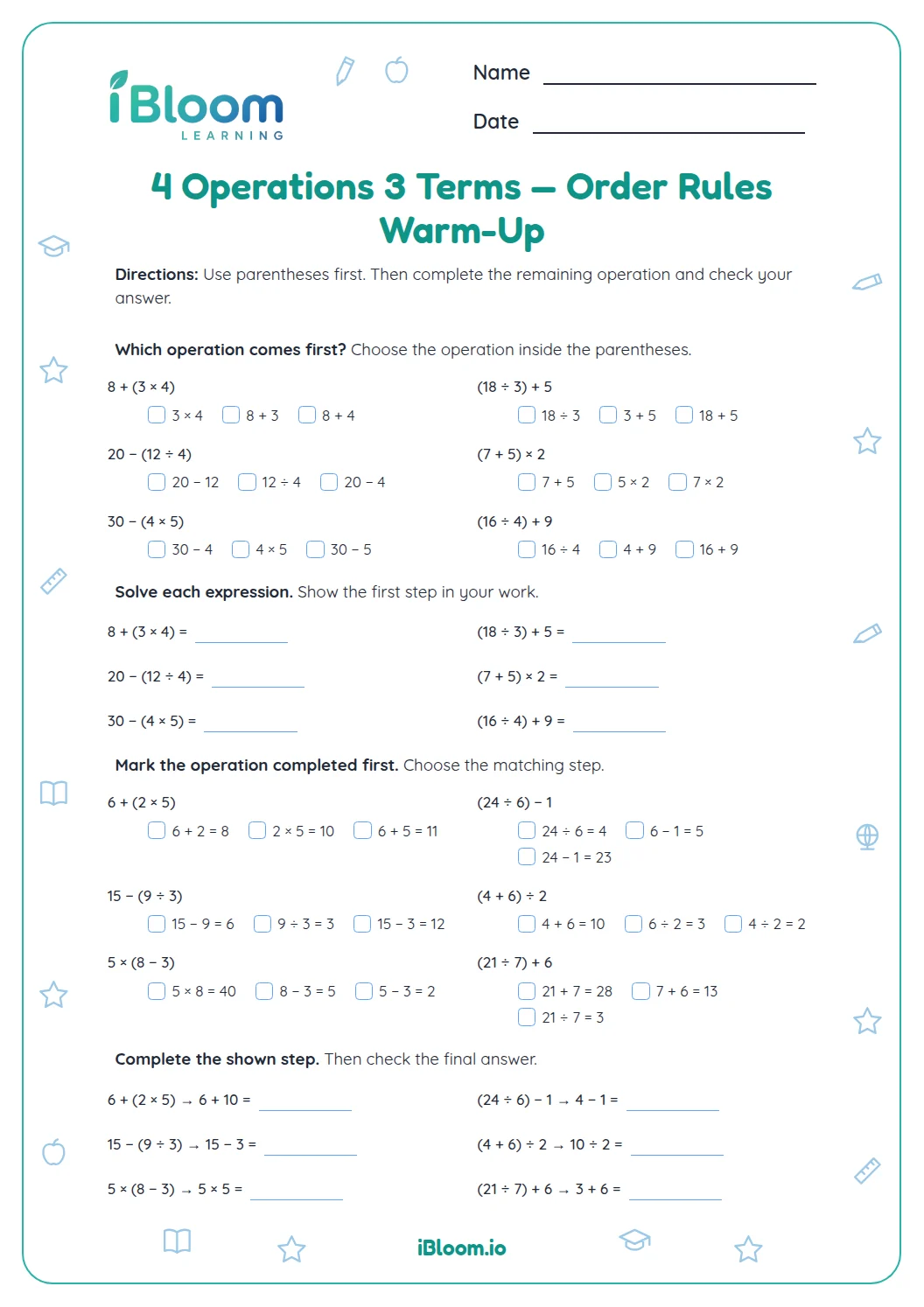
Part A asks which operation to perform first in eight expressions with powers. Part B asks for the final value of eight expressions; powers are printed as superscripts.
- Part A: Choose the first step
- A separate answer key follows the worksheet pages.
How can students work through the page?
- 1Find any exponent and evaluate it.
- 2Complete multiplication or division before addition or subtraction.
- 3When operations share a level, continue from left to right.
- 4Write the final value for each expression.
- 5Check the order and arithmetic with the key.
Common order-of-operations mistakes
The mistake
Reading 3² as 3 × 2.
The fix
A superscript tells how many times the base is a factor: 3² = 3 × 3.
The mistake
Adding before completing multiplication.
The fix
Evaluate powers first, then multiplication or division, and then addition or subtraction.
The mistake
Treating 18 ÷ 3 + 2² × 2 as a single left-to-right chain.
The fix
Do the power and multiplication or division before adding the resulting terms.
What to practice next
Make more practice
Questions parents and teachers ask
What does a superscript 2 mean?
It means the base is a factor two times. For example, 3² means 3 × 3, which equals 9. It does not mean 3 × 2. The sheet uses superscript notation for every power. Students should read the superscript as the number of equal factors, then continue through the expression.
What should students evaluate first?
Evaluate the powers first. Then complete multiplication or division before addition or subtraction. If two operations have the same priority, work from left to right unless parentheses show a different grouping. Students should read the superscript as the number of equal factors, then continue through the expression.
How many terms are used in these expressions?
The expressions contain four numerical terms, including terms written as powers. They combine exponent evaluation with other operations so students practice using operation order across the complete expression. Students should read the superscript as the number of equal factors, then continue through the expression.
Does the answer key show the expression values?
Yes. It gives the first operation for the choice questions and the final numeric value for each evaluation question. Students can use it to check both the result and their operation order. Students should read the superscript as the number of equal factors, then continue through the expression.
Are the exponents written as superscripts?
Yes. Powers are printed with superscript numerals, such as 3² and 2³, so students can distinguish the exponent from the base and read each expression clearly. Students should read the superscript as the number of equal factors, then continue through the expression.