

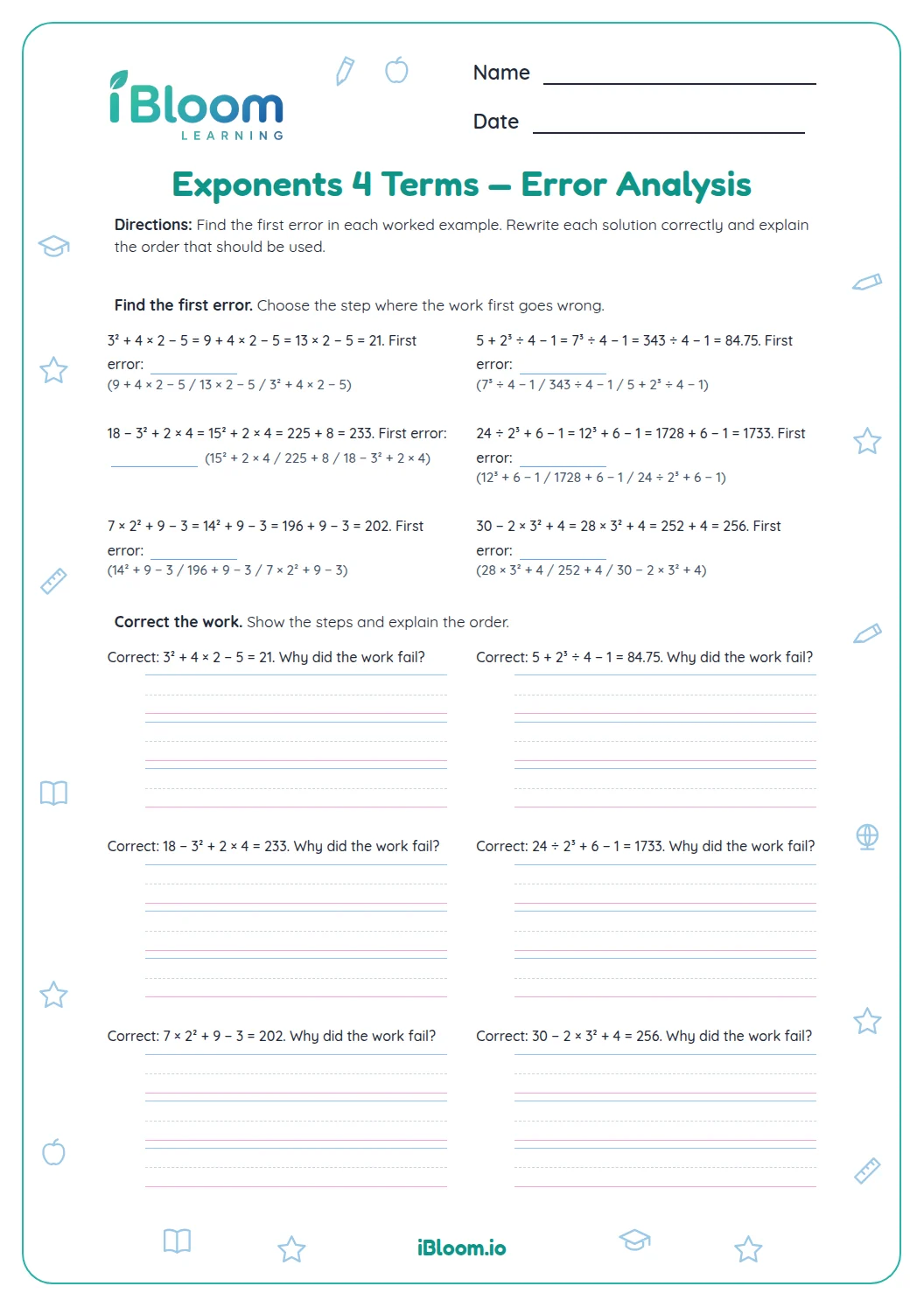
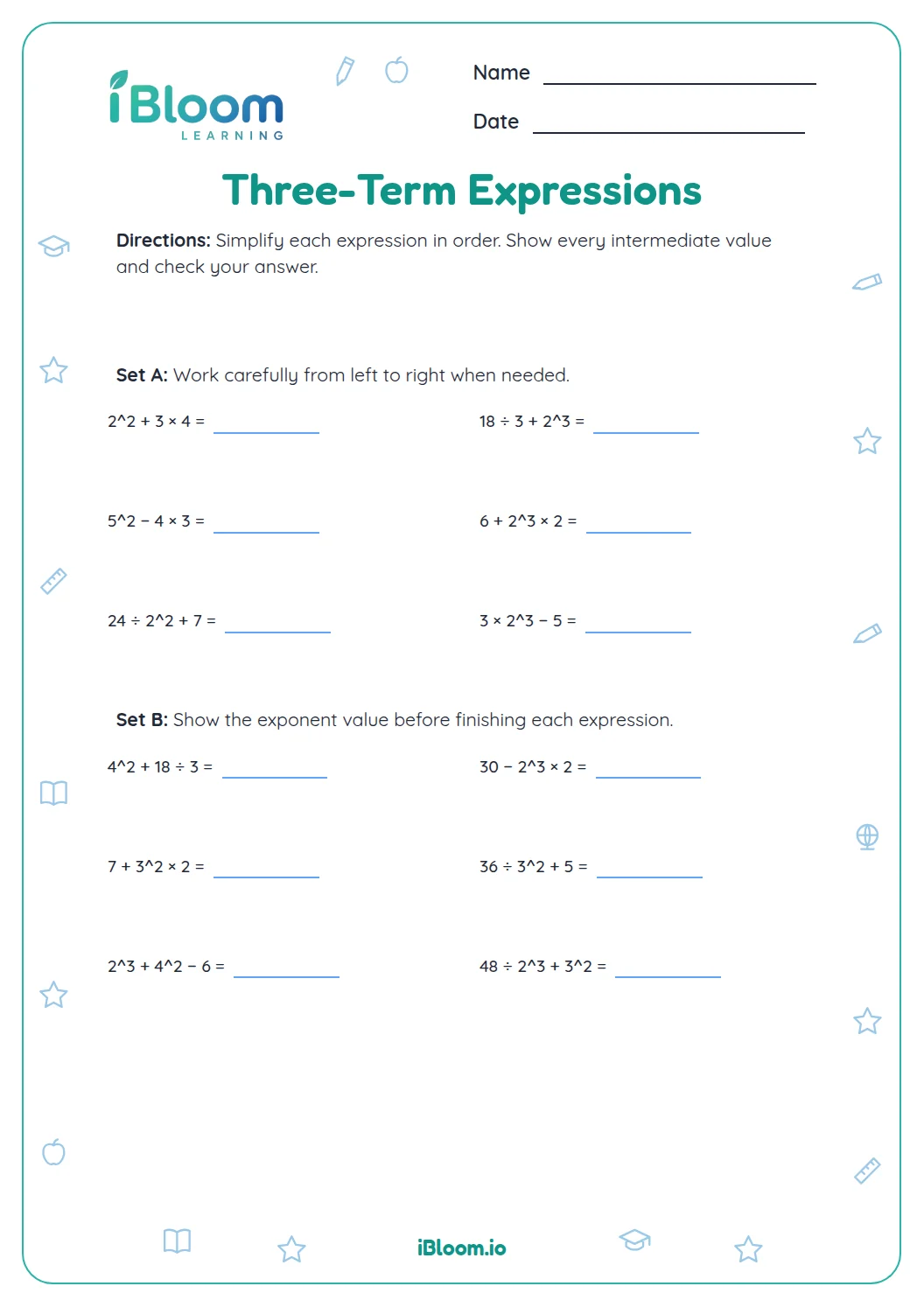

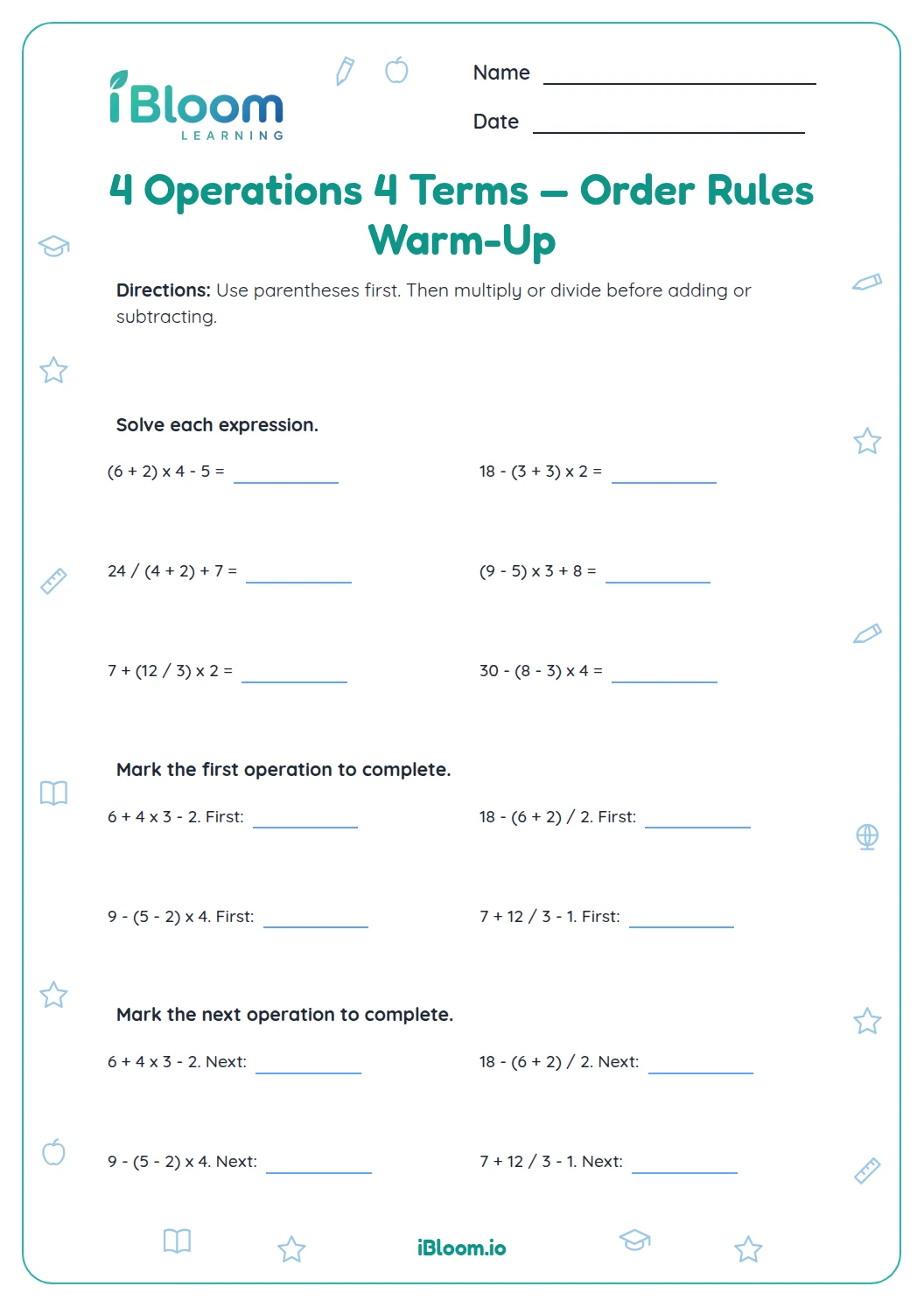

About this worksheet
This printable gives Grades 5–6 students 20 order-of-operations questions with whole-number exponents. Students fill missing signs and values, choose equations that are true, and evaluate expressions; the two-page sheet has a separate two-page answer key. It practices evaluating expressions with grouping and exponents (CCSS 5.OA.A.1 and 6.EE.A.1).
Aligned to 5.OA.A.1 and 6.EE.A.1
Which rule comes first?
An exponent is evaluated before multiplication or division. Addition and subtraction come last, moving from left to right.
Evaluate one operation at a time and copy the remaining signs and numbers exactly. Multiplication and division share a level, as do addition and subtraction; within each level, move from left to right.
- 13² + 4 ÷ 2 + 1
- 29 + 4 ÷ 2 + 1
- 39 + 2 + 1
- 412
How can you check each answer?
Try a candidate sign and evaluate the full left side. Check that the result equals the printed value.
Return to the original expression and repeat the steps in order. This helps separate an arithmetic slip from a choice of operation that came too early.
What practice is included?
The sheet has 20 questions in four parts: six missing-sign equations, four missing-value equations, five true-equation choices, and five evaluations. The separate answer key follows the same question numbers.
How to work through this sheet
- 1Evaluate each exponent.
- 2Do multiplication and division from left to right.
- 3Then do addition and subtraction from left to right.
- 4For a missing sign, test it and evaluate the whole expression.
- 5For a missing value, substitute your result to check.
- 6Use the key after attempting each item.
Common mistakes and quick fixes
The mistake
Adding before dividing
The fix
Finish the division first, then add.
The mistake
Multiplying the base by its exponent
The fix
A power such as 3² means 3 × 3.
The mistake
Guessing a missing sign without checking
The fix
Substitute the sign and evaluate the entire left side.
Common Core alignment
This worksheet practices evaluating numerical expressions and applying operation rules.
Evaluate numerical expressions by following operation symbols and grouping marks.
On this sheet: Students evaluate numerical expressions with grouping symbols.
Show the official wordingHide the official wording
Use parentheses, brackets, or braces in numerical expressions, and evaluate expressions with these symbols.
Evaluate expressions that include whole-number exponents.
On this sheet: Students evaluate numerical expressions with whole-number exponents.
Show the official wordingHide the official wording
Write and evaluate numerical expressions involving whole-number exponents.
What to practice next
Make more practice
Further reading
Questions parents and teachers ask
How do I solve a missing-sign equation?
Test each allowed sign, then evaluate the entire left side in order. For 3² + 4 ÷ 2 + 1, calculate 9 + 2 + 1 = 12. The plus sign makes the equation true. Keep the other numbers and signs unchanged while checking each candidate.
What does 3² mean?
It means 3 × 3, or 9. The exponent tells how many times the base is used as a factor; it does not mean 3 × 2. Evaluate powers before multiplication, division, addition, or subtraction, and copy the signs carefully as you rewrite each line.
What number completes 2⁴ − ___ × 2 + 3 = 13?
The missing number is 3. Evaluate 2⁴ as 16, then multiply 3 × 2 to get 6; finally, 16 − 6 + 3 = 13. Substitute the value into the original expression to confirm that it makes the whole equation true.
How many questions are on the printable?
There are 20 questions over two worksheet pages: six missing-sign equations, four missing-value equations, five true-equation choices, and five expressions to evaluate. A separate two-page answer key follows the same question numbers. Students can check each kind of response in its matching section.
When do multiplication and division happen?
Evaluate exponents first. Then do multiplication and division from left to right, followed by addition and subtraction from left to right. For example, 18 ÷ 3 × 2 becomes 6 × 2, or 12. Keeping the expression visible helps preserve the operation signs.