

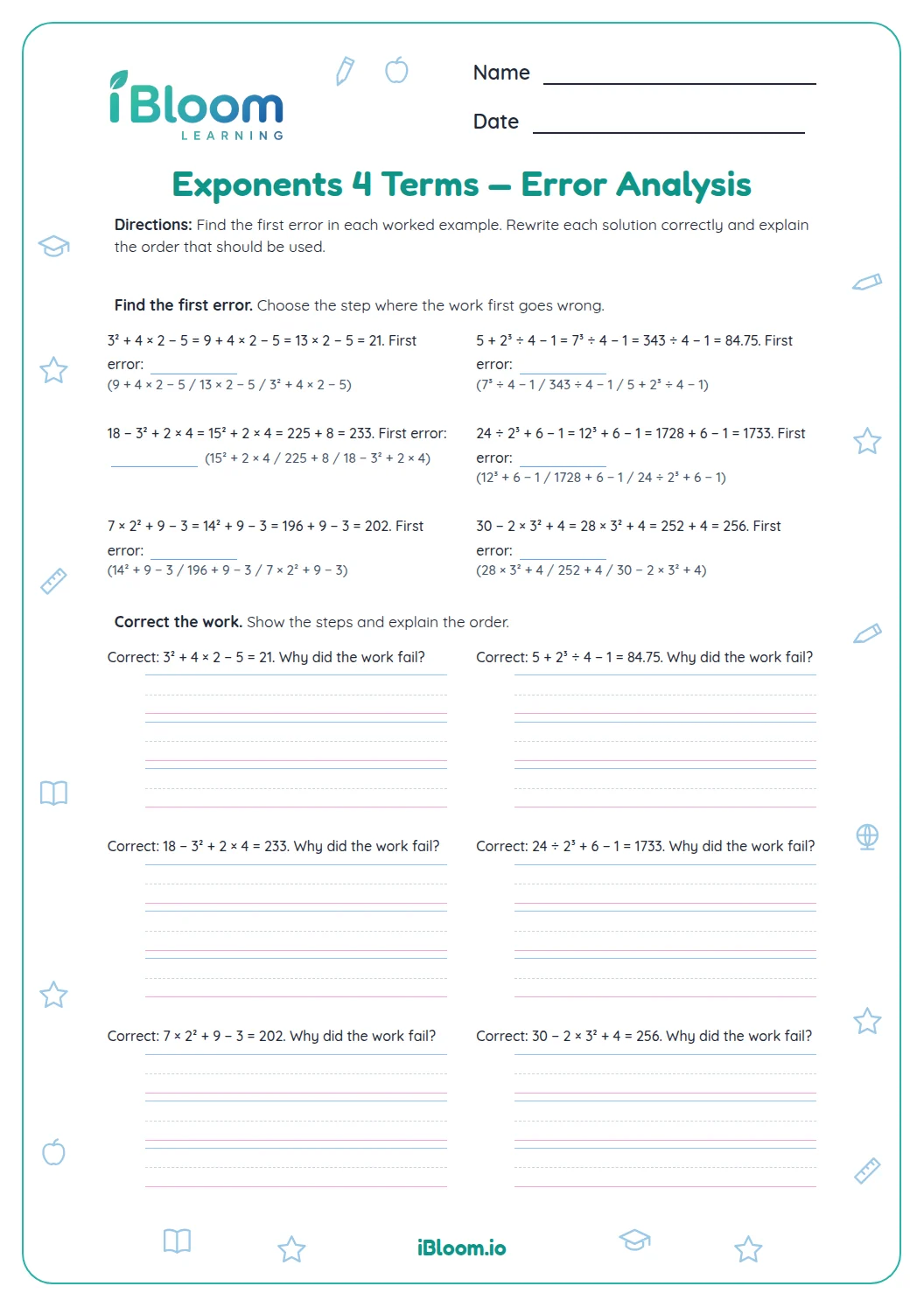
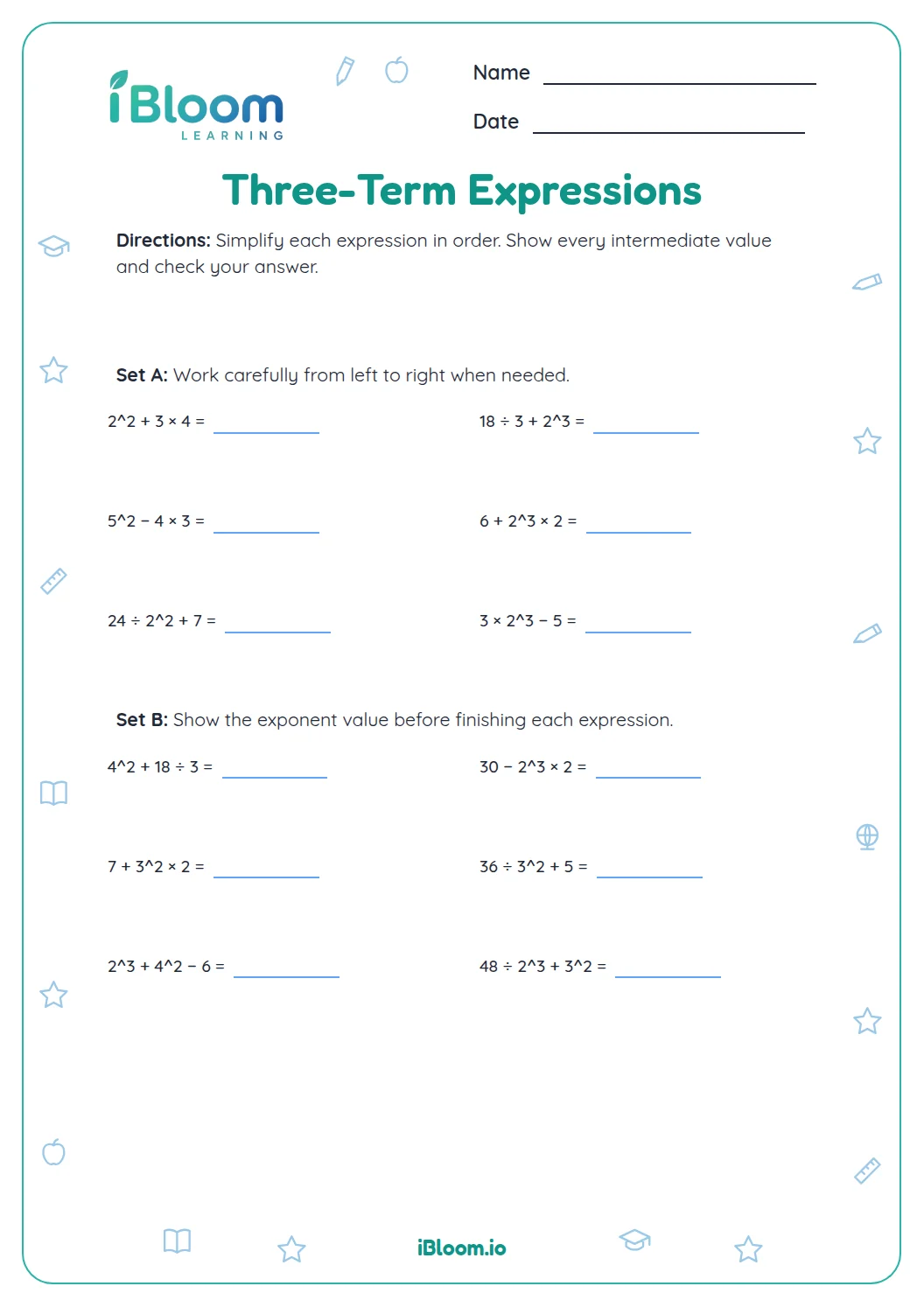

About this worksheet
This Grades 5–6 mastery printable contains 14 questions about evaluating expressions with exponents, multiplication, division, addition, subtraction, and parentheses. Students calculate six values, compare expressions by value, and respond to three short application prompts. The worksheet and separate answer key each span two pages; the practice aligns with CCSS 5.OA.A.1 and 6.EE.A.1.
Aligned to 5.OA.A.1 and 6.EE.A.1
Which rule comes first?
Mastery practice combines exponents, division, multiplication, addition, subtraction, grouping marks, and short explanations.
Evaluate one operation at a time and copy the remaining signs and numbers exactly. Multiplication and division share a level, as do addition and subtraction; within each level, move from left to right.
- 15² − 9 ÷ 3 + 2
- 225 − 3 + 2
- 322 + 2
- 424
How can you check each answer?
Keep unchanged terms in order as you replace one operation at a time.
Return to the original expression and repeat the steps in order. This helps separate an arithmetic slip from a choice of operation that came too early.
What practice is included?
The sheet has 14 questions in three parts: six evaluations, five multiple-choice comparisons, and three short-answer applications. One prompt asks students to explain a calculation and another asks them to write an expression. A separate two-page answer key includes sample responses where wording can vary.
How to work through this sheet
- 1Evaluate powers before other operations.
- 2Work inside parentheses first.
- 3Complete multiplication and division from left to right.
- 4Complete addition and subtraction from left to right.
- 5Evaluate choices before comparing their values.
- 6Check written work one operation at a time.
Common mistakes and quick fixes
The mistake
Working left to right before evaluating powers
The fix
Calculate the exponent first.
The mistake
Treating multiplication as always before division
The fix
Complete both operations in the order they appear.
The mistake
Changing parentheses without evaluating the group first
The fix
Work inside grouping marks before outside operations.
Common Core alignment
This worksheet practices evaluating numerical expressions and applying operation rules.
Evaluate numerical expressions by following operation symbols and grouping marks.
On this sheet: Students evaluate numerical expressions with grouping symbols.
Show the official wordingHide the official wording
Use parentheses, brackets, or braces in numerical expressions, and evaluate expressions with these symbols.
Evaluate expressions that include whole-number exponents.
On this sheet: Students evaluate numerical expressions with whole-number exponents.
Show the official wordingHide the official wording
Write and evaluate numerical expressions involving whole-number exponents.
What to practice next
Make more practice
Further reading
Questions parents and teachers ask
What is the value of 5² − 9 ÷ 3 + 2?
It equals 24. First evaluate 5² as 25 and 9 ÷ 3 as 3. Then calculate 25 − 3 + 2 from left to right: 22 + 2 = 24. This is the first evaluation on the sheet and is also shown in the worked example.
Do multiplication and division have different priority?
They have equal priority, so complete whichever appears first from left to right. Addition and subtraction follow the same left-to-right rule. Evaluate powers and parentheses first. The worksheet includes expressions where following this sequence determines the correct value.
Why compare expressions with parentheses?
Parentheses tell you to evaluate a group first, which can change an expression’s value. For example, 5² − 9 ÷ 3 + 2 equals 24, while 5² − (9 ÷ 3 + 2) equals 20. Evaluate each option before selecting the one that matches the target.
What should a written explanation include?
Show the order of the operations and the values after each step. For 18 ÷ 3 × 2, divide first because it appears first from the left: 6 × 2 = 12. The prompt asks students to explain why the expression equals 12, so a short sequence of steps is enough.
How many questions and pages are included?
There are 14 questions in three parts over two worksheet pages: six evaluations, five multiple-choice comparisons, and three short-answer applications. A separate two-page key includes the numeric answers and sample responses for the written prompts. Then compare your answer with the matching number in the key.