Free printable practice
Synonyms Practice Activities
Class 1 synonyms worksheets help children match, choose, and use words with similar meanings in simple reading and writing tasks.
Free printable worksheet PDFs
Preview every available page, then download the free worksheet PDF for home, homeschool, tutoring, or classroom practice.
Preview the exact activity before downloading it.
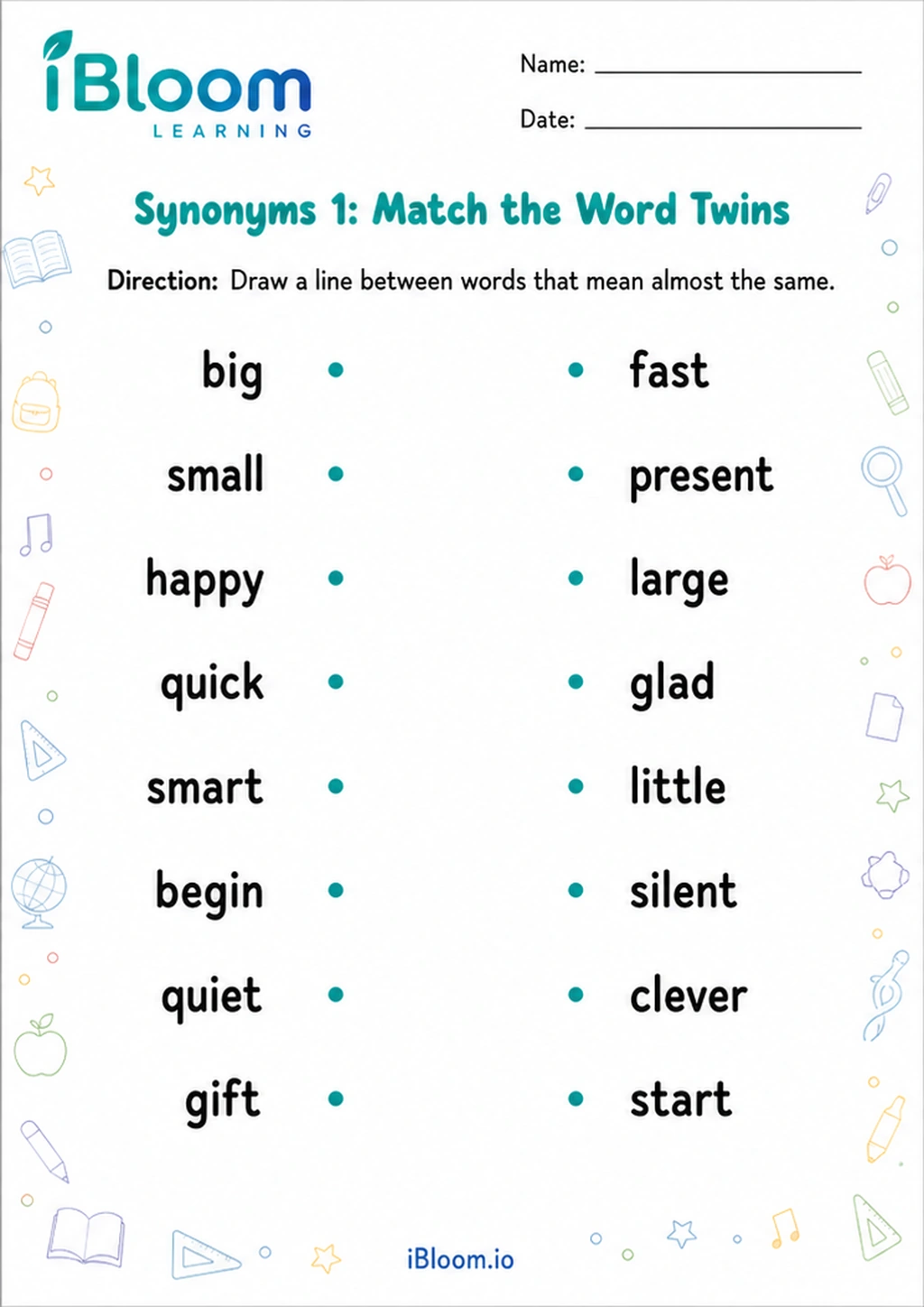 Synonyms 1: Match the Word TwinsClass 1 printable practice for Synonyms.Class 1Free PDF preview
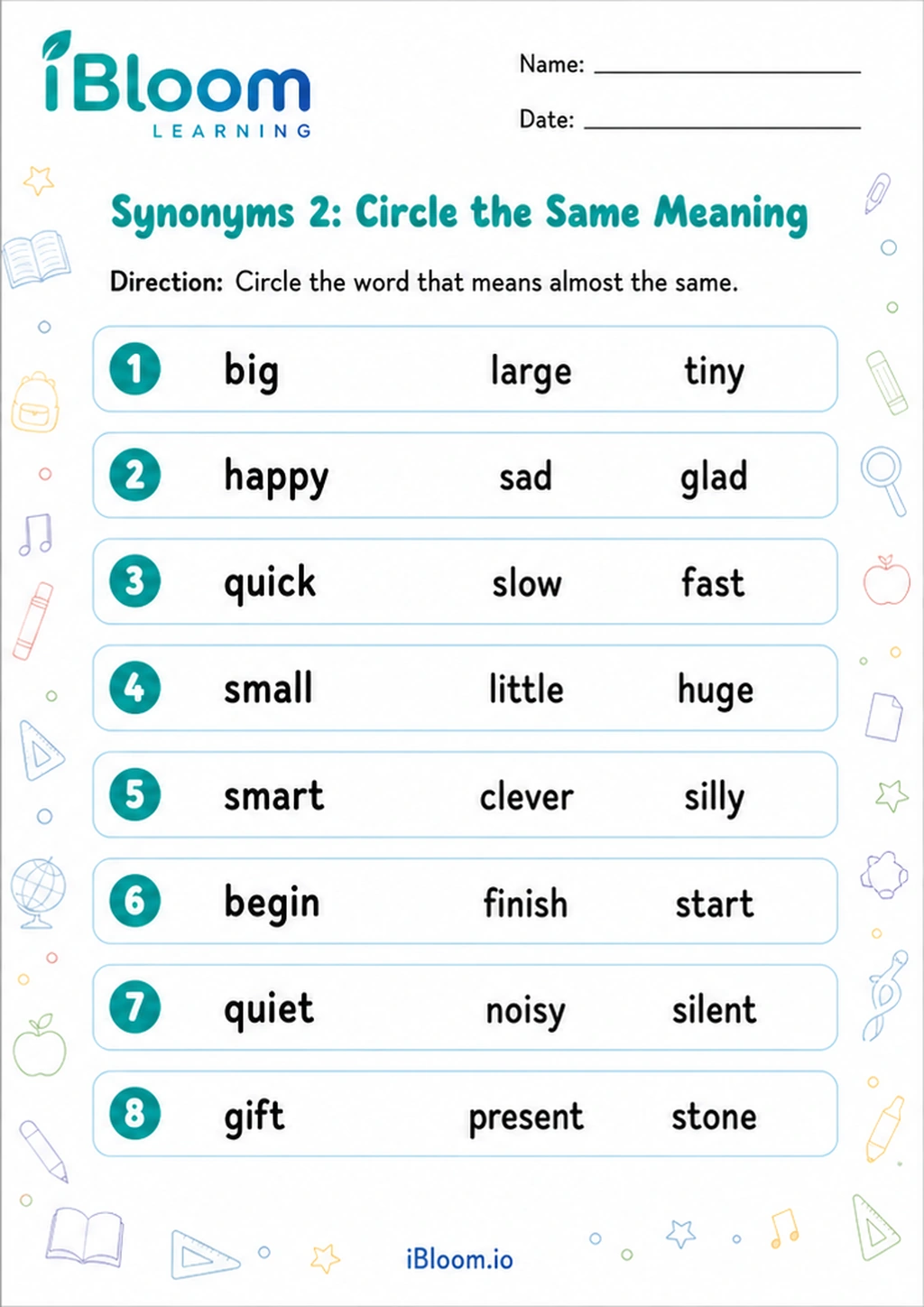 Synonyms 2: Circle the Same MeaningClass 1 printable practice for Synonyms.Class 1Free PDF preview
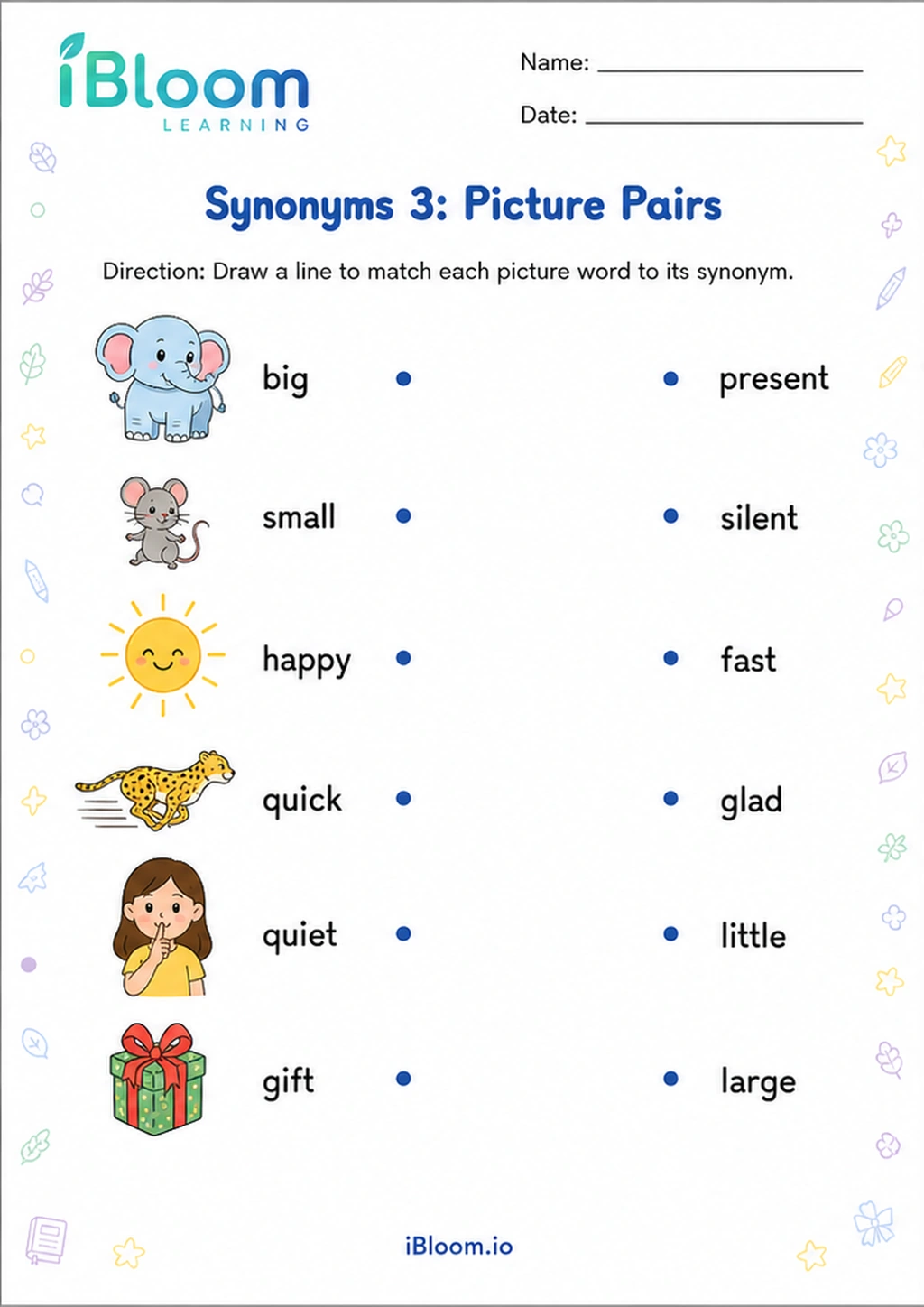 Synonyms 3: Picture PairsClass 1 printable practice for Synonyms.Class 1Free PDF preview
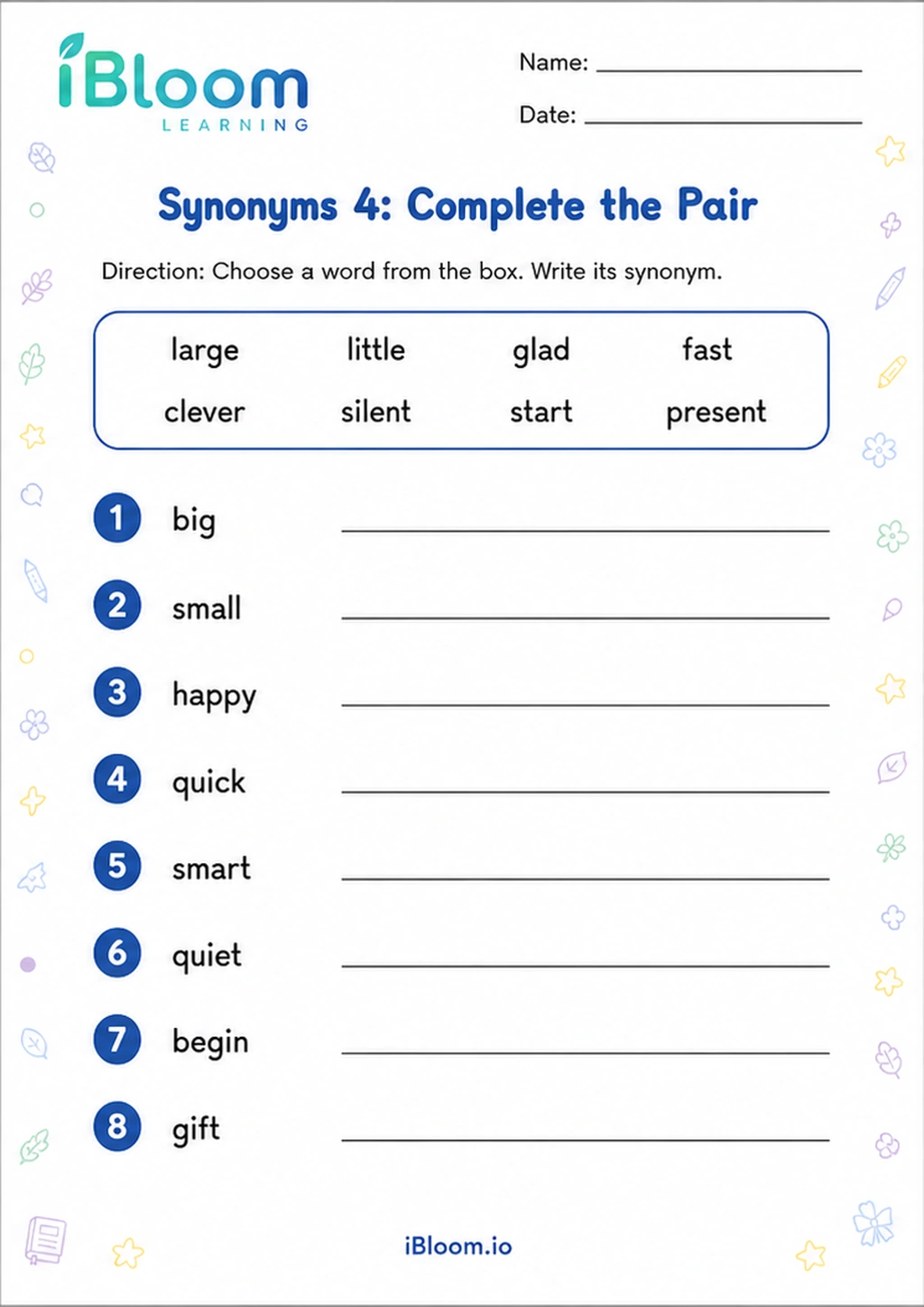 Synonyms 4: Complete the PairClass 1 printable practice for Synonyms.Class 1Free PDF preview
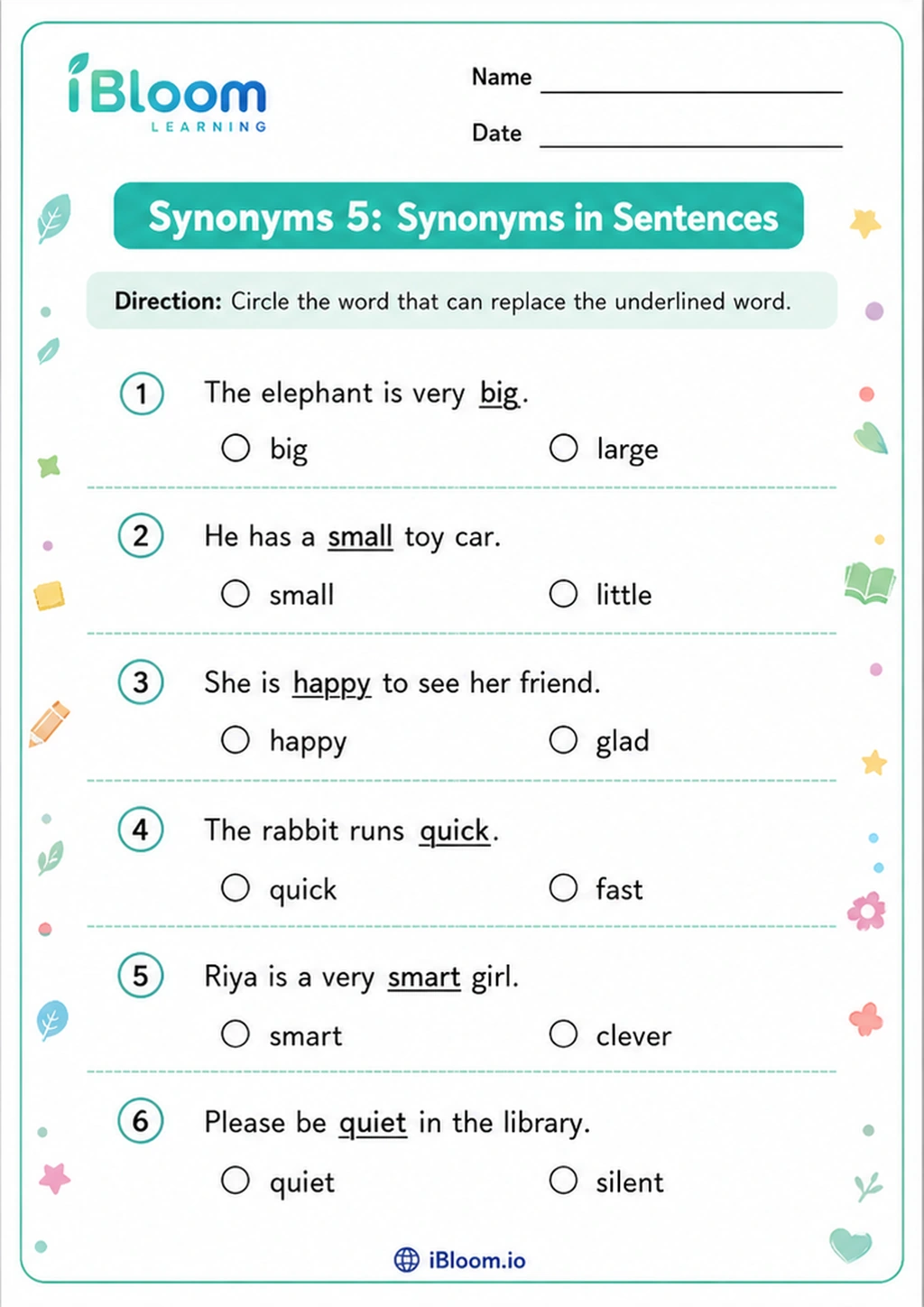 Synonyms 5: Synonyms in SentencesClass 1 printable practice for Synonyms.Class 1Free PDF preview
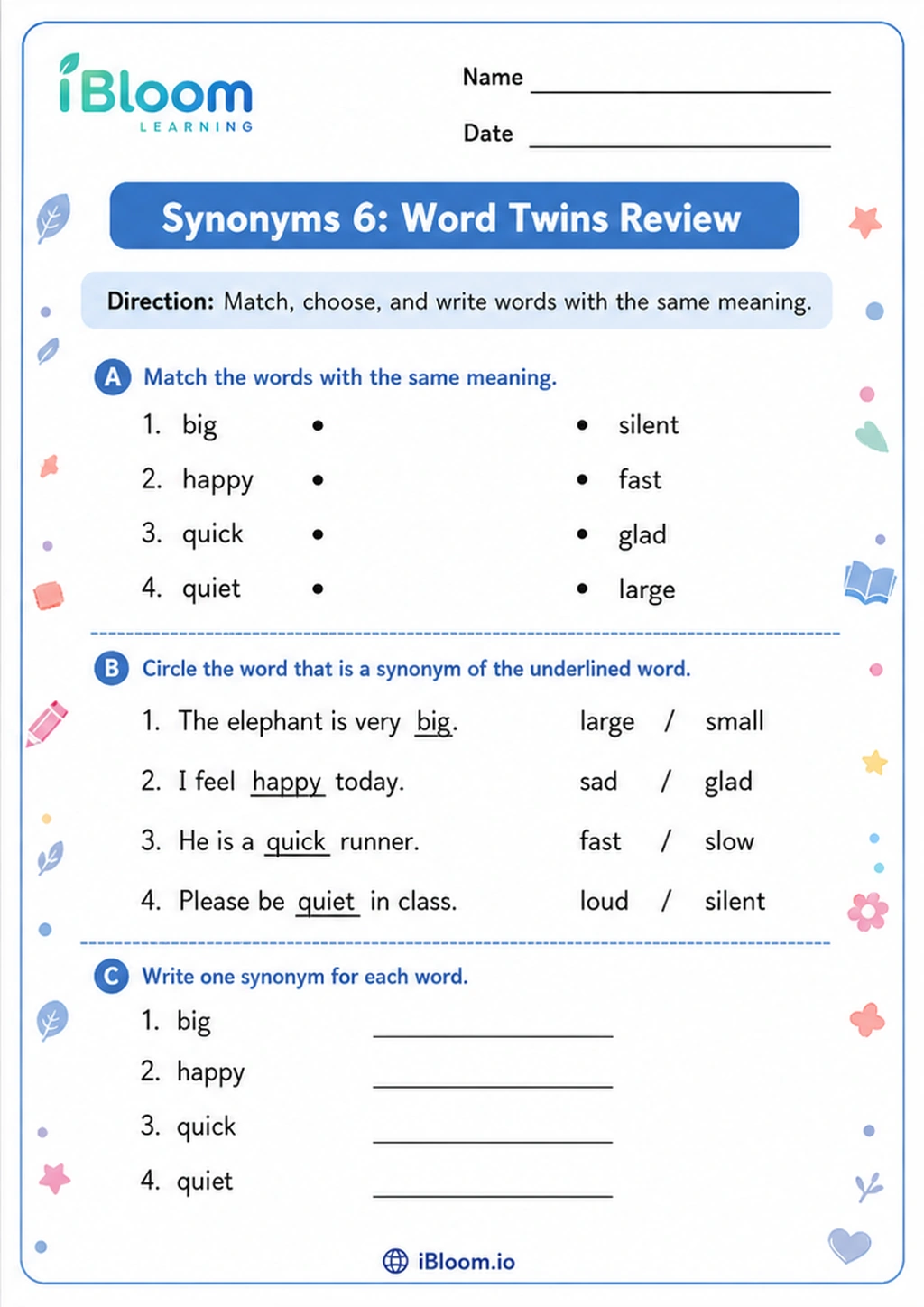 Synonyms 6: Word Twins ReviewClass 1 printable practice for Synonyms.Class 1Free PDF preview
Practice that builds confidence
Understanding synonyms
Class 1 children use these synonyms worksheets to understand that two different words can have a similar meaning, such as small/little, big/large, happy/glad, and fast/quick. The practice supports everyday vocabulary, reading comprehension, and clearer sentence writing.
The printable activities include matching word pairs, circling the word with the same meaning, choosing a synonym for an underlined word, and completing short sentences. Each page uses familiar, age-appropriate words so children can focus on meaning rather than memorising difficult lists.
Synonyms are words that are close in meaning. For Class 1 learners, the aim is not to learn complicated vocabulary, but to notice word relationships: a child may say a bag is big, then learn that large can describe the same idea. This helps children read with confidence when a known idea appears in a new word.

How the practice progresses
The worksheets move from recognition to use. Children first match simple pairs, then choose the word that means almost the same as a given word. Later tasks ask them to read a short sentence and replace a word with a suitable synonym. This gentle progression connects vocabulary work with sentence meaning.
A simple parent routine
At home, choose four words from one worksheet and say them aloud. Ask your child to act them out, draw them, or use them in a sentence: “The rabbit is quick.” Then ask, “Can we say fast instead?” Keep a small “word twins” list on paper and add pairs as your child meets them in stories, signs, or conversations.

Classroom uses
Teachers can use these printables during vocabulary lessons, reading groups, morning work, or language centres. A worksheet can become a pair activity where one child reads a word and the other finds its synonym. For a quick board activity, write three options for a word like happy and let children explain why glad fits better than sad or tall.

Common errors to watch for
Some children think synonyms must be exactly the same in every sentence. Explain that they are usually similar, not always identical. For example, little and small often match, but a “little brother” is not always the same as a “small brother.” Watch for opposite-word confusion too, especially with pairs like hot/cold or happy/sad.
Free printable PDF download
Use this class 1 synonyms worksheet page to preview the activity, print it, or download it as a PDF for quick practice. It works well for homework, homeschool lessons, tutoring, morning work, revision, and classroom centers.
Answers and answer key support
After the child completes the worksheet independently, parents and teachers can use the answer support or answer key information to check the work, review mistakes, and choose the next practice step.
Why iBloom worksheets help
The pages keep the focus on one vocabulary skill at a time, with clear instructions and child-friendly word choices. Repeated formats reduce confusion, while varied tasks encourage children to listen, compare, choose, and use words. A helpful strategy for children is: read the word, think of its meaning, try the new word in the same sentence, and ask, “Does it still make sense?”
Helpful answers
Frequently asked questions
What are synonyms for Class 1 children?
Synonyms are words that have a similar meaning. For Class 1, examples include big and large, small and little, happy and glad, or fast and quick.
How do these worksheets teach synonyms?
They begin with simple matching and circling tasks, then move to choosing a synonym for a word in a sentence. This helps children connect word meaning with reading and writing.
Should my child memorise all synonym pairs?
No. At this level, the goal is to understand that some words can mean nearly the same thing. Regular use in speech, stories, and simple sentences is more helpful than rote memorisation.
What if my child chooses an opposite instead of a synonym?
Use the sentence to test the choice. Ask, “Does the sentence still mean almost the same thing?” This helps children notice the difference between similar meanings and opposite meanings.
Can these synonyms worksheets be used in class?
Yes. Teachers can use them for vocabulary lessons, reading groups, pair work, revision, or language centres where children practise identifying and using similar meaning words.
Is this class 1 synonyms worksheet free?
Yes. You can preview it for free and use the printable worksheet for home or classroom practice.
Can I download this class 1 synonyms worksheet as a PDF?
Yes. Use the worksheet download option to save a printable PDF, or print the worksheet directly from the page.
Does this class 1 synonyms worksheet include answers or an answer key?
When the activity has fixed answers, iBloom includes answer support so parents and teachers can check the completed worksheet.