Solving Puzzles Using Addition (Numbers 1 To 10) worksheet for Class 1

Lesson-Wise Builder
A premium AI tool that creates syllabus-aligned questions and worksheets for any lesson in seconds.
Addition part-part-whole puzzles to 10 ask a Class 1 learner to combine two known parts and choose the missing whole. In the activity, the child studies the numbers on the lower puzzle pieces, adds them, and places the matching total in the upper piece. The useful habit is simple: name both parts, find their sum, compare the answer choices, and explain why the chosen number is the whole.
What the Addition Puzzle Asks the Learner to Do
The visible puzzle uses a part-part-whole model. Two lower pieces show the known parts and the upper piece shows a question mark. The child is not looking for another part; the child is looking for the total made by joining both parts. The first item shows 6 and 1. Its choices include 8, 6, 7 and 9. The correct whole is 7 because 6 + 1 = 7. A second item shows 7 and 2, so its missing whole is 9.
This is addition reasoning within 10, not a speed test. The learner must connect a visual model, an addition sentence and an answer choice. Saying “six is one part, one is the other part, and seven is the whole” checks more understanding than choosing a piece without an explanation.
Understand Parts and the Whole
In a part-part-whole model, the parts are the smaller quantities that are joined. The whole is the total quantity after the parts are combined. A number bond shows the same relationship without puzzle shapes. For example, 6 and 1 are parts of 7, while 7 is the whole. The matching addition sentence is 6 + 1 = 7.
The words addend and sum describe the equation: the addends are 6 and 1, and the sum is 7. The plus sign tells the learner to join the parts. The equals sign tells the learner that the value on one side is the same as the value on the other side. These words support Class 1 maths, but the child can first use the simpler language of parts and whole.
A Step-by-Step Method for a Missing Whole
- Read the model. Point to each lower puzzle piece and say both known parts.
- Join the parts. Count all objects or start with the larger part and count on the smaller part.
- Write or say the fact. Turn the model into a sentence such as 6 + 1 = 7.
- Compare the choices. Reject a choice that is one of the parts or does not equal the sum.
- Check once. Recount, use counters, draw dots, use a ten frame or make jumps on a number line.
A learner who is still building number sense can touch one counter for each count. A learner who knows addition facts to 10 can solve mentally and then explain the relationship. Accuracy matters before speed.
Worked Examples That Match the Activity
Parts 6 and 1
Start at 6 and count on one number: 7. Therefore 6 + 1 = 7. The choice 6 is only one part, while 8 and 9 are too large. The upper puzzle piece should contain 7.
Parts 7 and 2
Start at 7 and count on twice: 8, 9. Therefore 7 + 2 = 9. A learner can check by drawing seven dots in one group and two dots in another group, then counting all nine dots.
A New Puzzle With Parts 5 and 3
Join 5 and 3 to make 8. The equation is 5 + 3 = 8. If the choices are 5, 7, 8 and 9, choose 8 and explain that 5 is a part, 7 is one too small, and 9 is one too large.
Make a Whole of 10
Choose two parts such as 4 and 6. Put 4 and 6 in the lower pieces and 10 in the whole. Other pairs that make 10 include 1 and 9, 2 and 8, 3 and 7, and 5 and 5.
How to Compare and Check Answer Choices
Answer choices are useful only when the learner still does the mathematics. First find the expected sum. Then compare each option with that sum. A number smaller than either positive part cannot be the whole in these puzzles. A choice equal to one part usually shows that the child forgot to combine both parts. A choice one more or one less than the sum often shows a counting error.
Ask the learner to prove the answer in a second way. The child might use counters first and a number line second, or count on first and draw a number bond second. Comparing strategies builds mathematical reasoning and helps the learner notice an inaccurate recount.
Parent and Teacher Guidance
Short Practice at Home
Use buttons, bottle caps or small blocks to make two groups. Ask the child to say the two parts before pushing the groups together. After finding the whole, write three or four answer choices and ask why each distractor is wrong. Five calm minutes with a clear explanation is more useful than giving the answer quickly.
Classroom and Small-Group Use
Use one puzzle as a Class 1 warm-up, maths-centre prompt or small-group check. Invite partners to compare methods: one child may count all, another may count on, and another may recall the fact. Record whether a learner identifies the whole, counts each part once and uses the equals sign correctly.
Support Without Giving the Answer
If a child guesses, cover the choices temporarily and ask, “What are the two parts?” If counting is inaccurate, provide one counter for each quantity and move counted objects into a new row. If the picture feels abstract, draw two boxes for the parts and one larger box for the whole.
Common Mistakes and Useful Corrections
- Choosing a part as the answer: repeat that both lower pieces must be joined.
- Counting the first part twice: start at the larger number and count only the smaller number of steps.
- Skipping a number: move one counter or one number-line jump for every spoken count.
- Guessing from the choices: solve before looking at the options.
- Confusing a missing whole with a missing part: point to the question mark and name its position in the model.
- Ignoring the equals sign: read the full equation aloud and check that both sides have the same value.
Practice Ideas and Related Concepts
Repeat the puzzle with new parts while keeping totals within 10. Let the learner build a model, write the equation and create plausible distractors for an adult. Number cards can turn the task into an oral reasoning routine: show two part cards and ask for the whole, then ask how the child knows.
Once finding the whole is secure, introduce a missing part. If the whole is 9 and one part is 7, the unknown part is 2. This connects addition to subtraction and fact families without changing the meaning of the model. The child learns that addition can make the whole and subtraction can find a missing part.
Continue with related iBloom practice
- practise Class 1 addition facts to 10: Reinforces the addition facts used in the part-part-whole puzzles.
- explore the addition and subtraction relationship to 10: Extends the same part-whole relationship to inverse operations.
Frequently Asked Questions
What is a part-part-whole puzzle?
It is a visual model that shows two parts and their total. When the whole is missing, add the two known parts.
How can a child find the missing whole?
Count all items or start with the larger part and count on the smaller part. Then compare the sum with the answer choices.
Why should the learner explain a wrong choice?
Explaining a distractor reveals whether the child understands parts, whole and addition instead of relying on a guess.
When should counters or a number line be used?
Use a concrete or visual model whenever the learner loses track, counts a part twice or cannot explain how the total was found.
What concept can follow this activity?
Move to puzzles with a missing part, related addition and subtraction facts, and simple fact families within 10.
More practice for this grade
More Math worksheets
.webp)
Free Add First, Then Subtract (Numbers 1 to 10) Worksheets for Class 1
Looking for class 1 math help? Download free, interactive add first, then subtract (numbers 1 to 10) worksheets. AI-personalized and Common Core-aligned. Practice math with iBloom.
.webp)
Use Addition to Solve Subtraction to 20 | Class 1
Help Class 1 learners solve subtraction within 20 by finding the missing addend first, then checking each difference with the related addition fact.
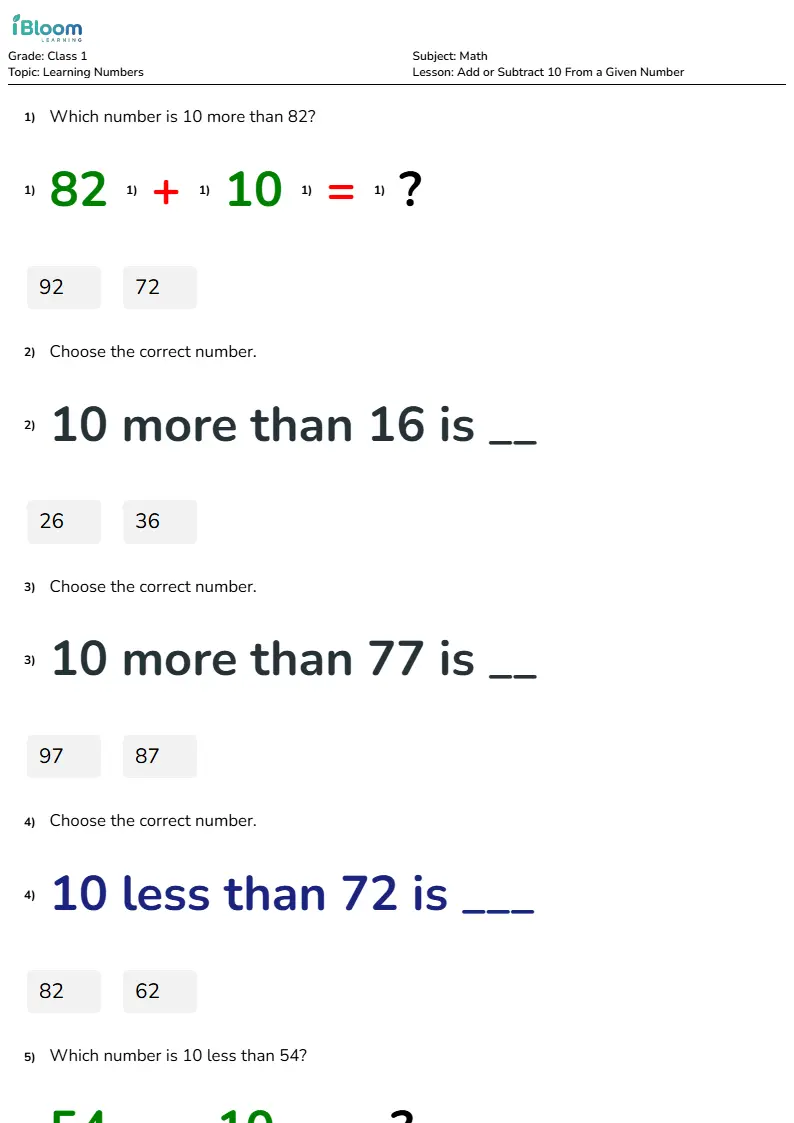
Free Add or Subtract 10 From a Given Number Worksheets for Class 1
Looking for class 1 math help? Download free, interactive add or subtract 10 from a given number worksheets. AI-personalized and Common Core-aligned. Practice math with iBloom.
.webp)
Free Adding in Any Order (Numbers 1 to 10) Worksheets for Class 1
Looking for class 1 math help? Download free, interactive adding in any order (numbers 1 to 10) worksheets. AI-personalized and Common Core-aligned. Practice math with iBloom.
.webp)
Free Adding in Any Order (Numbers 1 to 20) Worksheets for Class 1
Looking for class 1 math help? Download free, interactive adding in any order (numbers 1 to 20) worksheets. AI-personalized and Common Core-aligned. Practice math with iBloom.
.webp)
Free Addition Facts (1 to 10) Worksheets for Class 1
Looking for class 1 math help? Download free, interactive addition facts (1 to 10) worksheets. AI-personalized and Common Core-aligned. Practice math with iBloom.
.webp)
Free Addition Facts (1 to 15) Worksheets for Class 1
Looking for class 1 math help? Download free, interactive addition facts (1 to 15) worksheets. AI-personalized and Common Core-aligned. Practice math with iBloom.
.webp)
Free Addition Facts (1 to 20) Worksheets for Class 1
Looking for class 1 math help? Download free, interactive addition facts (1 to 20) worksheets. AI-personalized and Common Core-aligned. Practice math with iBloom.
.webp)
Free Addition Facts (1 to 5) Worksheets for Class 1
Looking for class 1 math help? Download free, interactive addition facts (1 to 5) worksheets. AI-personalized and Common Core-aligned. Practice math with iBloom.
.webp)
Free Addition on Number Line (Numbers 1 to 10) Worksheets for Class 1
Looking for class 1 math help? Download free, interactive addition on number line (numbers 1 to 10) worksheets. AI-personalized and Common Core-aligned. Practice math with iBloom.
.webp)
Free Addition on Number Line (Numbers 1 to 20) Worksheets for Class 1
Looking for class 1 math help? Download free, interactive addition on number line (numbers 1 to 20) worksheets. AI-personalized and Common Core-aligned. Practice math with iBloom.
.webp)
Ten-Frame Addition Worksheet for Class 1
Help Class 1 children model addition within 10 on ten frames, compare coloured groups, count the total, and write matching addition sentences.
.webp)
Free Addition Using Ten Frames (Numbers 1 to 20) Worksheets for Class 1
Looking for class 1 math help? Download free, interactive addition using ten frames (numbers 1 to 20) worksheets. AI-personalized and Common Core-aligned. Practice math with iBloom.
.webp)
Free Addition with Three Numbers (1 to 10) Worksheets for Class 1
Looking for class 1 math help? Download free, interactive addition with three numbers (1 to 10) worksheets. AI-personalized and Common Core-aligned. Practice math with iBloom.
.webp)
Free Addition with Three Numbers (1 to 20) Worksheets for Class 1
Looking for class 1 math help? Download free, interactive addition with three numbers (1 to 20) worksheets. AI-personalized and Common Core-aligned. Practice math with iBloom.
.webp)
Free Addition Word Problems Using Frames (Numbers 1 to 10) Worksheets for Class 1
Looking for class 1 math help? Download free, interactive addition word problems using frames (numbers 1 to 10) worksheets. AI-personalized and Common Core-aligned. Practice math with iBloom.
.webp)
Addition Frames Word Problems | Class 1
Help Class 1 children read addition stories, identify the start, added amount and total, model numbers to 20 with frames, and write number sentences.
.webp)
Number Line Addition Word Problems Class 1
Teach Class 1 children to solve addition stories within 10 by finding the start, making forward hops on a number line and writing the number sentence.
.webp)
Free Addition Word Problems Using Number Line (Numbers 1 to 20) Worksheets for Class 1
Looking for class 1 math help? Download free, interactive addition word problems using number line (numbers 1 to 20) worksheets. AI-personalized and Common Core-aligned. Practice math with iBloom.
.webp)
Free Addition Word Problems Using Objects (Numbers 1 to 10) Worksheets for Class 1
Looking for class 1 math help? Download free, interactive addition word problems using objects (numbers 1 to 10) worksheets. AI-personalized and Common Core-aligned. Practice math with iBloom.
.webp)
Free Addition Word Problems Using Objects (Numbers 1 to 20) Worksheets for Class 1
Looking for class 1 math help? Download free, interactive addition word problems using objects (numbers 1 to 20) worksheets. AI-personalized and Common Core-aligned. Practice math with iBloom.
.webp)
Free Addition Word Problems with Three Numbers (Numbers 1 to 10) Worksheets for Class 1
Looking for class 1 math help? Download free, interactive addition word problems with three numbers (numbers 1 to 10) worksheets. AI-personalized and Common Core-aligned. Practice math with iBloom.
.webp)
Free Addition Word Problems with Three Numbers (Numbers 1 to 20) Worksheets for Class 1
Looking for class 1 math help? Download free, interactive addition word problems with three numbers (numbers 1 to 20) worksheets. AI-personalized and Common Core-aligned. Practice math with iBloom.
.webp)
Free Addition Word Problems with Three Numbers Using Frames (1 to 10) Worksheets for Class 1
Looking for class 1 math help? Download free, interactive addition word problems with three numbers using frames (1 to 10) worksheets. AI-personalized and Common Core-aligned. Practice math with iBloom.