Introduction To Shapes: Circle worksheet for LKG

Lesson-Wise Builder
A premium AI tool that creates syllabus-aligned questions and worksheets for any lesson in seconds.
This circle shape worksheet for LKG introduces one clear task: look at paired pictures and choose the circle. The captured activity includes a circle beside non-circle choices such as a heart and a plus shape. Children learn to inspect the outline, select carefully, and explain one clue instead of relying on colour or position.
How the picture-choice activity works
Each visible question asks, “Which shape is a circle?” A learner compares two pictures, points to the circle, and can then explain why the other picture does not fit. The useful routine is the same even when colours or positions change:
- Look at both pictures before touching an answer.
- Follow each outline with the eyes or a finger.
- Notice any point, corner, or straight segment.
- Choose the closed shape whose boundary curves all the way around.
- Say one reason: “This is a circle because it has no corners.”
This is a recognition activity. The verified image does not establish colouring, printing, a separate solutions page, or measurement work.
The clues that identify a circle
A circle is a flat, closed shape with a continuous curved boundary. It has no corners and no straight boundary segments. Young learners may say it is “round”; adults can extend that answer by asking what the edge does. A stronger explanation is, “The edge curves all the way around and comes back to where it started.”
Colour, size, and position are not defining clues. A green circle and a yellow circle are still circles. A small circle and a large circle have the same kind of boundary.
Circle and heart: compare the outlines
Both pictures can include curved parts, so “it has curves” is not enough. A familiar heart outline has an inward dip at the top and a point at the bottom. A circle has neither feature; its boundary continues smoothly around without a pointed end. Trace both pictures and pause at the heart's dip and point.
Ask the child to finish two sentences: “The circle has…” and “The heart has…”. The comparison turns a visual choice into useful shape language.
Circle and plus: find curves and corners
A plus-shaped picture is built from straight segments and has several corners. A circle has a curved boundary and no corners. If a child is uncertain, let them trace the plus outline slowly and stop at each change of direction. Then trace the circle without stopping. The different movement makes the contrast easier to feel and describe.
The plus is a distractor based on shape. This page is not teaching addition; it only asks whether the outline is a circle.
Compare a circle with other flat shapes
The same boundary check works with a square, triangle, rectangle, star, or oval. Squares, triangles, rectangles, and stars show corners or straight edges. An oval is also curved and closed, but it is stretched rather than equally round. At LKG level, use clear examples and introduce only one difficult comparison at a time.
- Circle versus square: curved boundary compared with four straight sides.
- Circle versus triangle: no corners compared with three corners.
- Circle versus rectangle: curved outline compared with four straight sides.
- Circle versus star: smooth curve compared with points.
Teach children to check shape, not appearance
Change one unimportant feature at a time. Show circles in different colours, then in different sizes, then as outlines and filled shapes. Ask what stayed the same. Next, turn or move a shape card. A circle remains a circle because its boundary has not changed.
Encourage a left-to-right scan of all options. If a child always selects the brighter or larger picture, use two choices with the same colour and similar size. This makes the boundary the most useful clue.
Find circular faces in everyday objects
Connect the flat shape with a plate face, clock face, button, circular lid, coin face, or wheel face. Name the circular part rather than calling every object a circle. A ball is a three-dimensional sphere, although its outline in a flat picture may appear circular.
During a short circle hunt, ask the child to point, name the object, and say which surface or outline looks like a circle. This keeps real-world examples mathematically accurate.
Use touch and movement to reinforce the curve
- Trace a circle picture with one slow finger movement.
- Make a closed circle with string or modelling dough.
- Air-draw a circle and then air-draw a plus to feel the difference.
- Place a circle card over a matching outline.
- Draw around a circular lid and describe the new boundary.
- Let the child create a two-picture question for an adult.
These are optional extensions after the exact selection task. Keep them short and return to the picture choices to check whether the child can transfer the clue.
Parent guidance for five-minute practice
Begin with the worksheet and ask the child to trace before choosing. If the answer is uncertain, use the prompt, “Does it have a corner or a straight part?” Avoid naming the circle immediately. Two picture cards are enough for a useful round of practice.
Try one circle-and-heart comparison, one circle-and-plus comparison, and one household object. Praise the reason, not just the tap: “You noticed the point on the heart.” Stop after one independent choice and explanation. In multilingual homes, discuss the clue in a familiar language first, then repeat circle, curve, and corner in English.
Teacher and tutor guidance
Use paired cards as a warm-up or small-group check. First ask the learner to point to the circle without speaking. Then ask for the name, and finally ask for a reason. These three steps separate visual recognition, vocabulary recall, and explanation.
Display circles in varied colours and sizes so children do not memorise one example. For related practice, use the verified Introduction to Circle lesson for LKG or broaden the set with the Identifying Shapes worksheet for LKG.
Common mistakes and calm corrections
- Choosing by colour: show a circle and non-circle in the same colour.
- Choosing the largest picture: use similarly sized choices.
- Calling a heart a circle: trace the heart's dip and pointed bottom.
- Calling a plus a circle: stop at each straight edge and corner.
- Confusing circle and oval: compare clear examples side by side.
- Calling a ball a circle: distinguish the solid ball from its flat circular outline.
- Answering too quickly: require a scan of both picture boundaries.
Build simple shape sentences
Useful sentence frames include “This is a circle because…”, “This is not a circle because…”, and “I noticed…”. Accept a short reason such as “no corners” before asking for a longer sentence. Model the precise word circle instead of using only round, because many objects can look rounded without being flat circles.
When discussing the captured distractors, a child can say, “The heart has a point,” or “The plus has straight parts.” This is enough reasoning for an introductory LKG activity.
India-focused LKG use and next steps
Indian LKG learners may meet circle recognition during classroom shape work, home revision, or tuition practice. This draft does not claim alignment with a particular board. It focuses on the exact visual-selection skill and common early-maths vocabulary.
After the child recognises a circle reliably, introduce one neighbouring shape at a time. Continue with the verified Square Shape worksheet and Triangle Shape worksheet. Later, mix the shapes for sorting and simple pattern work.
Continue with verified iBloom shape practice
- Circle Shape worksheet for LKG
- Introduction to Circle lesson for LKG
- Square Shape worksheet for LKG
- Triangle Shape worksheet for LKG
- Identifying Shapes worksheet for LKG
Frequently Asked Questions
What makes a shape a circle?
A circle is a closed flat shape with a continuous curved boundary. It has no corners or straight boundary segments.
Is a heart a circle?
No. A typical heart outline has an inward dip and a pointed bottom, so its boundary is different from a circle.
Is a plus a circle?
No. A plus shape has straight segments and corners. It is used as a non-circle picture choice in the captured activity.
Is a ball a circle?
A ball is a three-dimensional sphere. Its flat picture or one face may look circular, so adults should name the part being compared.
How long should LKG circle practice last?
Five attentive minutes can be enough. One accurate choice with a clear reason is more useful than many rushed guesses.
Why use picture choices?
Paired pictures let a child compare boundaries and reject a non-circle for a visible reason. They also show whether the learner recognises the shape when colour or distractor changes.
More practice for this grade
More Math worksheets
.webp)
Free Comparing Numbers (1-10) Worksheets for Lkg
Looking for lkg math help? Download free, interactive comparing numbers (1-10) worksheets. AI-personalized and Common Core-aligned. Practice math with iBloom.
.webp)
Comparing Objects 1-10 Worksheet for LKG
Help LKG children compare picture groups from 1 to 10 using more, fewer, less and equal, with clear counting tips for parents and teachers in India.
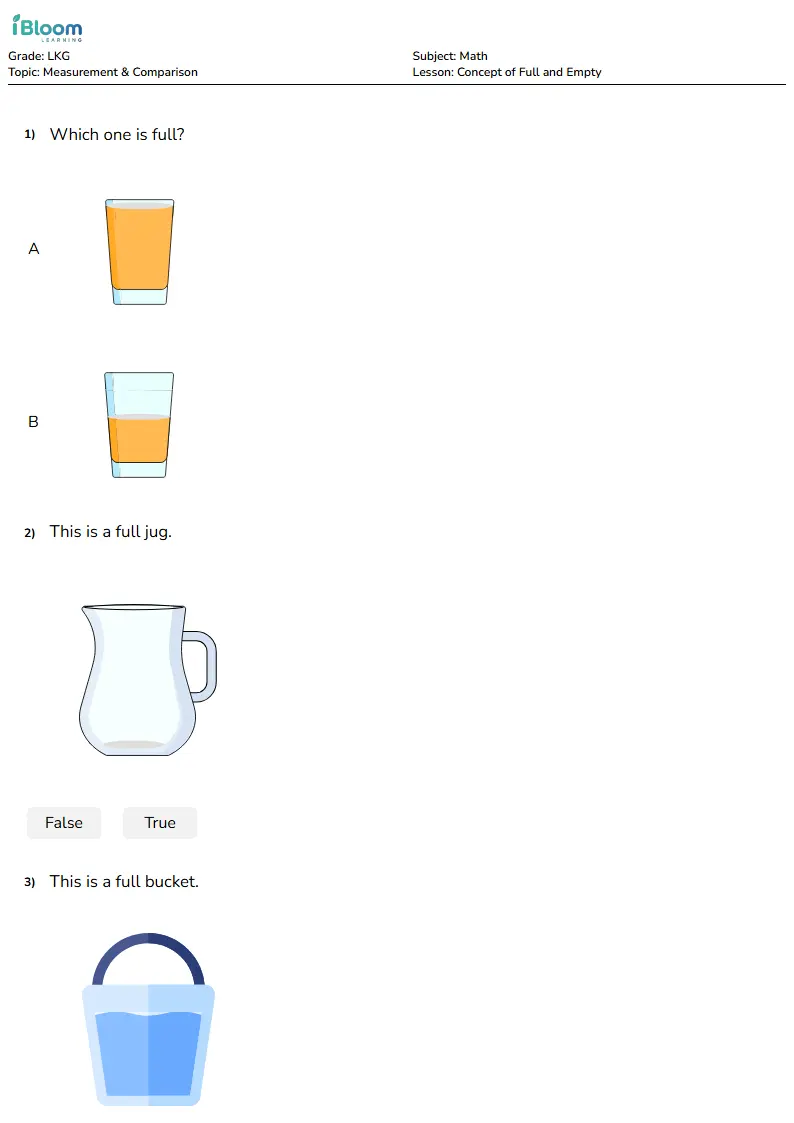
Full and Empty Worksheets for LKG
Full and empty worksheets for LKG and kindergarten with black-and-white practice, real-object examples, and answer guidance.
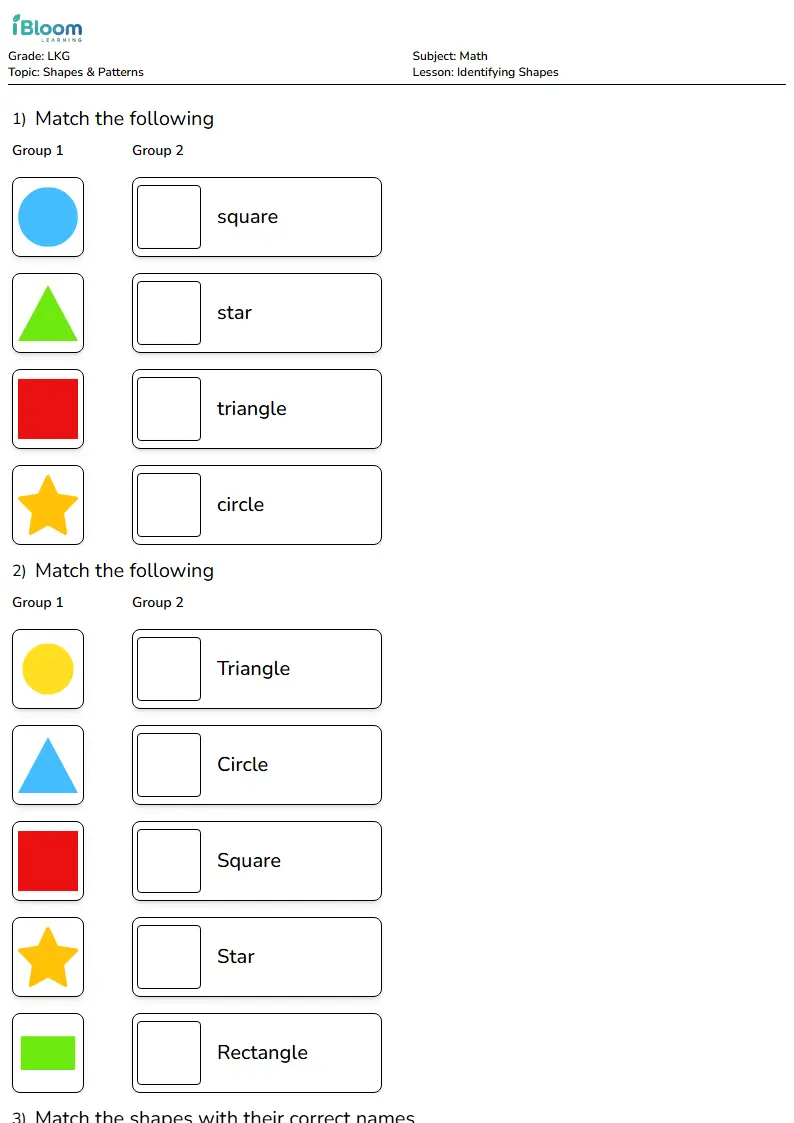
Free Identifying Shapes Worksheets for Lkg
Looking for lkg math help? Download free, interactive identifying shapes worksheets. AI-personalized and Common Core-aligned. Practice math with iBloom.
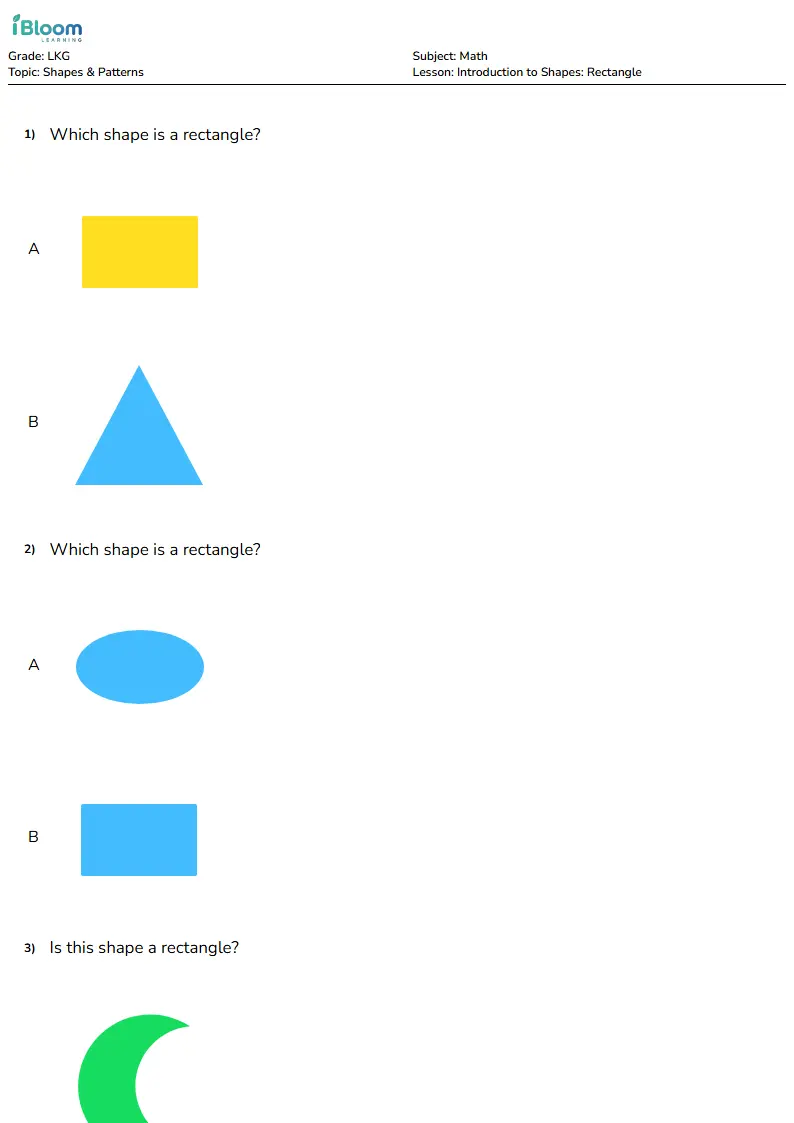
Free Introduction to Shapes: Rectangle Worksheets for Lkg
Looking for lkg math help? Download free, interactive introduction to shapes: rectangle worksheets. AI-personalized and Common Core-aligned. Practice math with iBloom.
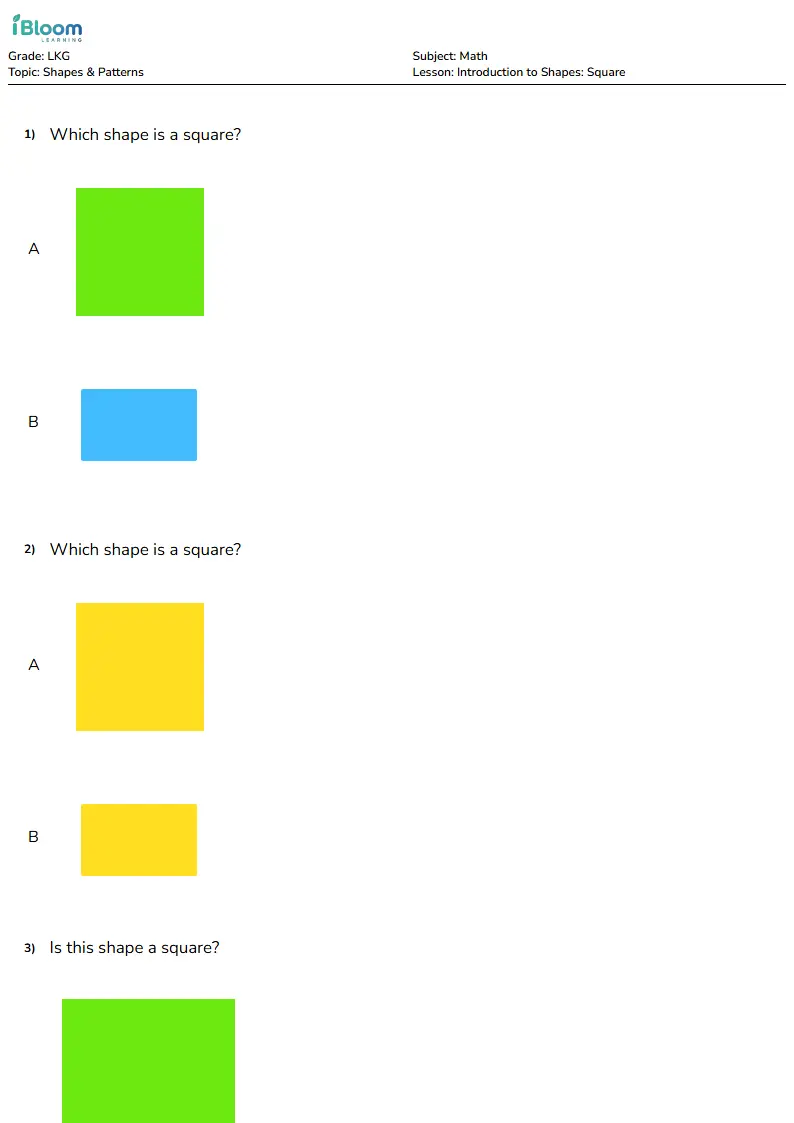
Square Shape Recognition Practice for LKG
Help LKG children recognise a square by its four equal sides and four corners, compare shapes, and find square objects through guided practice.
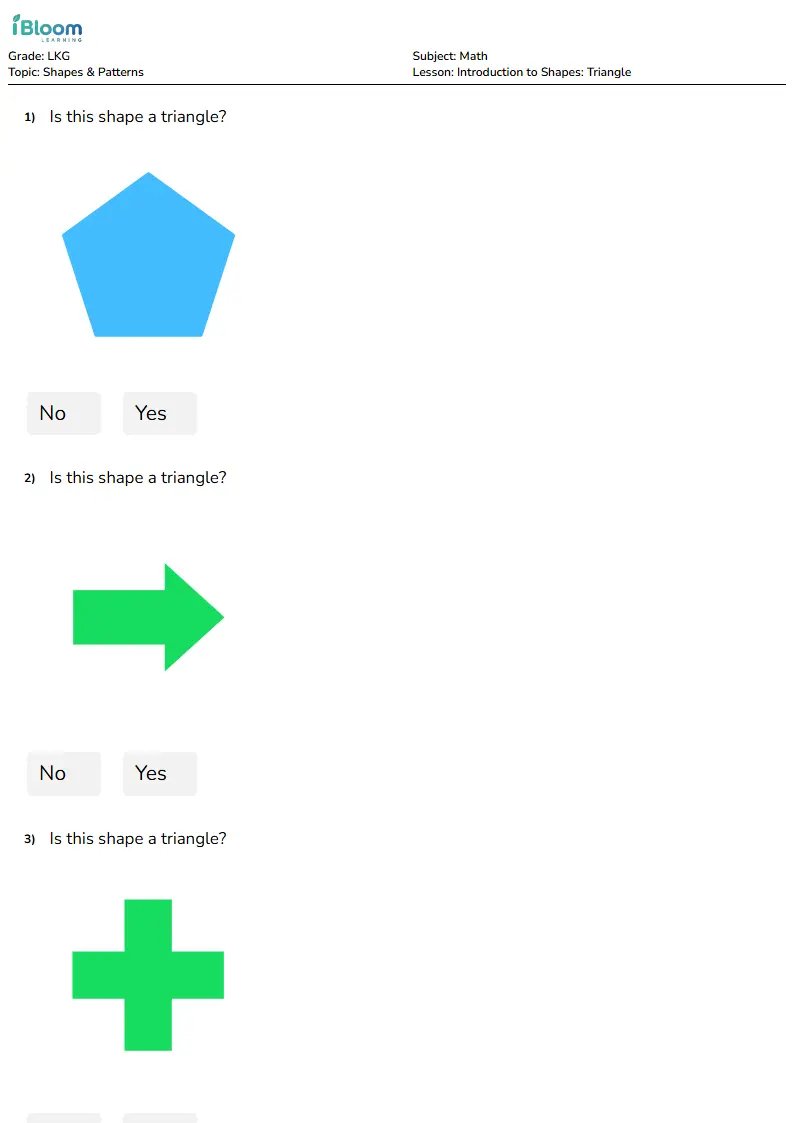
Free Introduction to Shapes: Triangle Worksheets for Lkg
Looking for lkg math help? Download free, interactive introduction to shapes: triangle worksheets. AI-personalized and Common Core-aligned. Practice math with iBloom.
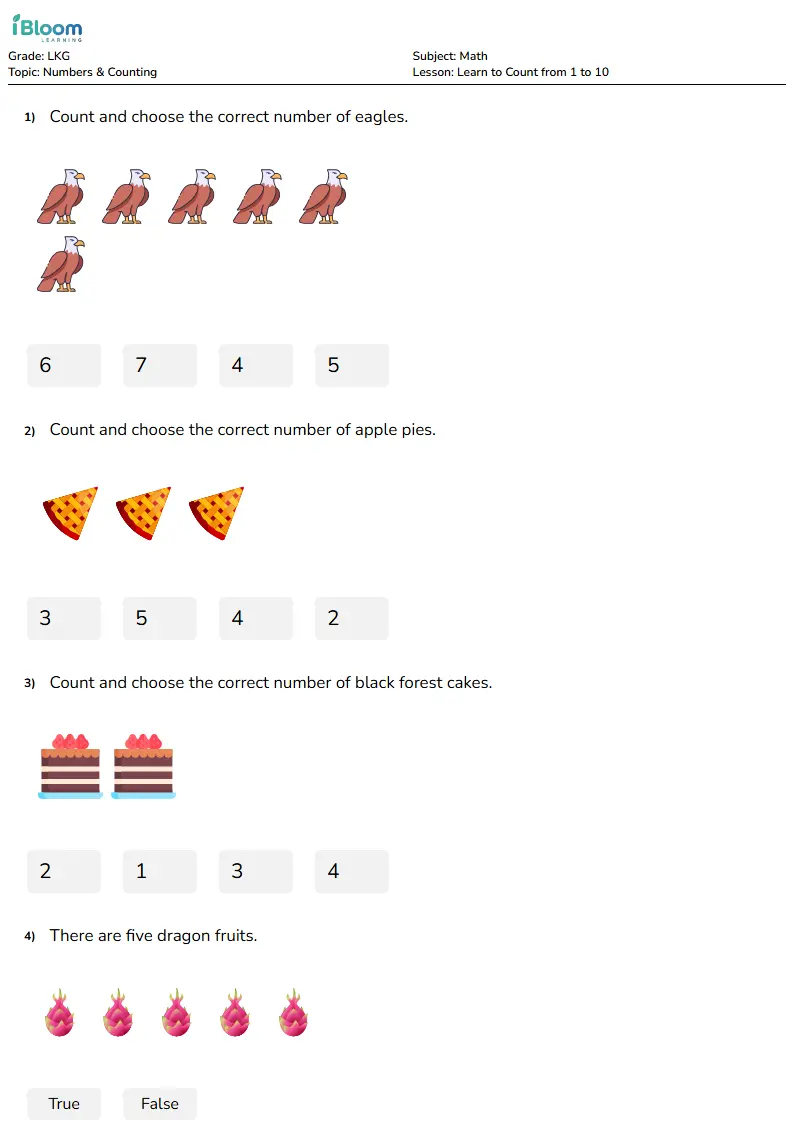
Free Learn to Count from 1 to 10 Worksheets for Lkg
Looking for lkg math help? Download free, interactive learn to count from 1 to 10 worksheets. AI-personalized and Common Core-aligned. Practice math with iBloom.

Count from 1 to 20 Worksheet for LKG
Help LKG children count from 1 to 20, match numbers to quantities, fill sequence gaps, and practise teen numbers with clear parent and teacher guidance.
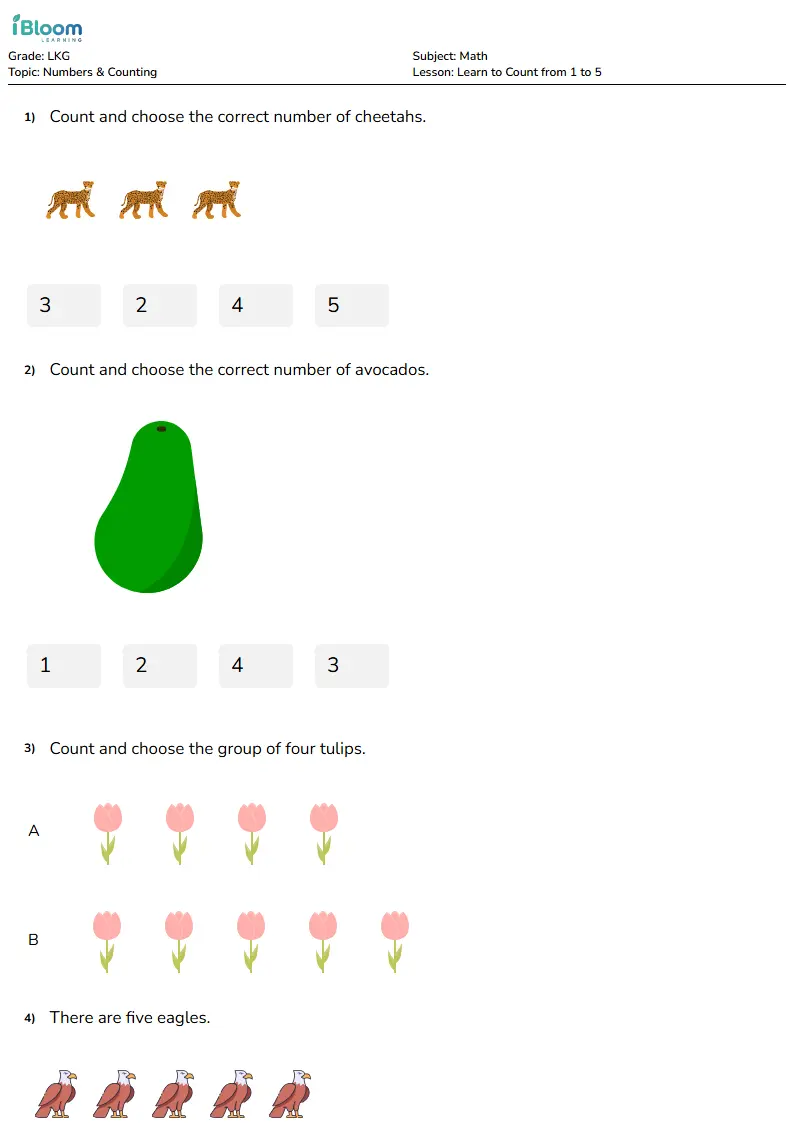
Free Learn to Count from 1 to 5 Worksheets for Lkg
Looking for lkg math help? Download free, interactive learn to count from 1 to 5 worksheets. AI-personalized and Common Core-aligned. Practice math with iBloom.
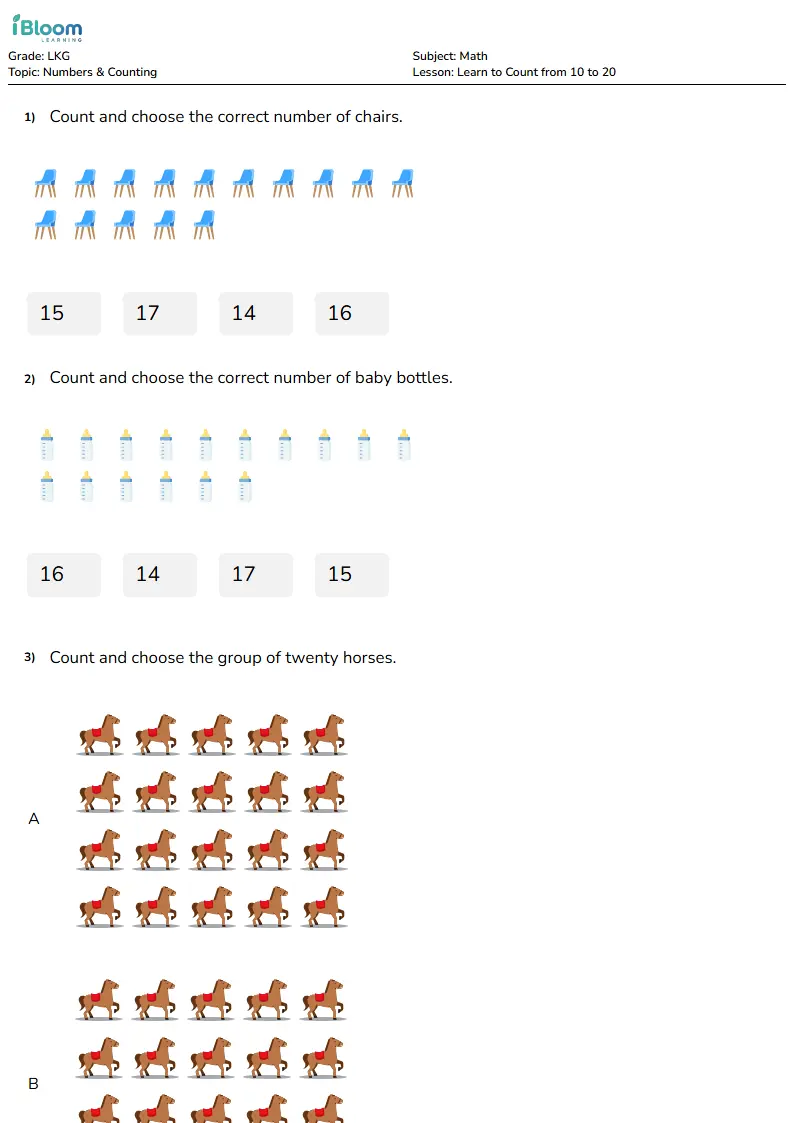
Free Learn to Count from 10 to 20 Worksheets for Lkg
Looking for lkg math help? Download free, interactive learn to count from 10 to 20 worksheets. AI-personalized and Common Core-aligned. Practice math with iBloom.
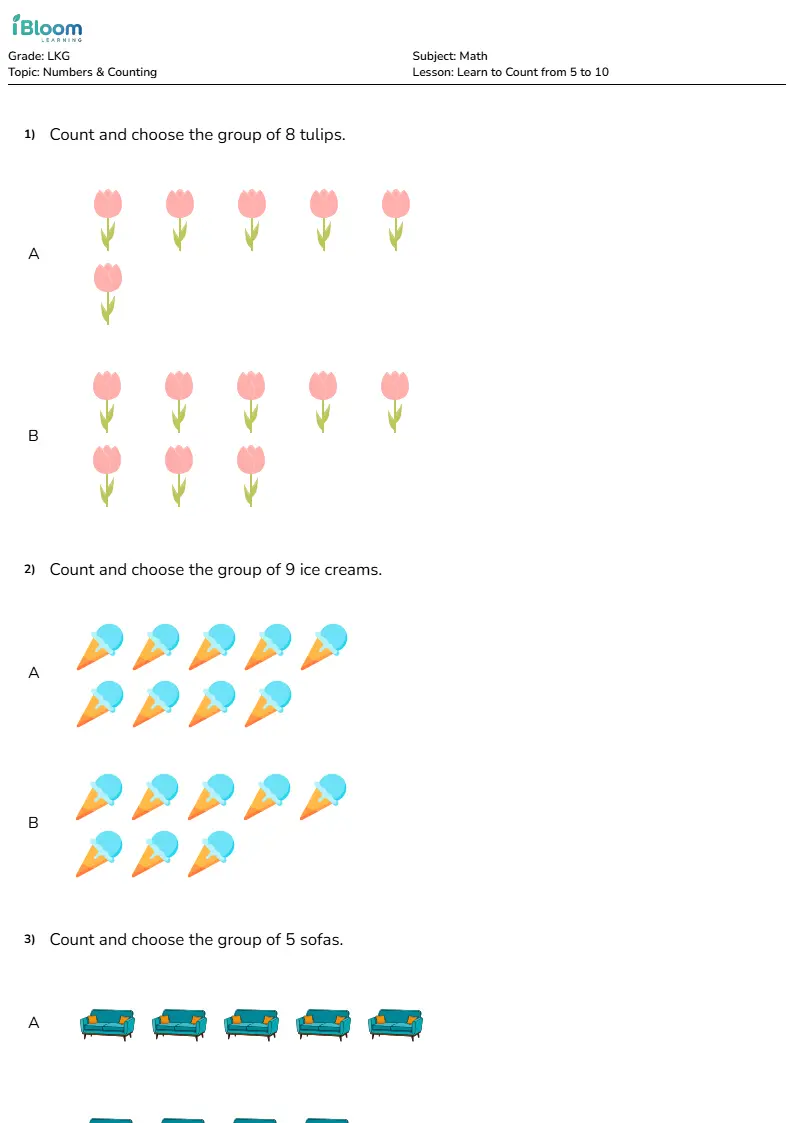
Free Learn to Count from 5 to 10 Worksheets for Lkg
Looking for lkg math help? Download free, interactive learn to count from 5 to 10 worksheets. AI-personalized and Common Core-aligned. Practice math with iBloom.
.webp)
Free Number Recognition (1-10) Worksheets for Lkg
Looking for lkg math help? Download free, interactive number recognition (1-10) worksheets. AI-personalized and Common Core-aligned. Practice math with iBloom.
.webp)
Number Recognition 1-3 Practice for LKG
Help LKG children recognise, name, match and write 1, 2 and 3 through visual activities, object counting, and short home or classroom practice.
.webp)
Free Number Recognition (1-5) Worksheets for Lkg
Looking for lkg math help? Download free, interactive number recognition (1-5) worksheets. AI-personalized and Common Core-aligned. Practice math with iBloom.
.webp)
Free Number Recognition (1-6) Worksheets for Lkg
Looking for lkg math help? Download free, interactive number recognition (1-6) worksheets. AI-personalized and Common Core-aligned. Practice math with iBloom.
.webp)
Free Number Recognition (1-7) Worksheets for Lkg
Looking for lkg math help? Download free, interactive number recognition (1-7) worksheets. AI-personalized and Common Core-aligned. Practice math with iBloom.
.webp)
Free Number Recognition (1-8) Worksheets for Lkg
Looking for lkg math help? Download free, interactive number recognition (1-8) worksheets. AI-personalized and Common Core-aligned. Practice math with iBloom.
.webp)
Free Number Recognition (1-9) Worksheets for Lkg
Looking for lkg math help? Download free, interactive number recognition (1-9) worksheets. AI-personalized and Common Core-aligned. Practice math with iBloom.
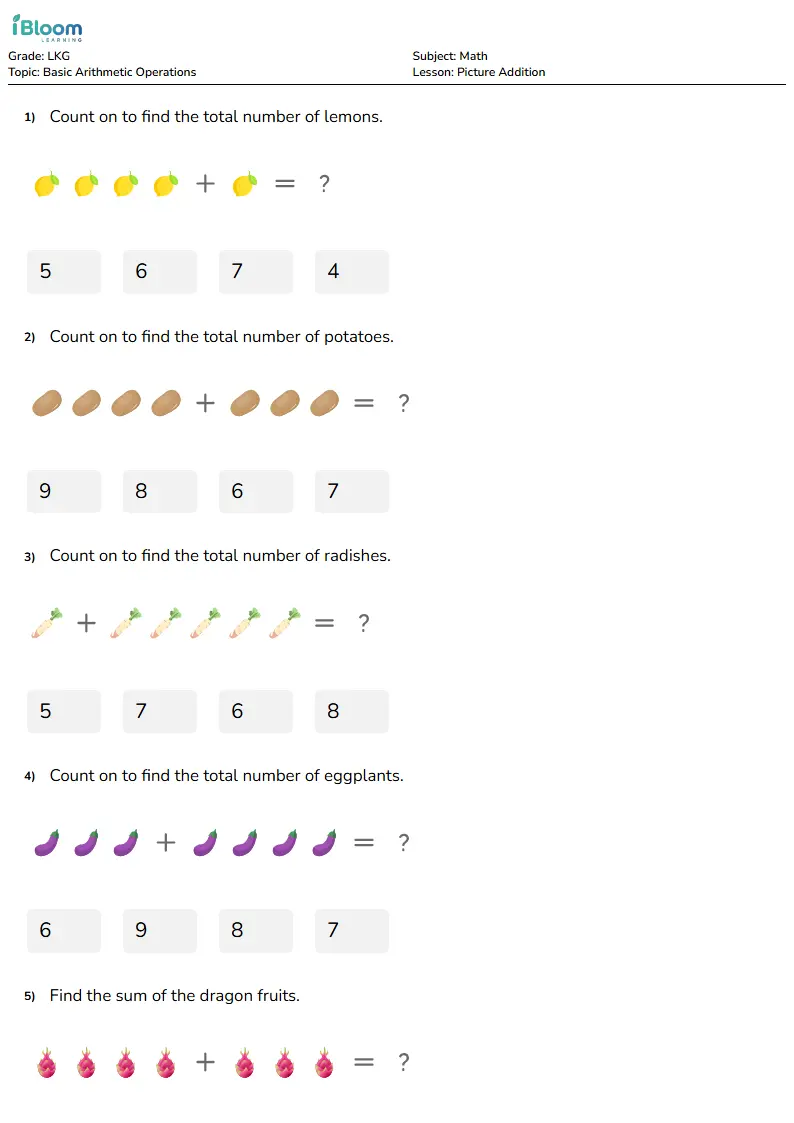
Free Picture Addition Worksheets for Lkg
Looking for lkg math help? Download free, interactive picture addition worksheets. AI-personalized and Common Core-aligned. Practice math with iBloom.
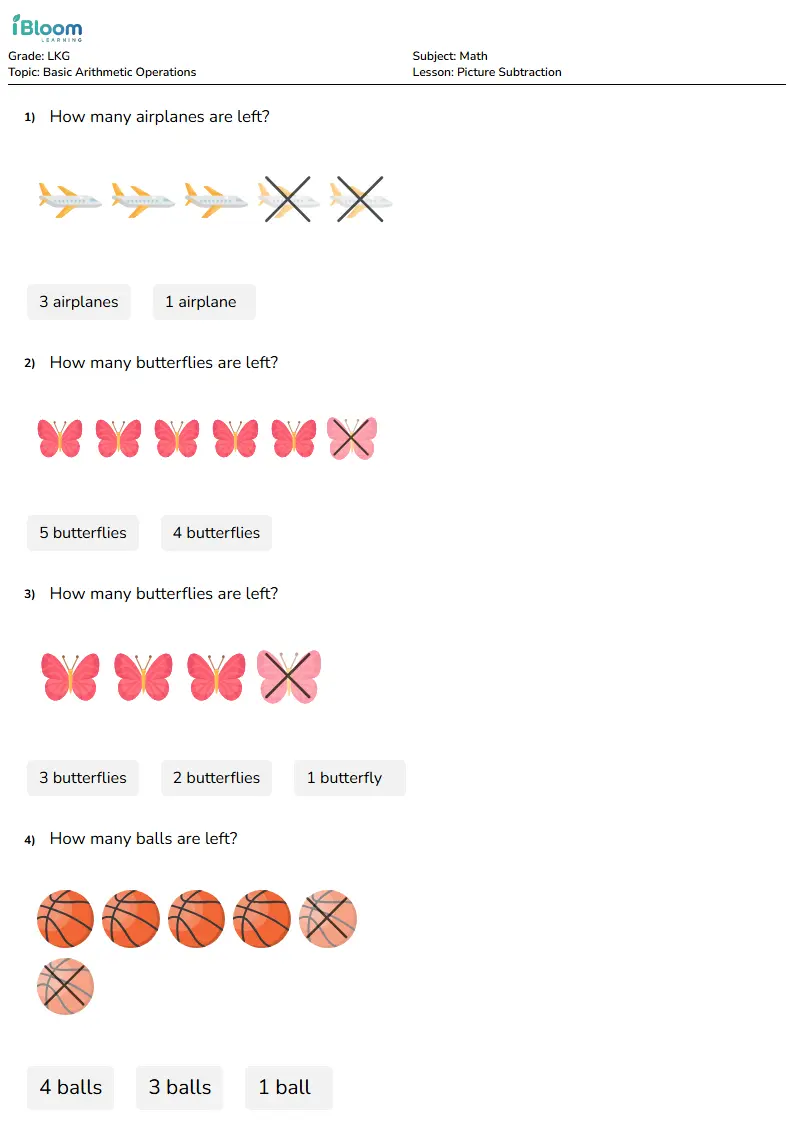
Free Picture Subtraction Worksheets for Lkg
Looking for lkg math help? Download free, interactive picture subtraction worksheets. AI-personalized and Common Core-aligned. Practice math with iBloom.
.webp)
Simple Addition to 5 for LKG | Practice Worksheet
Help LKG children combine two small groups and find totals up to 5 using objects, drawings, number sentences, and short guided practice.
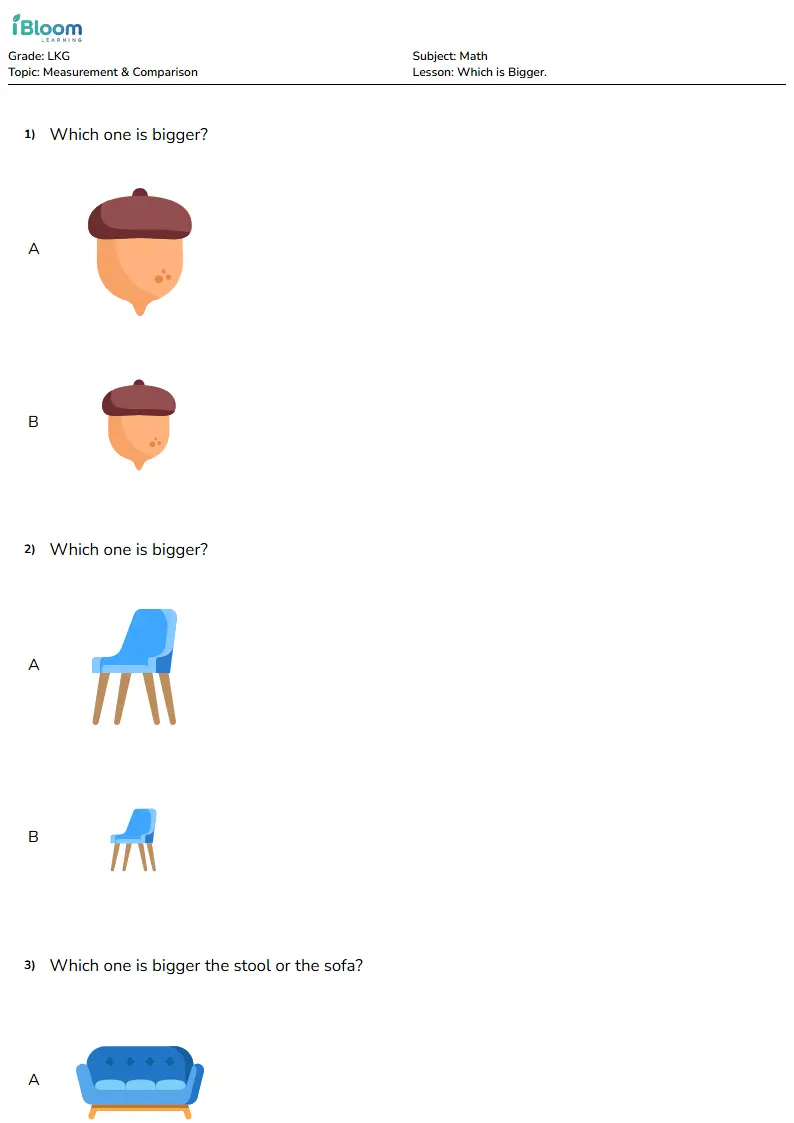
Free Which is Bigger. Worksheets for Lkg
Looking for lkg math help? Download free, interactive which is bigger. worksheets. AI-personalized and Common Core-aligned. Practice math with iBloom.
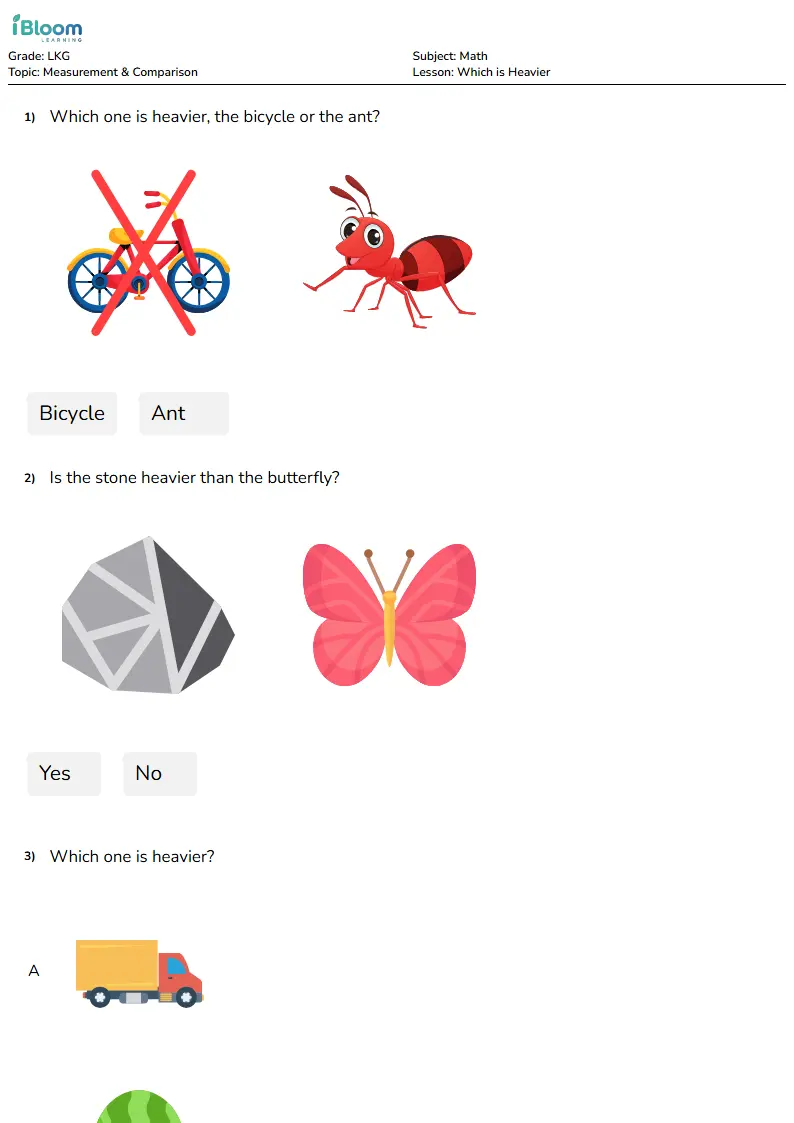
Free Which is Heavier Worksheets for Lkg
Looking for lkg math help? Download free, interactive which is heavier worksheets. AI-personalized and Common Core-aligned. Practice math with iBloom.