Free printable practice
Bar Charts Practice Activities
Printable Grade 1 bar chart worksheets that help children read, compare, and answer questions about simple data displays.
Free printable worksheet PDFs
Preview every available page, then download the free worksheet PDF for home, homeschool, tutoring, or classroom practice.
Preview the exact activity before downloading it.
Practice that builds confidence
What children learn from bar charts
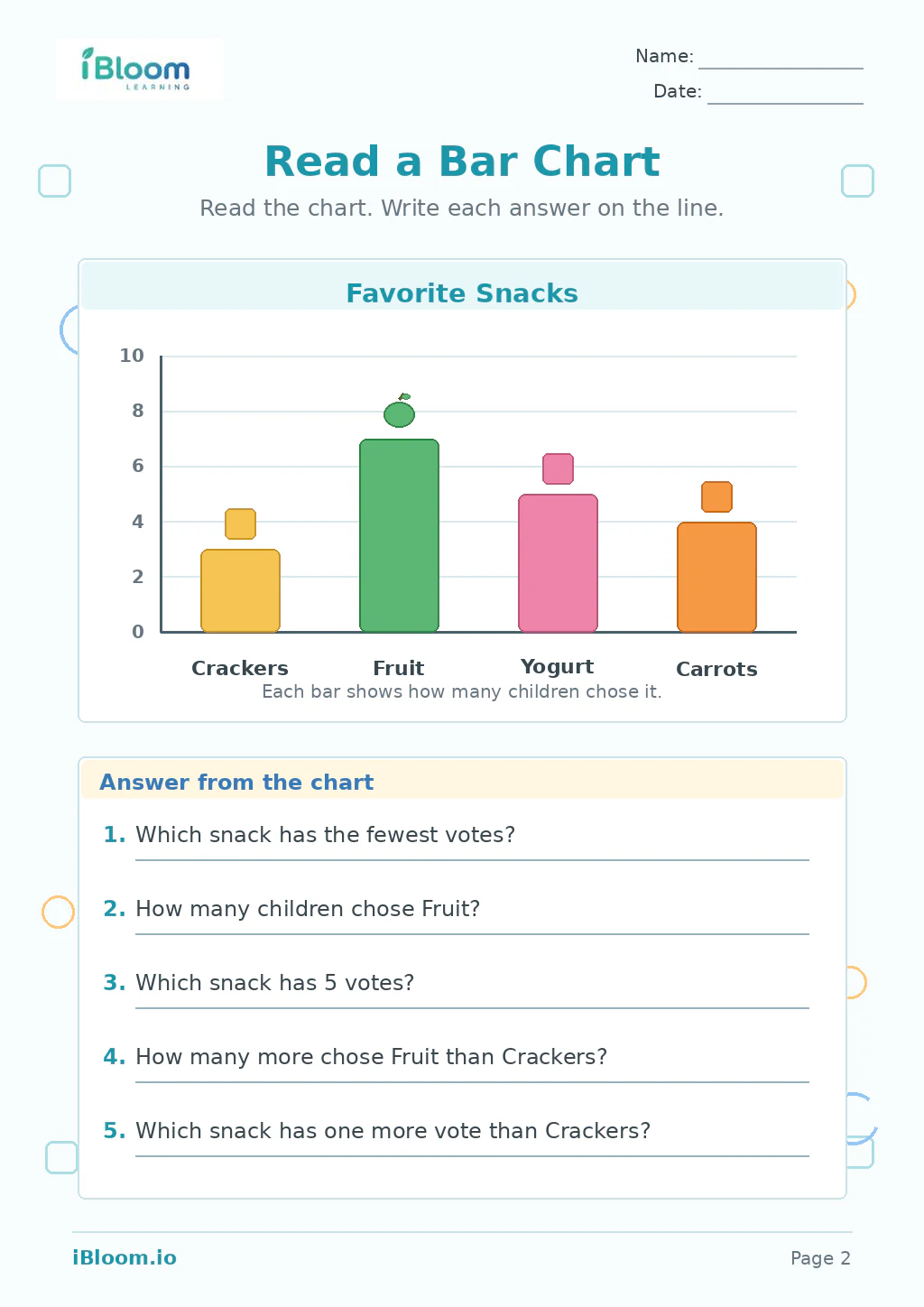
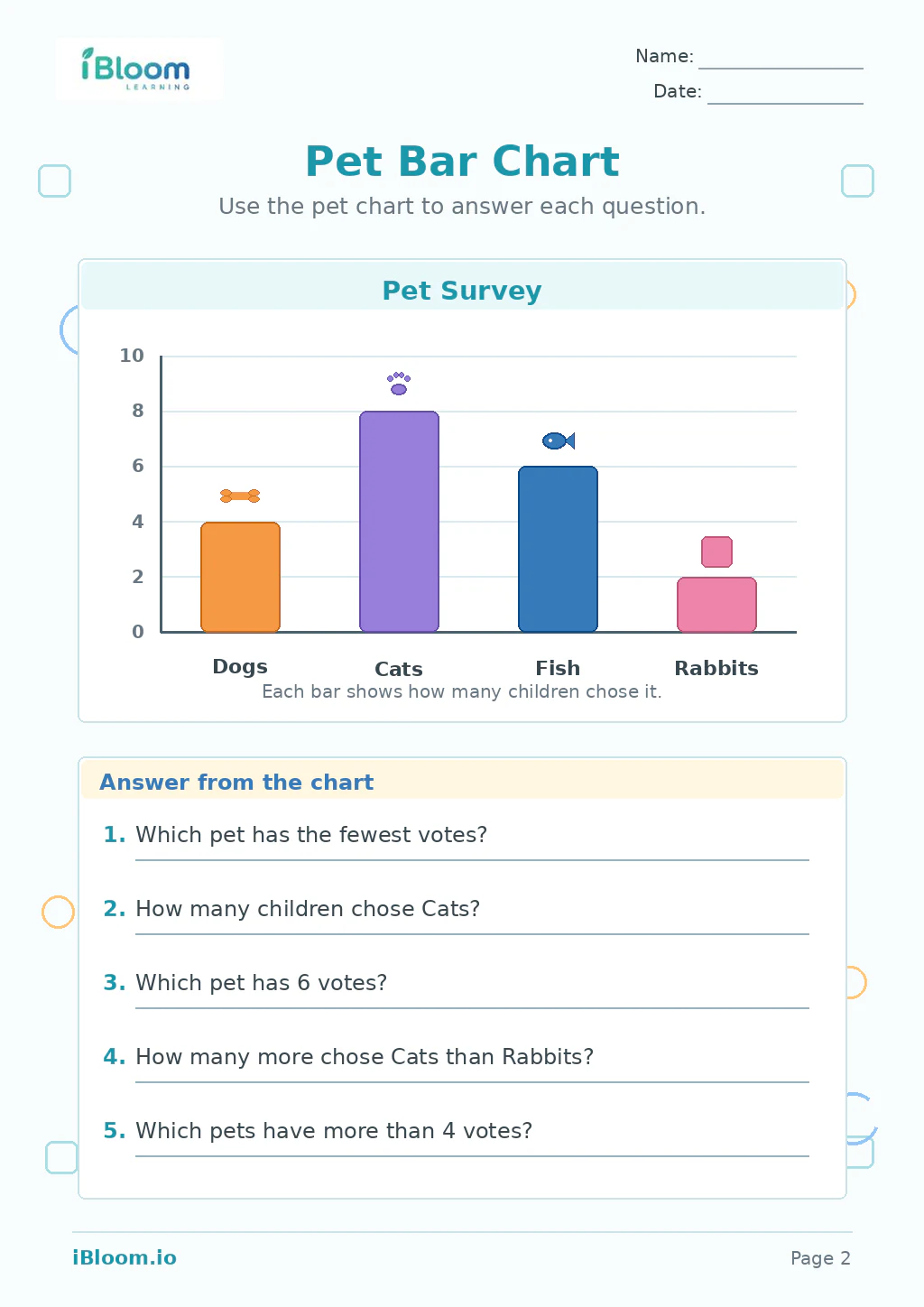
These Grade 1 bar chart practice activities help children make sense of data by looking at categories, counting bars, and comparing amounts. Students practise reading simple bar charts and answering questions such as which group has more, fewer, or the same number.
The printables include clear, child-friendly data displays with familiar contexts and straightforward question prompts. Children build confidence using chart vocabulary like title, label, category, bar, most, least, more, and fewer while strengthening counting and comparison skills.
Bar charts turn information into a picture children can read. In Grade 1, the focus is not on complicated graphing rules, but on noticing what each bar stands for, counting how high or long it goes, and using the chart to answer simple questions. These worksheets support early data skills within the Math > Grade 1 > Data Graphing > Bar Charts sequence.
Building from counting to comparing
Children first identify the categories on the chart, such as different choices, objects, or groups. Then they count the units shown by each bar. Once they can read the bars accurately, they compare them: which has the most, which has the least, how many more, and how many fewer. This progression connects graphing to addition, subtraction, and number sense in a natural way.
A simple parent routine
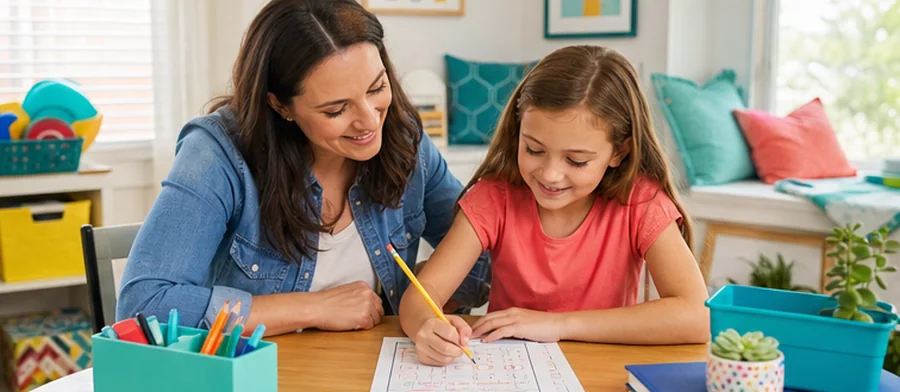
At home, start by asking your child to point to the chart title and name each category. Next, have them touch or trace each bar while counting. After they answer the worksheet questions, ask one extra question aloud, such as, “How do you know?” or “Which two bars are closest?” This short routine encourages children to explain their thinking rather than guess from the picture.
Classroom uses for teachers
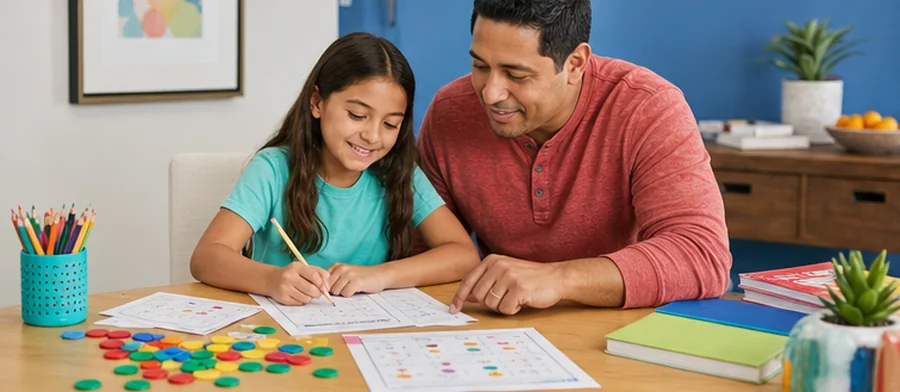
Teachers can use these pages for independent practice, math centers, small-group review, or a quick check after a data lesson. The worksheets also work well after a class survey, because students can connect their own collected data to the printed bar charts. Partners can take turns reading a question, finding the matching bar, and proving the answer with a count or comparison sentence.
Common errors to watch for
Some children count the spaces around a bar instead of the marked units, skip the chart labels, or choose the tallest-looking bar without checking the scale. Others mix up “more” and “fewer” when comparing two categories. Encourage careful left-to-right or bottom-to-top counting, and remind students that the label tells what the bar represents.
Free printable PDF download
Use this grade 1 bar chart worksheet page to preview the activity, print it, or download it as a PDF for quick practice. It works well for homework, homeschool lessons, tutoring, morning work, revision, and classroom centers.
Answers and answer key support
After the child completes the worksheet independently, parents and teachers can use the answer support or answer key information to check the work, review mistakes, and choose the next practice step.
Why iBloom worksheets help
The iBloom bar chart worksheets are designed for early readers and developing mathematicians. Clear layouts reduce visual clutter, while repeated question types help children practise important vocabulary and reasoning. A child-friendly strategy is: read the title, name the categories, count each bar, then compare. Saying the steps aloud helps Grade 1 learners slow down and use the chart as evidence.
Helpful answers
Frequently asked questions
What do Grade 1 students practise with these bar chart worksheets?
They practise reading simple bar charts, identifying categories, counting the bars, and answering comparison questions such as which category has more, fewer, most, or least.
Do children need to know how to draw bar charts first?
No. These activities focus mainly on reading and interpreting bar charts. Drawing a chart can come later, once children understand what the bars and labels mean.
How can I help my child if they guess from the tallest bar?
Ask your child to point to the category label, then count the bar carefully. Encourage them to prove the answer by saying, for example, “This bar shows 6, and that bar shows 4, so this one has more.”
What vocabulary should my child know for bar charts?
Helpful words include title, label, category, bar, data, most, least, more, fewer, same, and compare. The worksheets give children repeated practice using these words in context.
Can these worksheets be used in math centers?
Yes. They are suitable for independent work, partner practice, small-group reteaching, or a quick assessment after a Grade 1 data graphing lesson.
Is this grade 1 bar chart worksheet free?
Yes. You can preview it for free and use the printable worksheet for home or classroom practice.
Can I download this grade 1 bar chart worksheet as a PDF?
Yes. Use the worksheet download option to save a printable PDF, or print the worksheet directly from the page.
Does this grade 1 bar chart worksheet include answers or an answer key?
When the activity has fixed answers, iBloom includes answer support so parents and teachers can check the completed worksheet.