Free printable practice
Sort And Count Practice Activities
Grade 1 math worksheets that help children sort objects into groups, count each group, and prepare for simple data graphing.
Free printable worksheet PDFs
Preview every available page, then download the free worksheet PDF for home, homeschool, tutoring, or classroom practice.
Preview the exact activity before downloading it.
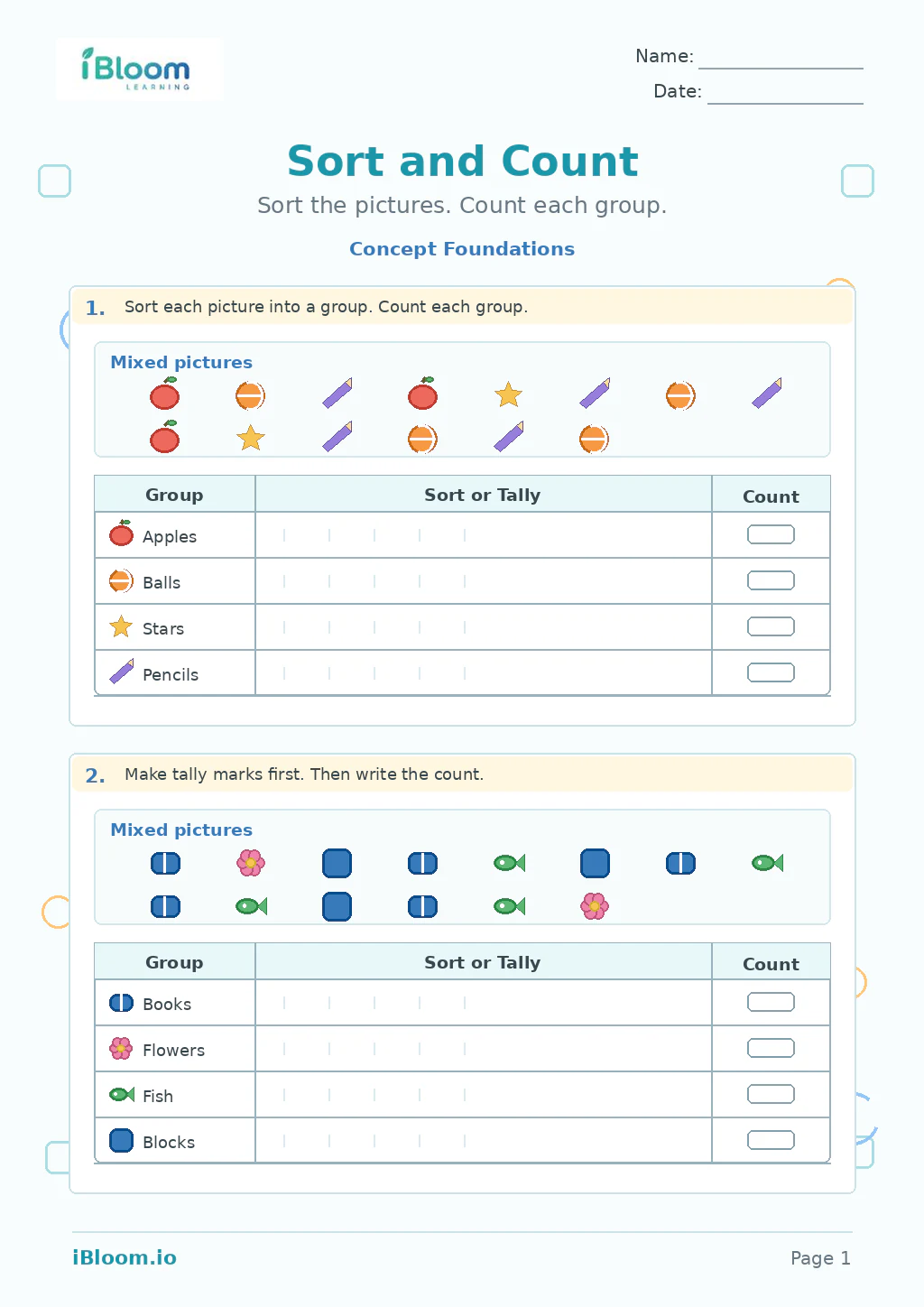 Sort And Count — Concept FoundationsGrade 1 math worksheets that help children sort objects into groups, count each group, and prepare for simple data graphing. This Grade 1 foundations worksheet adds concise teaching notes, worked examples, and supported first attempts.Grade 1Free PDF preview
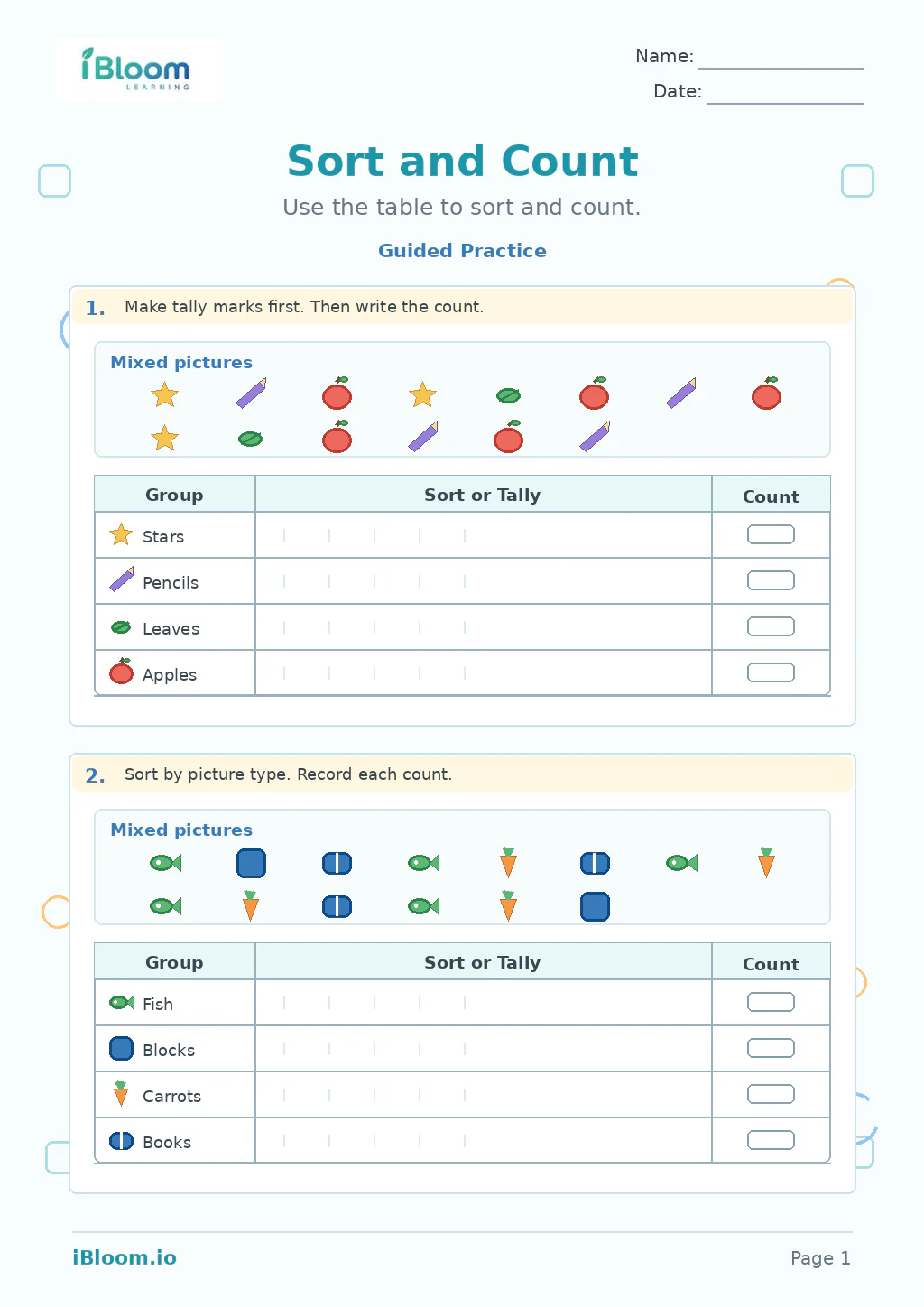 Sort And Count — Guided PracticeGrade 1 math worksheets that help children sort objects into groups, count each group, and prepare for simple data graphing. This Grade 1 guided-practice worksheet progresses from prompts and checkpoints to independent questions.Grade 1Free PDF preview
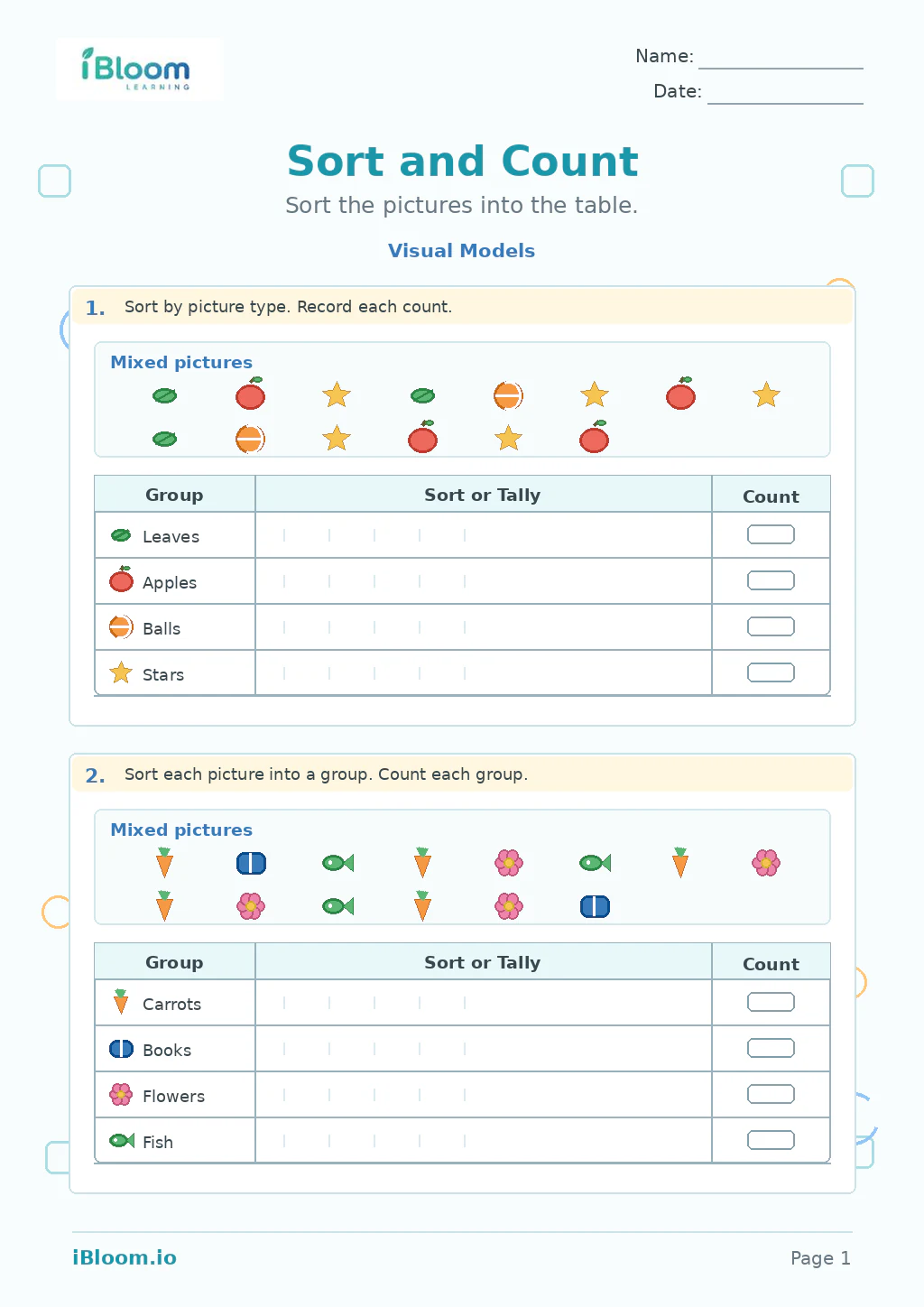 Sort And Count — Visual ModelsGrade 1 math worksheets that help children sort objects into groups, count each group, and prepare for simple data graphing. This Grade 1 visual-model worksheet connects suitable diagrams, tables, number lines, or place-value models to mathematical notation.Grade 1Free PDF preview
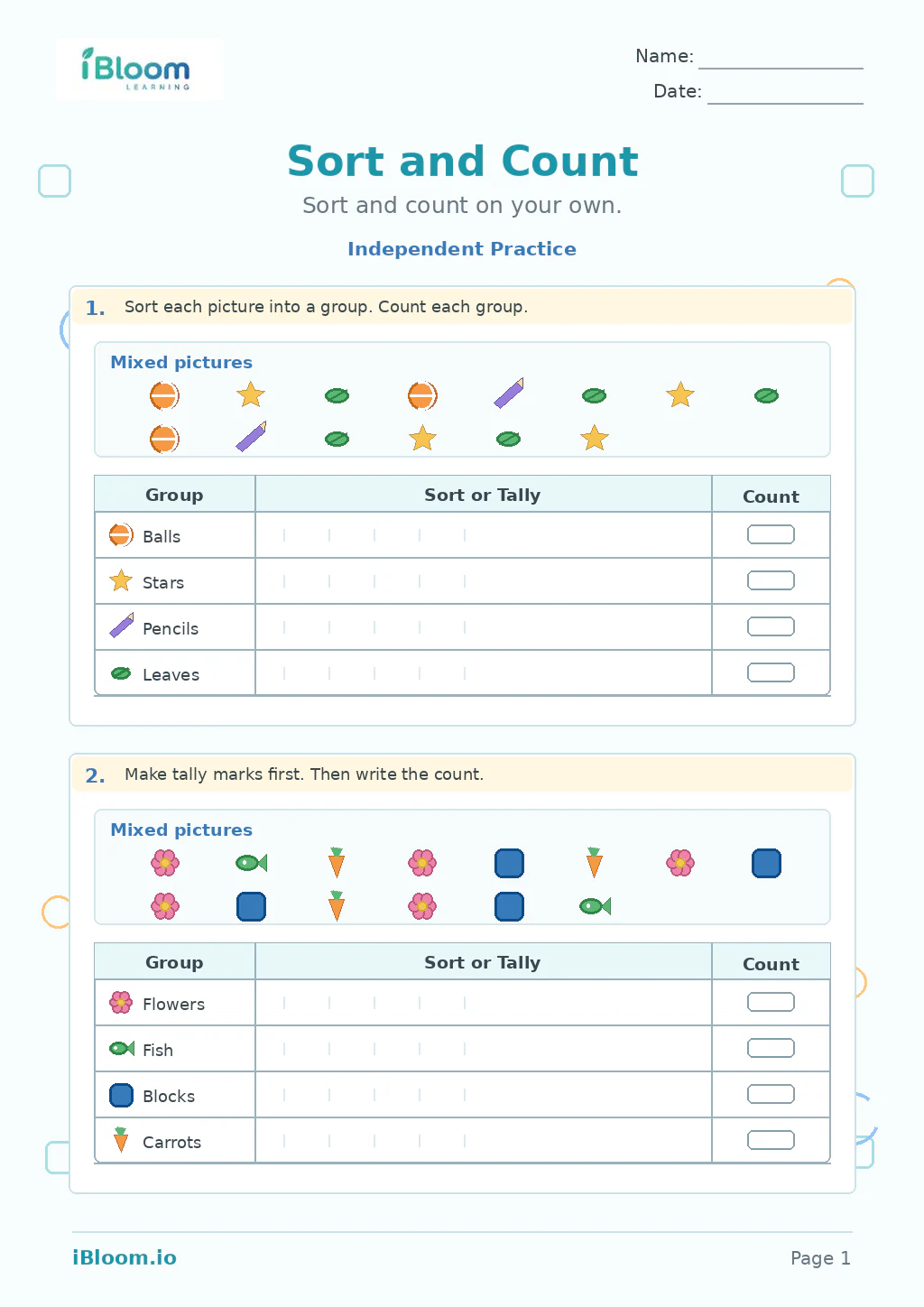 Sort And Count — Independent PracticeGrade 1 math worksheets that help children sort objects into groups, count each group, and prepare for simple data graphing. This Grade 1 independent-practice worksheet provides a balanced sequence of accurate, grade-level exercises.Grade 1Free PDF preview
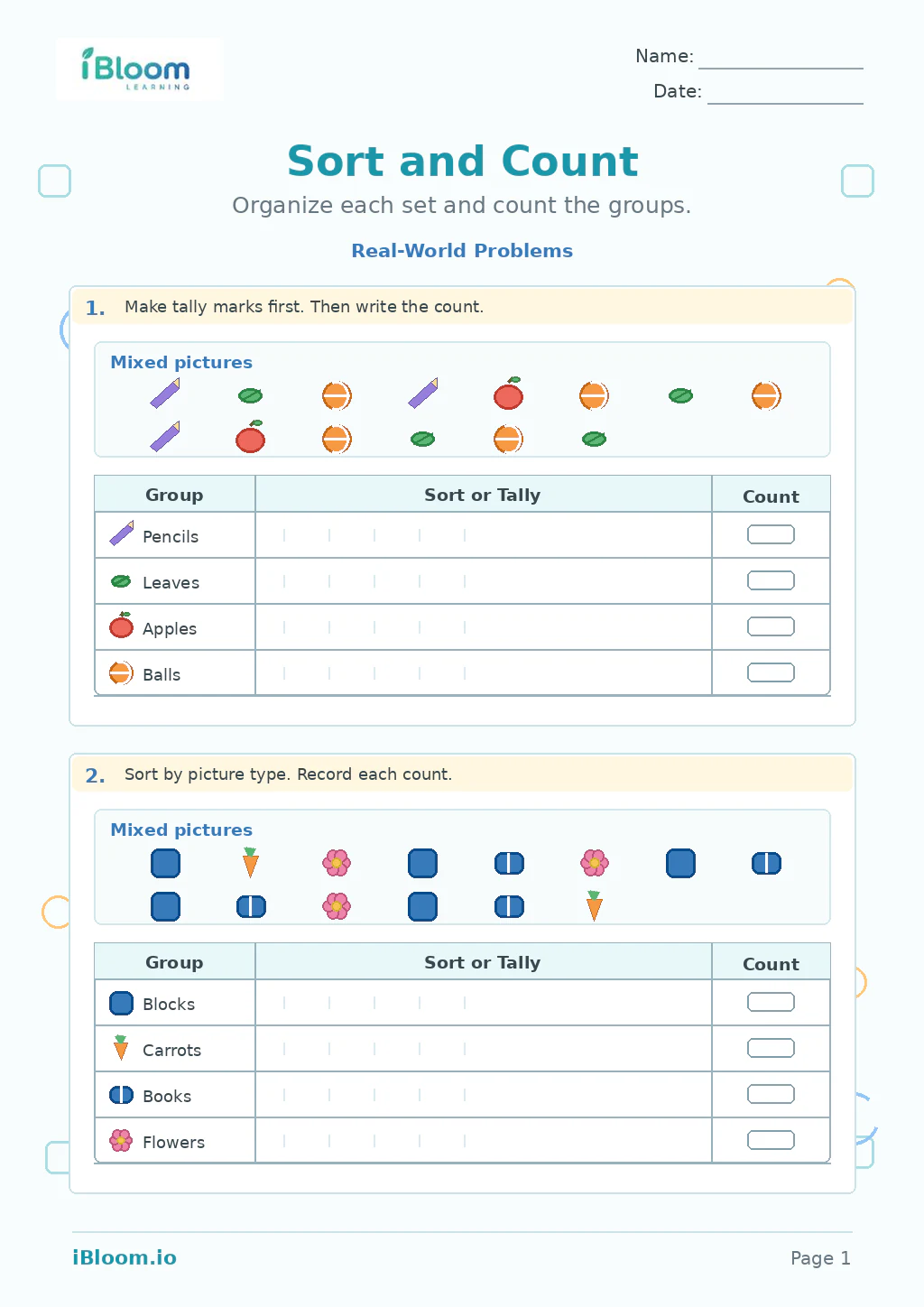 Sort And Count — Real-World ProblemsGrade 1 math worksheets that help children sort objects into groups, count each group, and prepare for simple data graphing. This Grade 1 application worksheet uses realistic one-step and multi-step situations with room to model and solve.Grade 1Free PDF preview
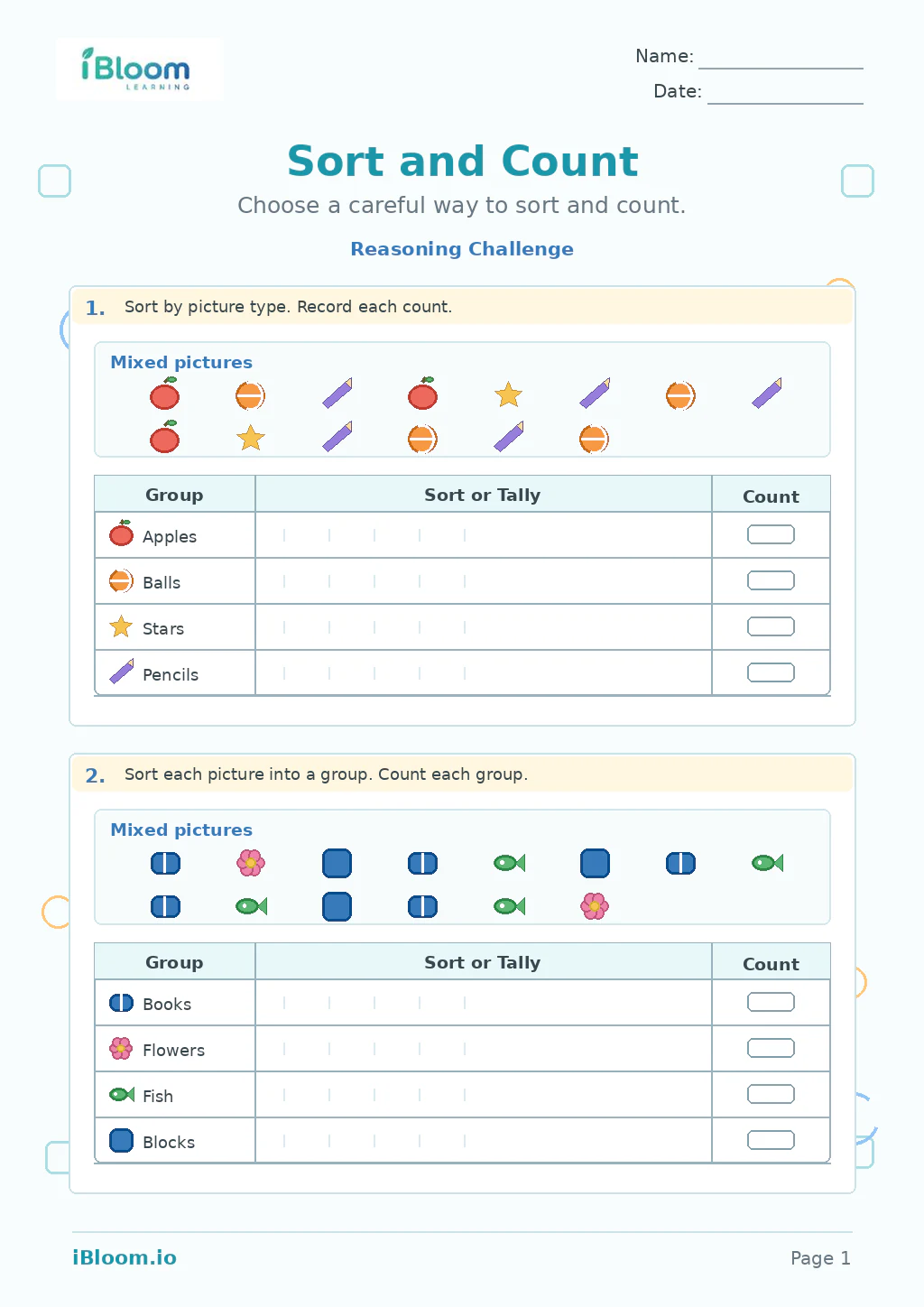 Sort And Count — Reasoning ChallengeGrade 1 math worksheets that help children sort objects into groups, count each group, and prepare for simple data graphing. This Grade 1 reasoning worksheet combines error analysis, strategy comparison, missing information, and a gentle extension.Grade 1Free PDF preview
Practice that builds confidence
Sorting before graphing
These Grade 1 Data Graphing worksheets focus on the important first step of working with data: sorting and counting. Children practise looking at a mixed set of objects, deciding how the objects are alike or different, grouping them, and counting how many are in each group.
The printable activities include clear visual sets, category-based counting tasks, and simple recording spaces. They help children build accuracy with tallying, comparing groups, and using data vocabulary before moving on to picture graphs and bar graphs.
Sorting and counting is where young learners begin to understand data. Instead of only counting a whole set, children notice attributes such as shape, color, size, type, or picture category. A worksheet might ask them to sort animals, classroom items, toys, or shapes, then write how many are in each group. This connects counting to a purpose: finding information.

How the skill progresses
Children usually start by matching obvious groups, such as all circles together or all apples together. Next, they count each group carefully and record the number. Later, they compare the results using words such as more, fewer, most, least, same, group, category, and total. This page supports that progression within Math > Grade 1 > Data Graphing > Sort And Count, so the focus stays on organizing data before drawing a graph.
A simple parent routine
At home, choose 10 to 20 small objects, such as buttons, crayons, blocks, or snack pieces. Ask your child, What is one way we can sort these? After sorting, have your child touch and count each group, say the number aloud, and write it down. Then ask one comparison question: Which group has more? Which has fewer? Repeating the same routine with different objects builds confidence and flexible thinking.

Classroom uses for teachers
Teachers can use these worksheets for math centers, morning work, small-group reteaching, or as a bridge to picture graphs. They are also useful after a hands-on sorting activity: students first sort real objects, then complete a printable version to show the same thinking on paper. For partner work, one child can name the category while the other counts, then they check the recorded totals together.

Common errors to watch for
Some first graders count an object twice, skip an item, or mix categories halfway through the task. Others sort correctly but write the total in the wrong space. Encourage children to use a steady touch-counting method and to circle or lightly mark items after they count them. If a child is unsure about categories, ask them to explain their rule before they begin.
Free printable PDF download
Use this grade 1 sort and count worksheet page to preview the activity, print it, or download it as a PDF for quick practice. It works well for homework, homeschool lessons, tutoring, morning work, revision, and classroom centers.
Answers and answer key support
After the child completes the worksheet independently, parents and teachers can use the answer support or answer key information to check the work, review mistakes, and choose the next practice step.
Why iBloom worksheets help
These iBloom worksheets keep the layout clean and the task specific, so children can focus on sorting, counting, and recording data. A child-friendly strategy is: look, sort, count, check. First look at all the objects, then sort by one rule, count each group slowly, and finally check that every object belongs to a group.
Helpful answers
Frequently asked questions
What does sort and count mean in Grade 1 math?
It means children group objects by a shared attribute, such as color, shape, or type, and then count how many objects are in each group.
How does sorting and counting prepare children for graphs?
Graphs show organized data. When children sort items into categories and count each category, they learn the exact information that later appears in picture graphs and bar graphs.
What vocabulary should my child know for these worksheets?
Helpful words include sort, group, category, count, total, more, fewer, same, most, and least. Children should also be able to explain the sorting rule they used.
What should I do if my child keeps miscounting a group?
Have your child touch each object once while counting aloud. They can also lightly mark or circle counted items so they do not skip or count the same item twice.
Can these worksheets be used with hands-on activities?
Yes. They work well after children sort real objects such as crayons, blocks, counters, or buttons, because the worksheet helps them transfer the same thinking to pictures and written numbers.
Is this grade 1 sort and count worksheet free?
Yes. You can preview it for free and use the printable worksheet for home or classroom practice.
Can I download this grade 1 sort and count worksheet as a PDF?
Yes. Use the worksheet download option to save a printable PDF, or print the worksheet directly from the page.
Does this grade 1 sort and count worksheet include answers or an answer key?
When the activity has fixed answers, iBloom includes answer support so parents and teachers can check the completed worksheet.