Free printable practice
Collecting Data Practice Activities
Grade 1 children practise asking simple questions, sorting responses, and recording data with tallies, checkmarks, and organized tables.
Free printable worksheet PDFs
Preview every available page, then download the free worksheet PDF for home, homeschool, tutoring, or classroom practice.
Preview the exact activity before downloading it.
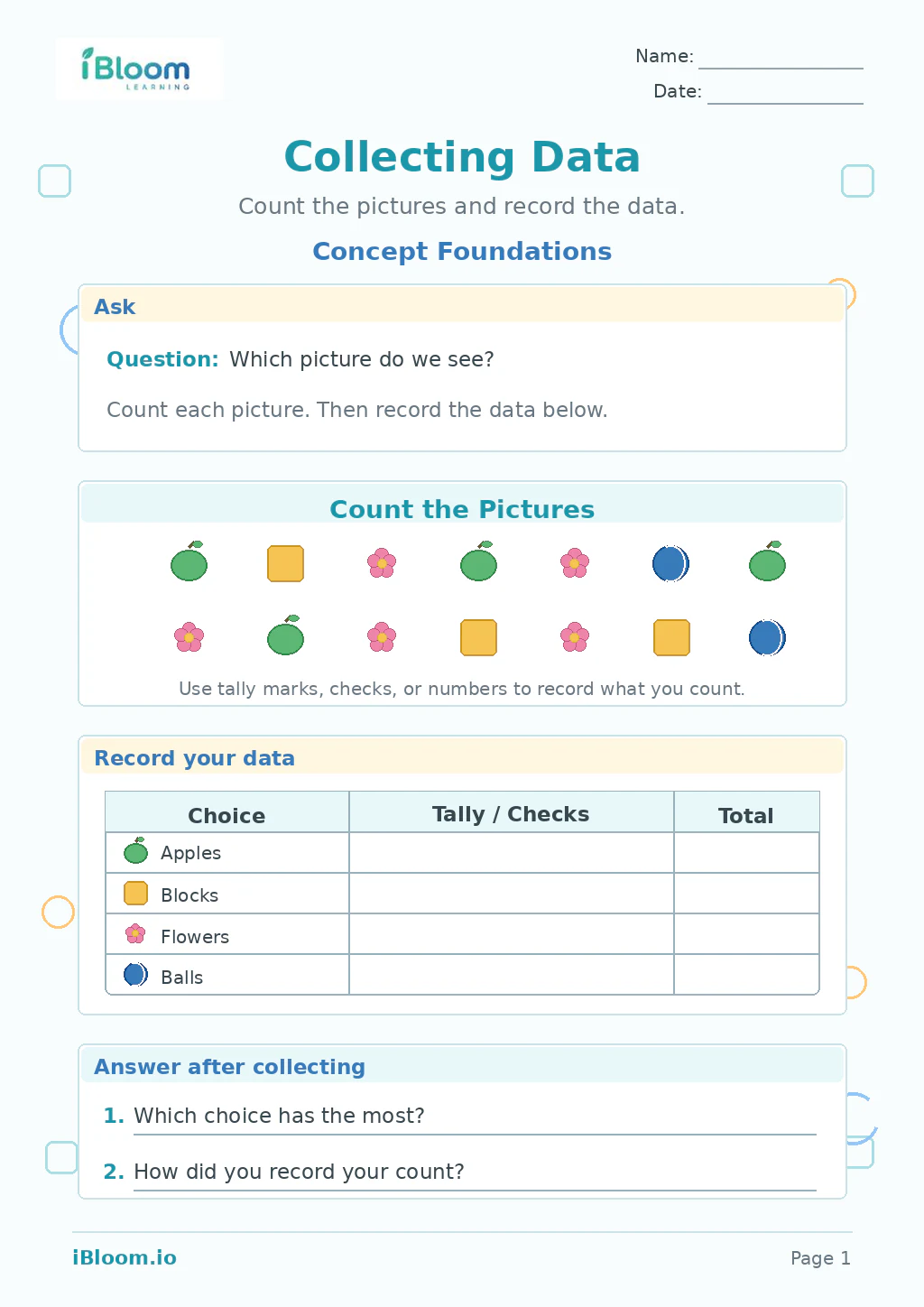 Collecting Data — Concept FoundationsGrade 1 children practise asking simple questions, sorting responses, and recording data with tallies, checkmarks, and organized tables. This Grade 1 foundations worksheet adds concise teaching notes, worked examples, and supported first attempts.Grade 1Free PDF preview
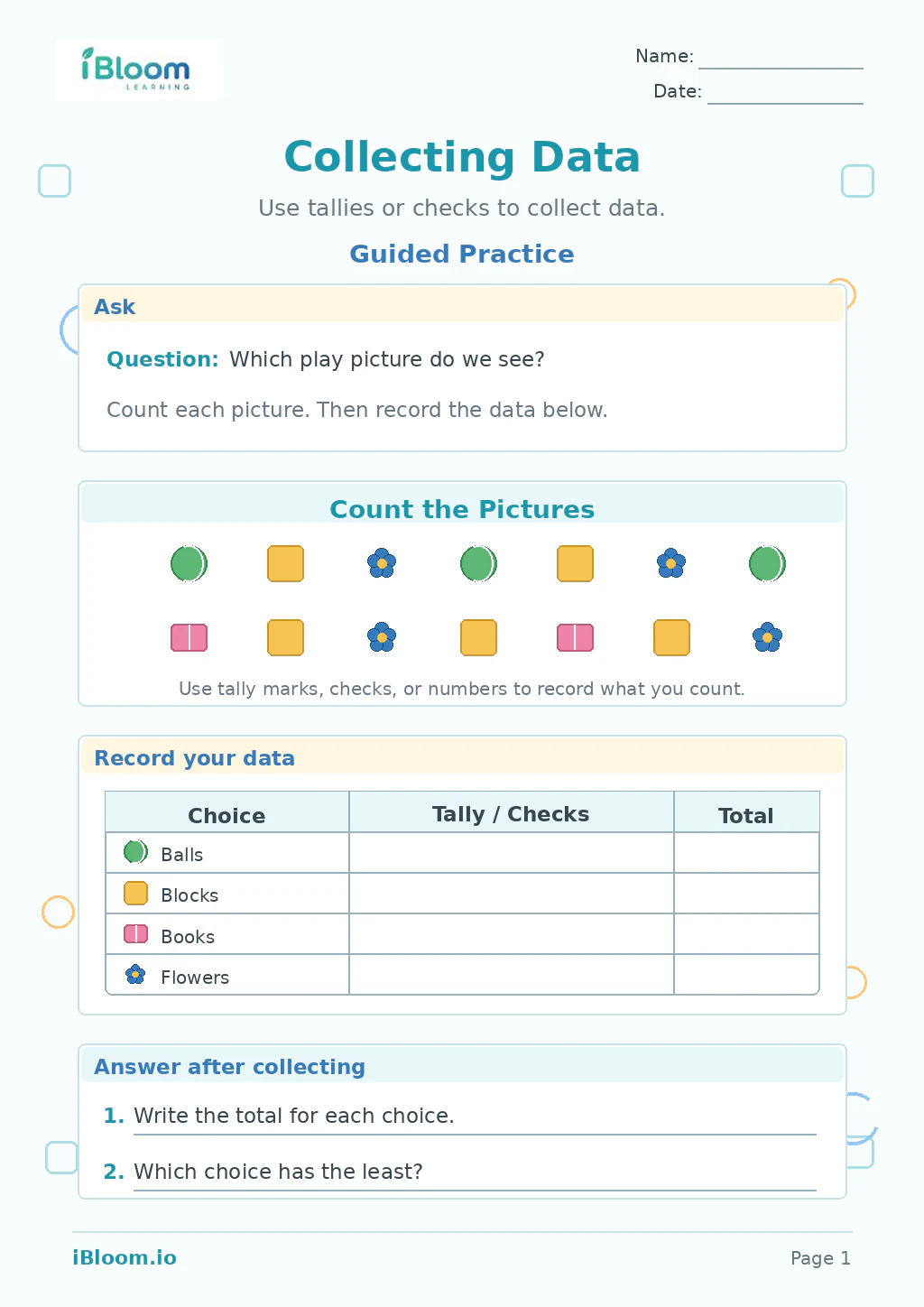 Collecting Data — Guided PracticeGrade 1 children practise asking simple questions, sorting responses, and recording data with tallies, checkmarks, and organized tables. This Grade 1 guided-practice worksheet progresses from prompts and checkpoints to independent questions.Grade 1Free PDF preview
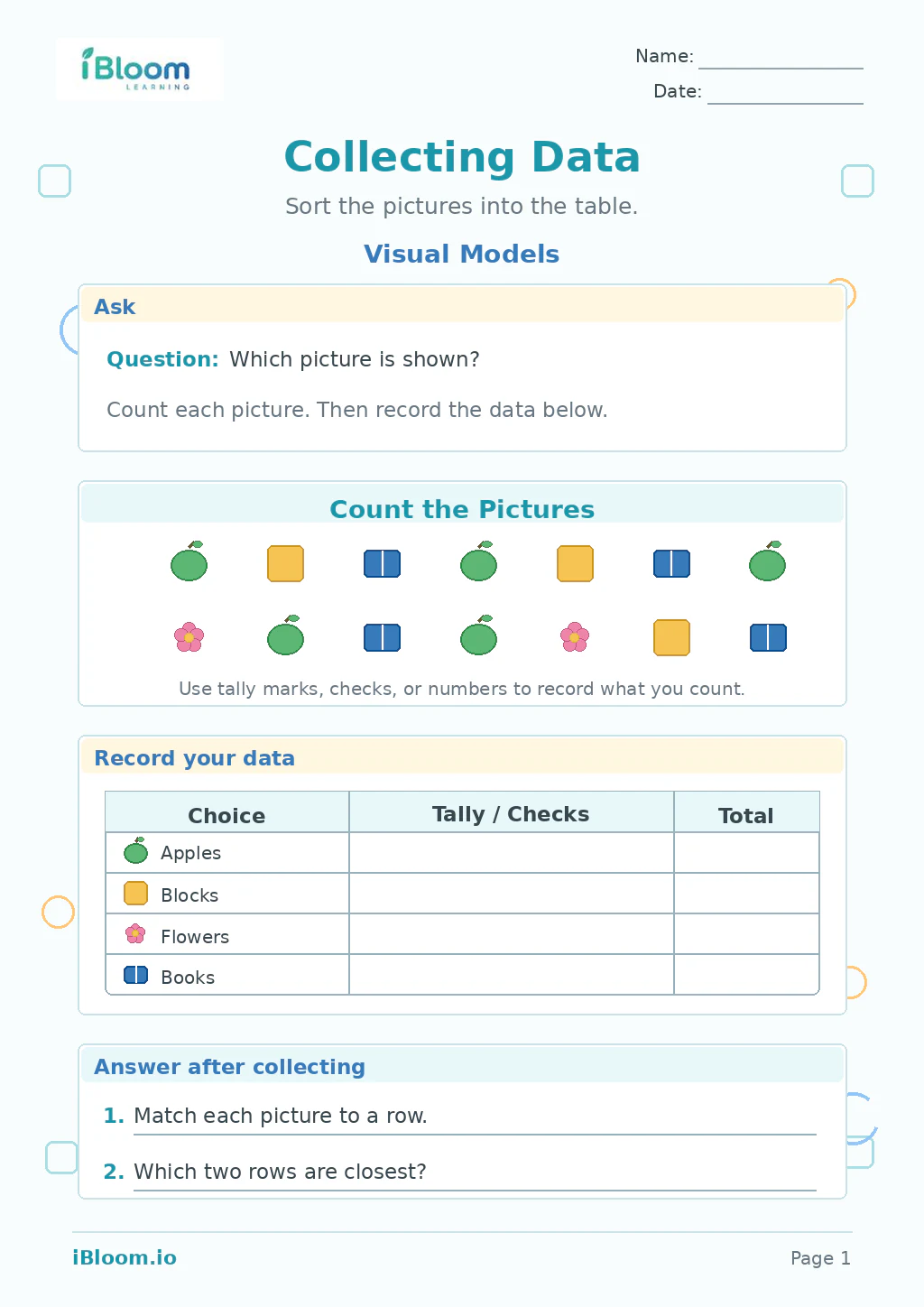 Collecting Data — Visual ModelsGrade 1 children practise asking simple questions, sorting responses, and recording data with tallies, checkmarks, and organized tables. This Grade 1 visual-model worksheet connects suitable diagrams, tables, number lines, or place-value models to mathematical notation.Grade 1Free PDF preview
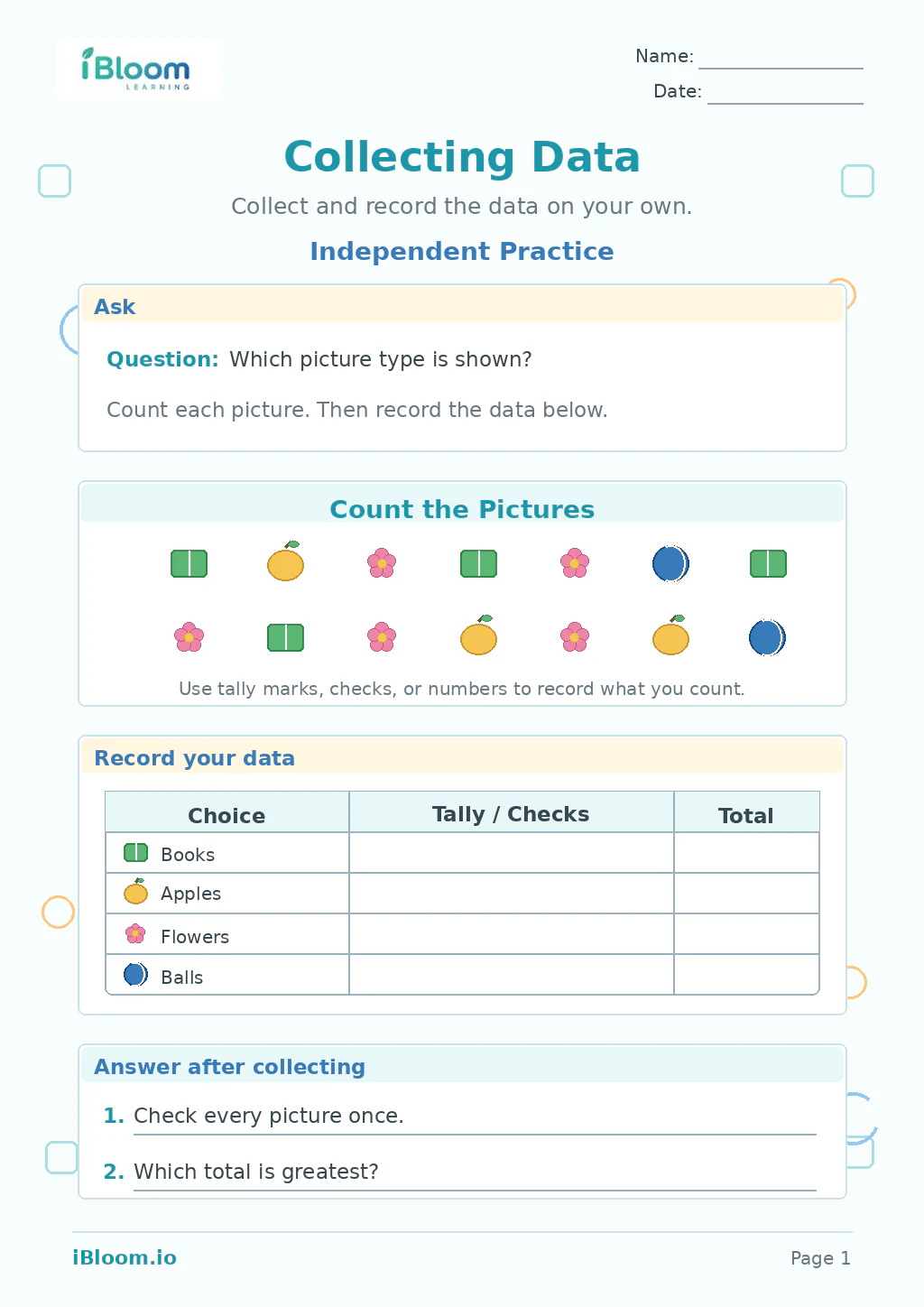 Collecting Data — Independent PracticeGrade 1 children practise asking simple questions, sorting responses, and recording data with tallies, checkmarks, and organized tables. This Grade 1 independent-practice worksheet provides a balanced sequence of accurate, grade-level exercises.Grade 1Free PDF preview
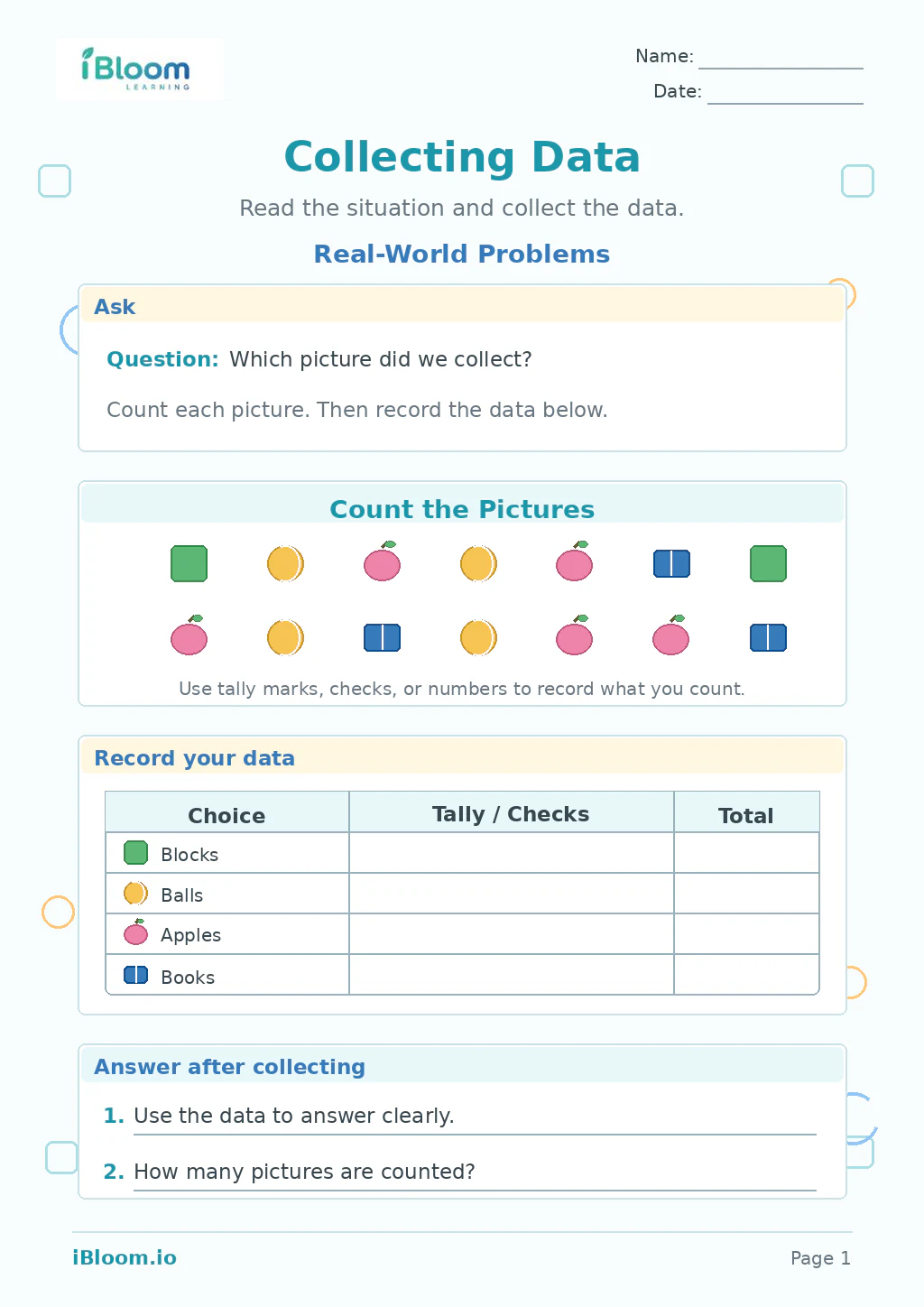 Collecting Data — Real-World ProblemsGrade 1 children practise asking simple questions, sorting responses, and recording data with tallies, checkmarks, and organized tables. This Grade 1 application worksheet uses realistic one-step and multi-step situations with room to model and solve.Grade 1Free PDF preview
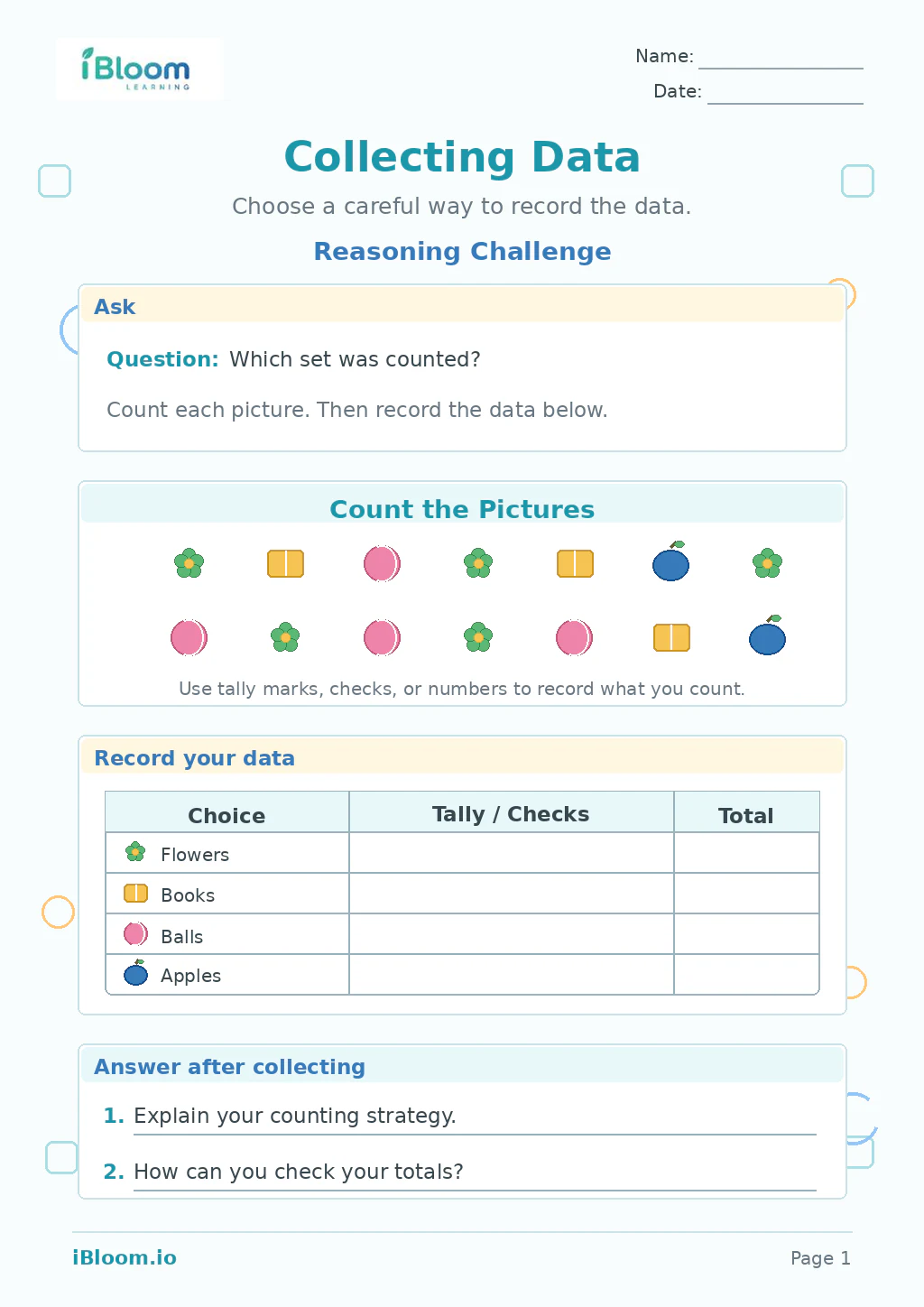 Collecting Data — Reasoning ChallengeGrade 1 children practise asking simple questions, sorting responses, and recording data with tallies, checkmarks, and organized tables. This Grade 1 reasoning worksheet combines error analysis, strategy comparison, missing information, and a gentle extension.Grade 1Free PDF preview
Practice that builds confidence
What children learn
These Grade 1 collecting data worksheets help children learn how information is gathered before it becomes a graph. Students practise asking a clear question, choosing categories, counting responses, and recording results accurately.
The printable activities include simple surveys, sorting tasks, tally marks, checkmark charts, and data tables using familiar topics such as favorite foods, pets, colors, classroom objects, and weather. Each page builds the habit of collecting data in an organized, easy-to-read way.
Collecting data is the first step in data graphing. In these worksheets, Grade 1 students learn that data are pieces of information gathered to answer a question, such as “Which fruit do you like best?” or “How many children chose a dog?” They practise identifying categories, making one mark for each response, and checking that every answer is counted once.

From real questions to organized records
The activities move from concrete sorting to written recording. Children may sort pictures into groups, add checkmarks to a chart, complete tally marks, or count totals in a small table. This progression helps them see that a messy set of answers can become organized information. Vocabulary such as survey, category, tally, total, more, fewer, and same supports later work with picture graphs and bar graphs.
A simple parent routine
At home, choose one daily question: “Which snack should we pack?” or “What color blocks did you use?” Let your child ask 3 to 6 family members or count a small set of objects. Have them make a checkmark or tally for each response, then count the totals aloud. Ask, “Which category has the most? Which has fewer? Did we count everyone?” This keeps the focus on careful collection, not just the final answer.

Classroom uses for teachers
Teachers can use these printables in math centers, morning work, partner surveys, or small-group intervention. They also work well after a class vote: students can record the same shared data independently, compare totals, and discuss why organized recording matters. For early finishers, invite children to write their own survey question with two or three choices.

Common errors to watch for
First graders may put two marks for one answer, skip a response, mix categories, or count tally groups incorrectly. Some children also start comparing before all data are collected. Encourage them to point to each object or name as they record it, leave space between categories, and recount the total at the end.
Free printable PDF download
Use this grade 1 collecting data worksheet page to preview the activity, print it, or download it as a PDF for quick practice. It works well for homework, homeschool lessons, tutoring, morning work, revision, and classroom centers.
Answers and answer key support
After the child completes the worksheet independently, parents and teachers can use the answer support or answer key information to check the work, review mistakes, and choose the next practice step.
Why iBloom worksheets help
The pages use familiar contexts and clear layouts so children can focus on the data-collection skill. Visual choices, small sets, and repeated recording formats build confidence. A helpful child-friendly strategy is: ask, mark, count, check. Ask the question, mark each answer, count each category, then check that the total matches the number of responses.
Helpful answers
Frequently asked questions
What does collecting data mean in Grade 1 math?
In Grade 1, collecting data means gathering simple information by counting, sorting, voting, or asking a question, then recording each response in an organized way.
Do these worksheets require children to make graphs?
The focus is on the step before graphing: collecting and recording information. Some pages may prepare children for picture graphs or bar graphs by using tables, tallies, and categories.
What recording methods do first graders practise here?
Children practise using tally marks, checkmarks, simple tables, sorted groups, and counted totals to show how many responses belong in each category.
How can I help my child if they lose count while recording data?
Ask your child to point to one item or person at a time and make exactly one mark for each response. Then have them recount the marks and compare the total with the number of items or people counted.
Can these worksheets be used for math centers?
Yes. They are useful for centers because students can work with partner surveys, object sorting, or prepared data sets while practising clear recording and counting routines.
Is this grade 1 collecting data worksheet free?
Yes. You can preview it for free and use the printable worksheet for home or classroom practice.
Can I download this grade 1 collecting data worksheet as a PDF?
Yes. Use the worksheet download option to save a printable PDF, or print the worksheet directly from the page.
Does this grade 1 collecting data worksheet include answers or an answer key?
When the activity has fixed answers, iBloom includes answer support so parents and teachers can check the completed worksheet.