





About this worksheet
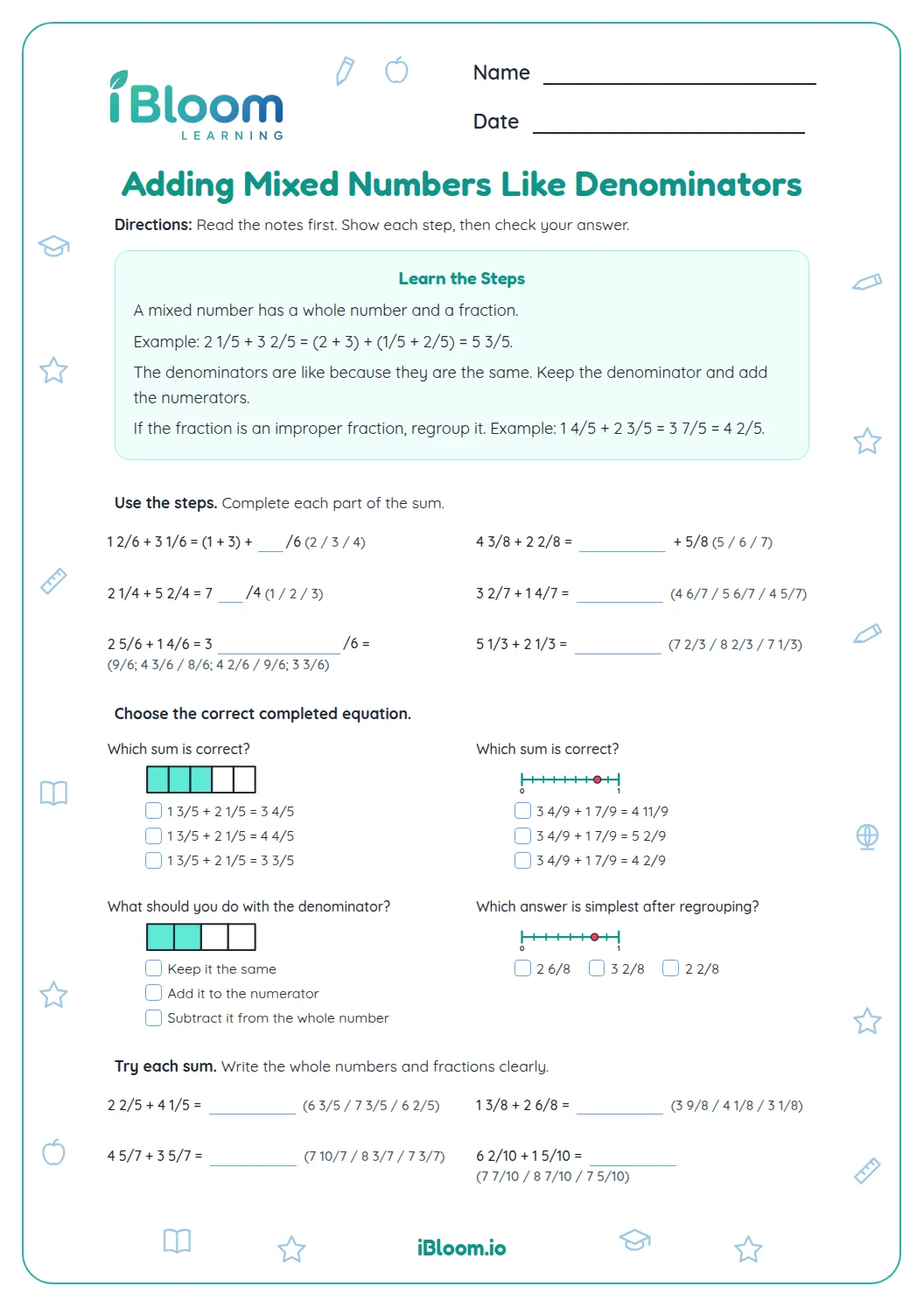
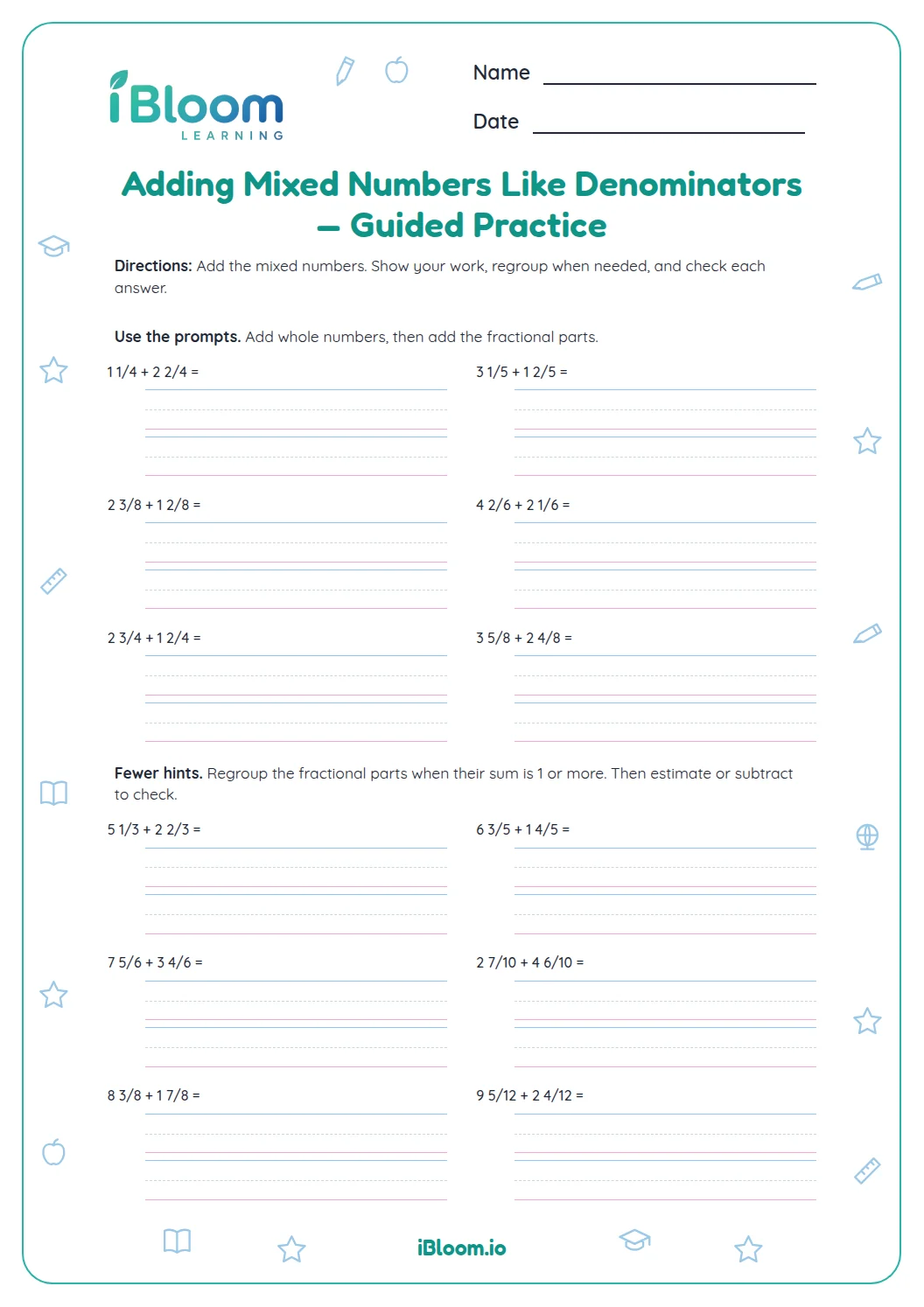
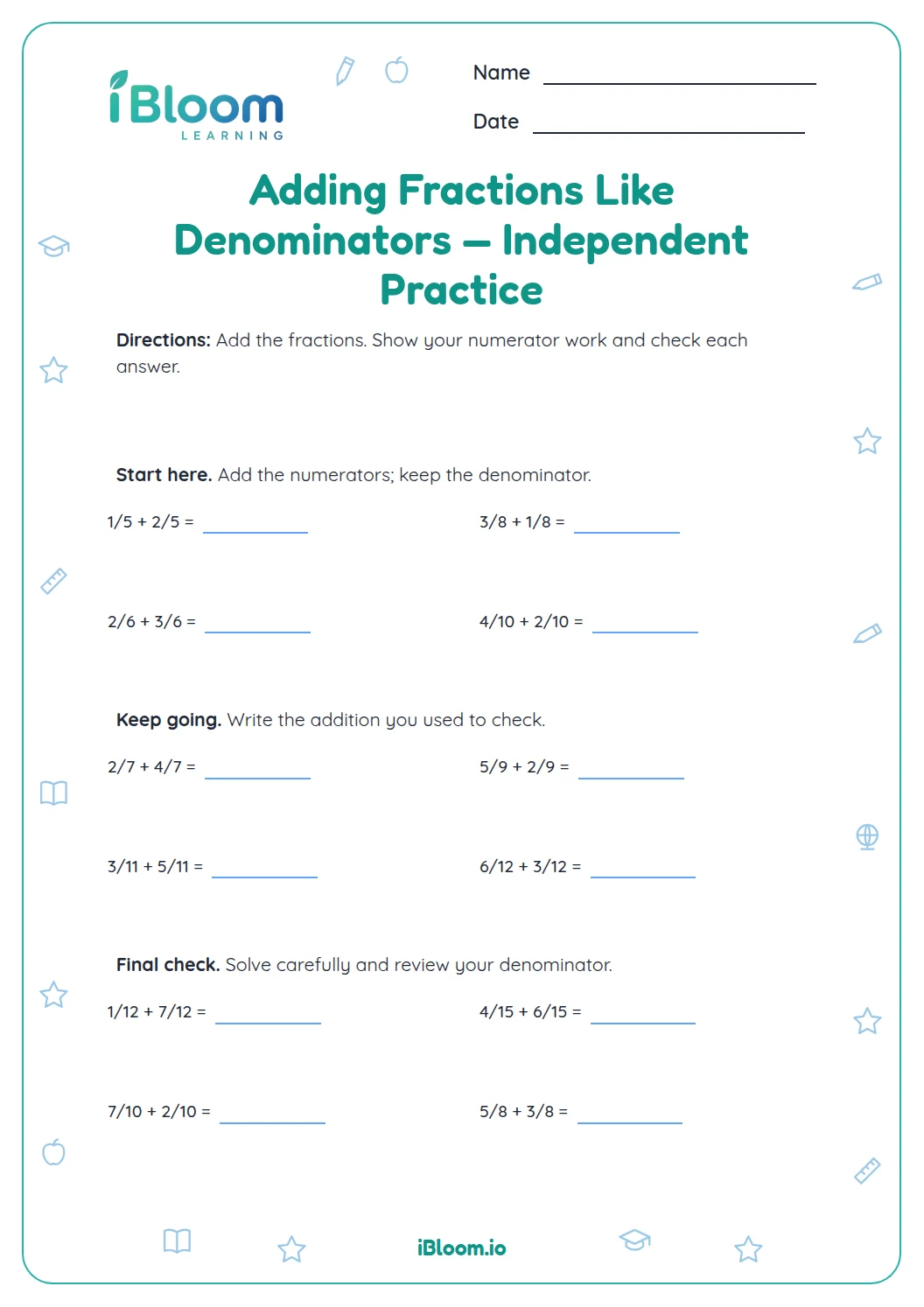
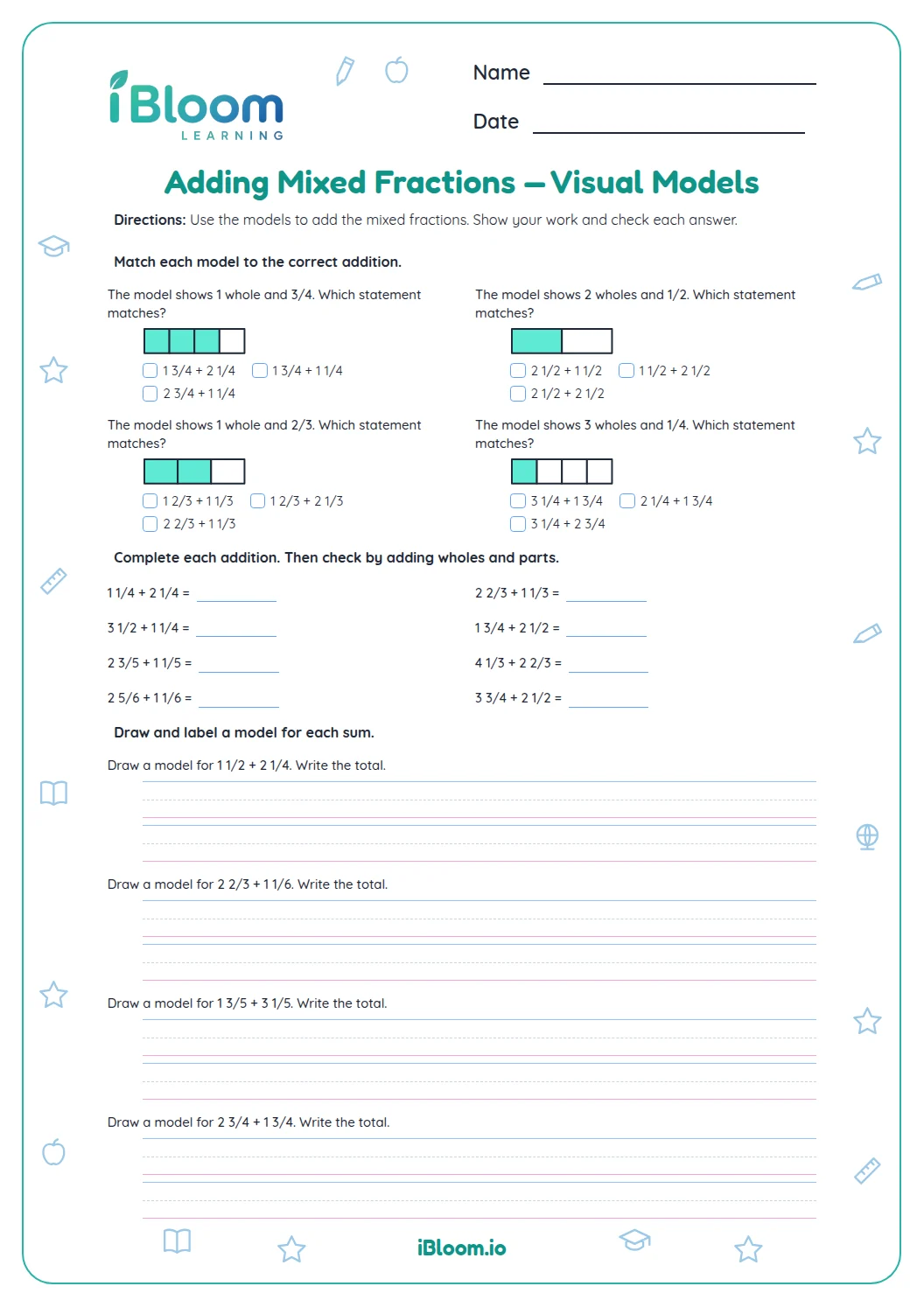
This Grade 3 visual-model worksheet has 15 questions on adding mixed numbers with like denominators. Each fraction bar represents the first addend, and the prompt gives the second addend, so students can connect the shaded parts to the sum. The three parts move from reading models to regrouping and independent checks. A separate answer key is included; the skill aligns with Common Core 4.NF.B.3.c.
Aligned to 4.NF.B.3.c
How does a fraction bar show a mixed number?
Count the fully shaded bars as wholes, then count the shaded parts in the next bar. The denominator tells how many equal parts make one whole. In question 1 the model shows 1 2/4; add 1 1/4 to get 2 3/4.
- 1Model: 1 2/4
- 21 2/4 + 1 1/4 = 2 3/4
How do students regroup the shaded parts?
Add the fractional parts using the same denominator. If the numerator total reaches the denominator, trade that group for one whole. For 2 5/6 + 1 4/6, the fractional parts make 9/6, or 1 3/6; the total is 4 1/2.
What is pictured on this worksheet?
All 15 questions include a fraction-bar model for the first addend and print the second addend in the prompt. The final answer should combine the whole-number parts with any regrouped fractional whole.
How to use this worksheet
- 1Read the model as whole bars and shaded fractional parts.
- 2Copy that mixed number as the first addend.
- 3Add the second addend shown in the prompt.
- 4Regroup any complete set of parts as one whole.
- 5Check the total against the shaded amount and answer key.
Common mistakes and quick fixes
The mistake
Adding unlike place values or pieces without naming their unit.
The fix
Say the unit or denominator aloud as you combine the values.
The mistake
Stopping when the fractional parts make one or more wholes.
The fix
Trade each complete set of parts for a whole and include it in the total.
The mistake
Copying an answer before checking every addend.
The fix
Read each addend again and check the total with the model or a second calculation.
Common Core alignment
This worksheet practices the fraction addition described in the standard below.
Add fractions or mixed numbers with like denominators and regroup when needed.
On this sheet: Students add fractions with like denominators and regroup fractional parts into wholes.
Show the official wordingHide the official wording
Add and subtract mixed numbers with like denominators, e.g., by replacing each mixed number with an equivalent fraction, and/or by using properties of operations and the relationship between addition and subtraction.
What to practice next
Make more practice
Further reading
Questions parents and teachers ask
What does each fraction bar represent?
Each bar shows the first mixed-number addend in its question. Fully shaded bars represent whole units, and the shaded pieces in the next bar represent the numerator. The denominator is printed in the addend, and the prompt supplies the second number to add.
What is the sum of 2 5/6 and 1 4/6?
The sum is 4 1/2. Add the whole numbers to get 3, and add the fractions to get 9/6. Rename 9/6 as 1 3/6, then combine the extra whole with 3 and simplify 3/6 to 1/2. The bar model helps show the regrouped whole.
How can students use a model to check an answer?
First read the model as a mixed number by counting whole bars and shaded parts. Then add the second addend from the prompt. Students can check whether the total amount is greater than either addend and whether any complete group of fractional parts was regrouped as a whole.
Does every question show a model?
Yes. Every one of the 15 questions includes a fraction bar for its first addend. The second addend is printed in the prompt. Students connect the pictured amount to the addition sentence, then write the total in simplest mixed-number form when needed.
Is an answer key included?
Yes. A separate key lists the sum for each model question. It can be used after students finish the page to check both the model reading and the regrouping step. Ask the student to explain how many wholes and fractional parts appear in the total.