





About this worksheet
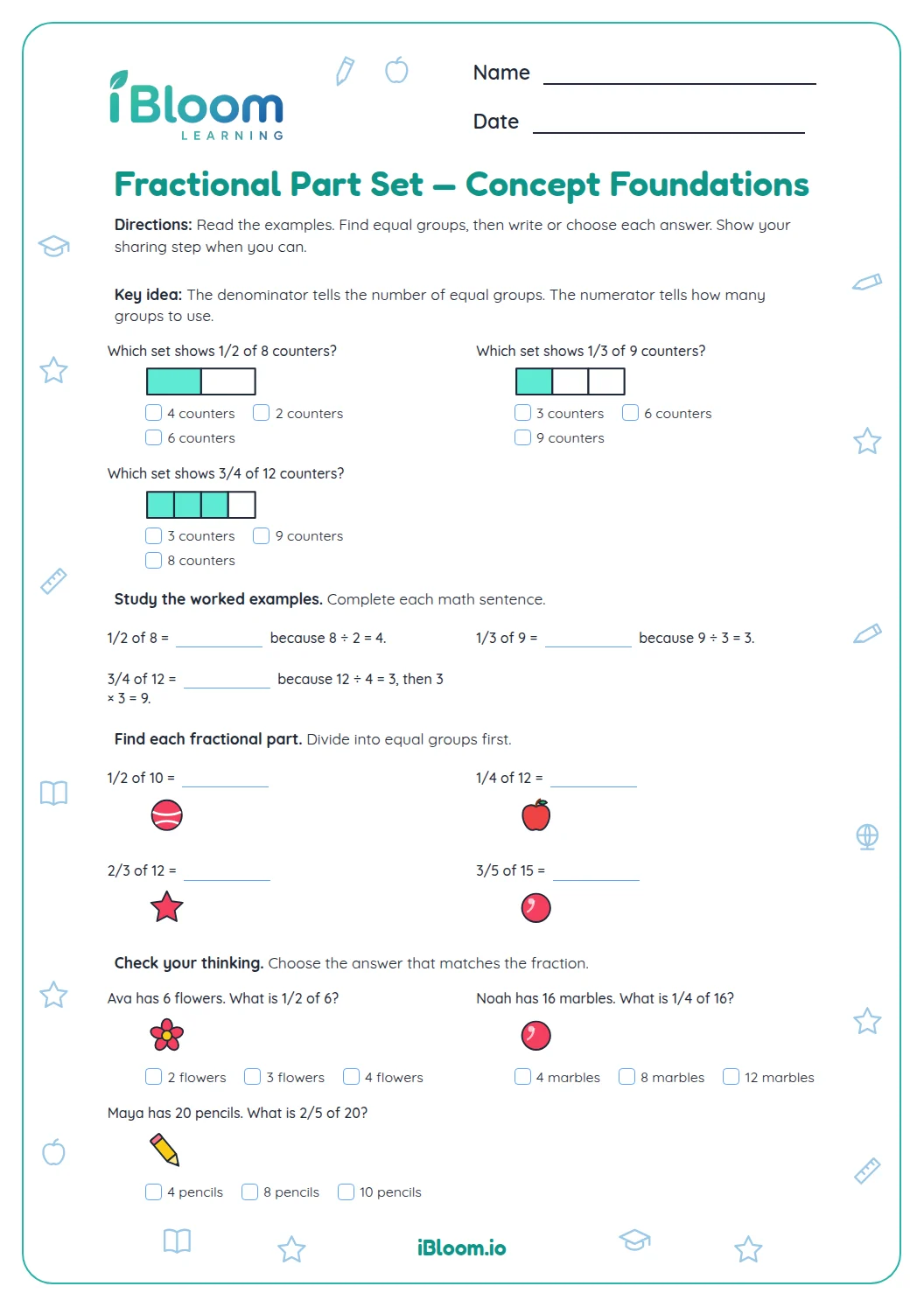
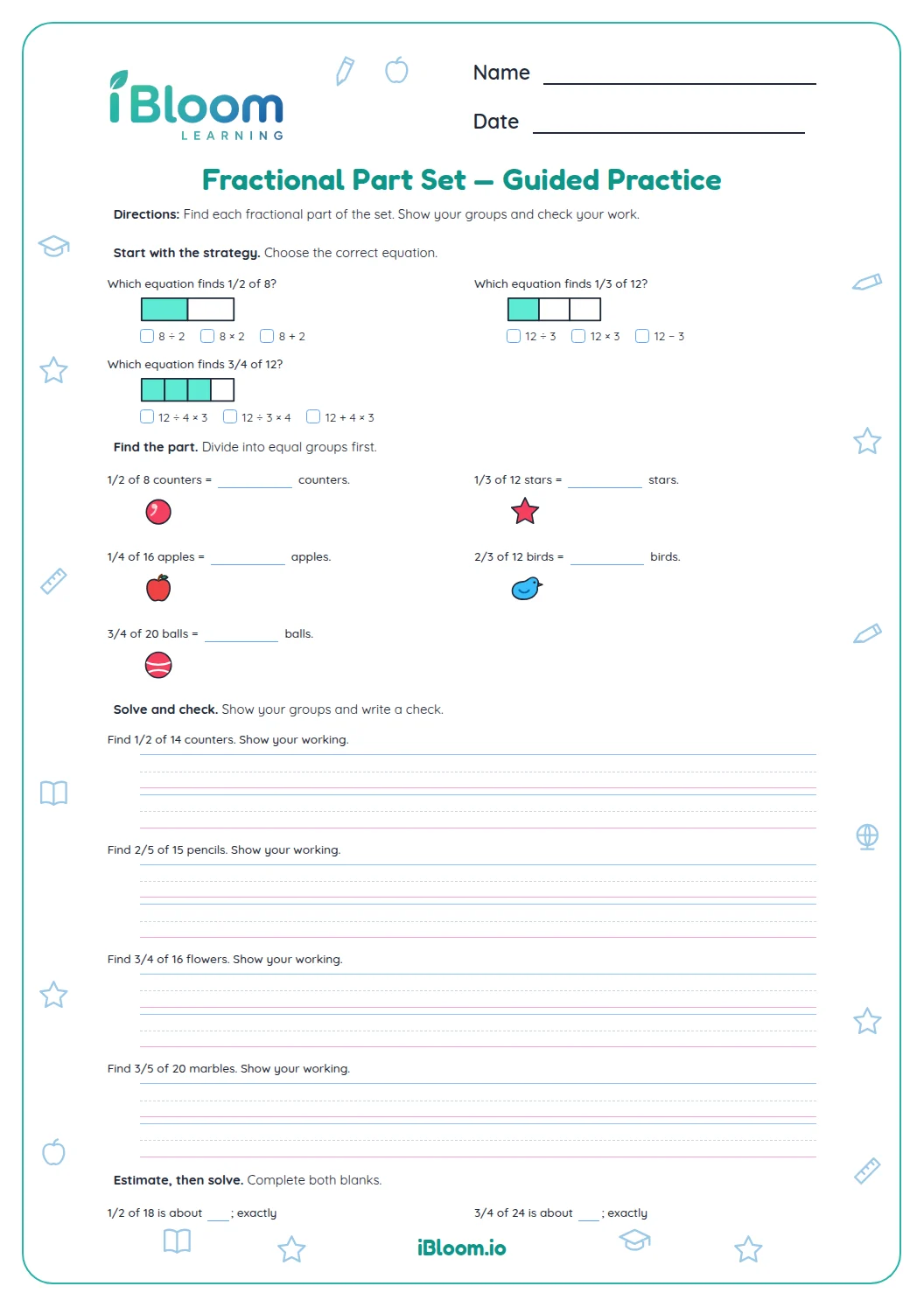
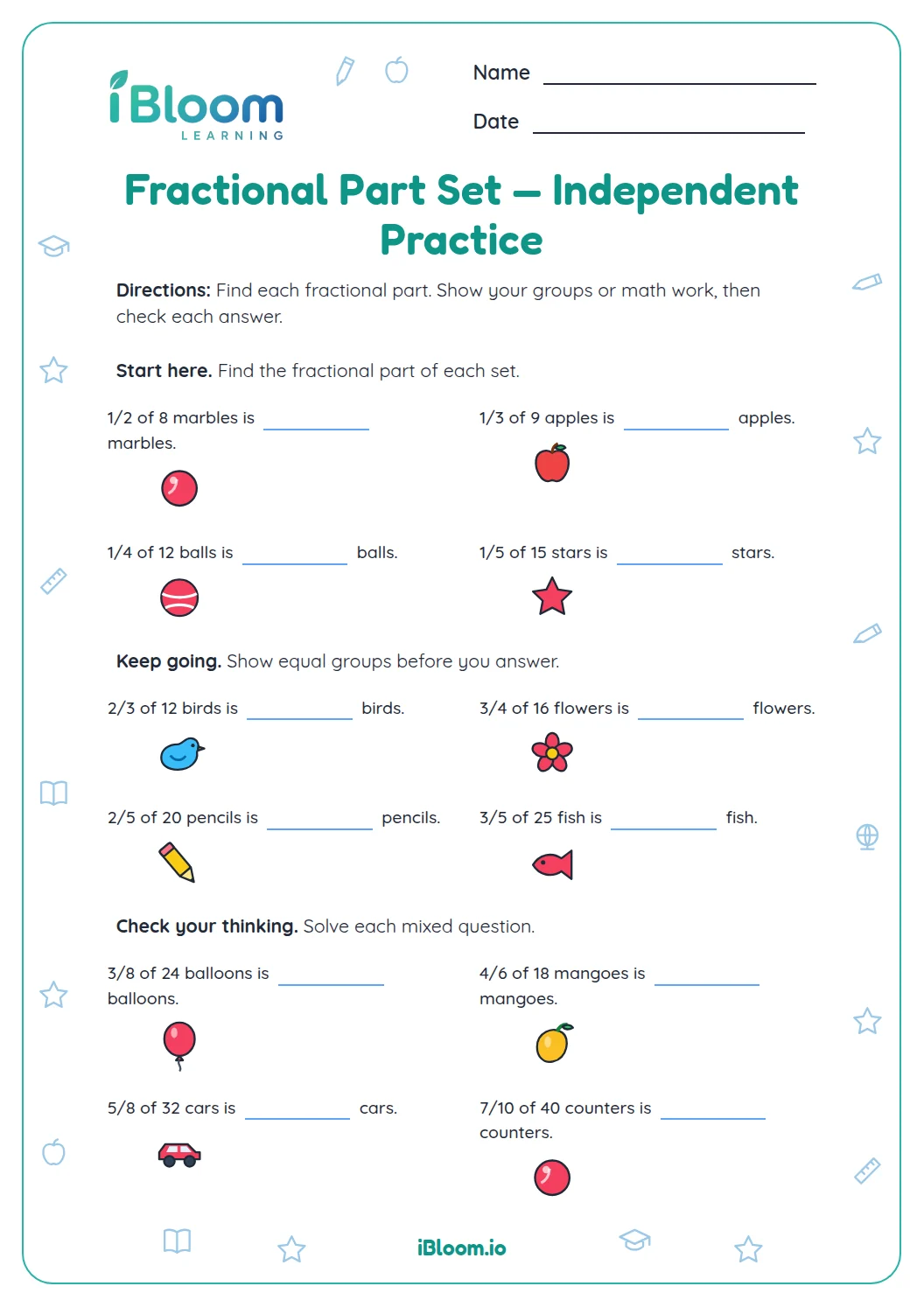
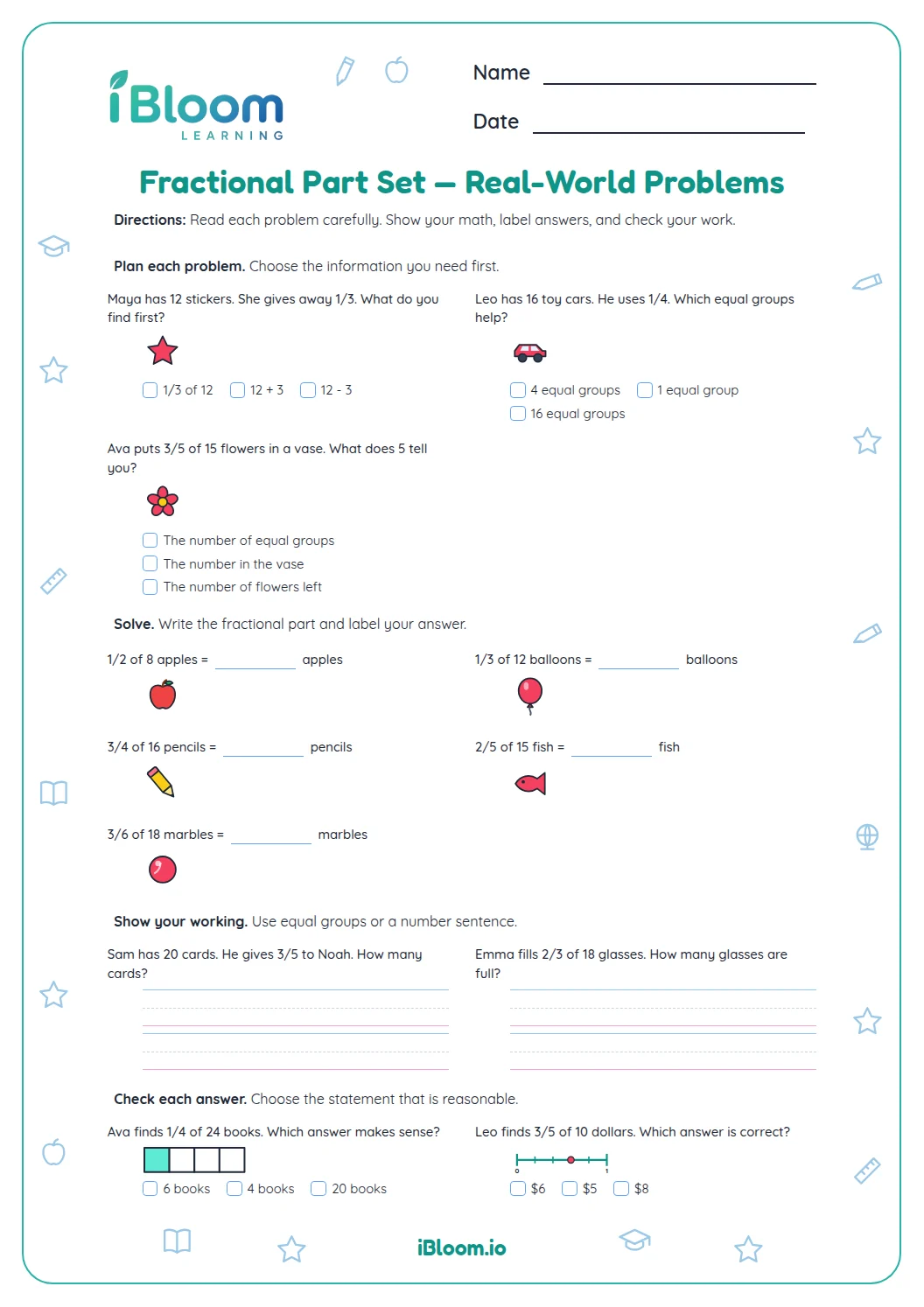
This printable worksheet helps Grade 3 students find fractions of sets using full arrays and familiar objects. Across 15 questions, children split groups into equal parts, count the requested parts, and check answers with addition. Arrays show the full quantities, while the stories ask learners to use the same group idea. The practice connects fraction multiplication to whole-number quantities.
How do equal groups show a fraction of a set?
A fraction of a set tells how many equal groups to make and how many groups to count. For 2/3 of 15, divide 15 objects into 3 groups of 5, then count 2 groups: 5 + 5 = 10.
Question 1 draws the full set as a 3 by 5 array; the requested two groups contain ten apples.
- 115 objects ÷ 3 equal groups = 5 in each
- 22 groups: 5 + 5 = 10
- 32/3 of 15 = 10
How can addition check the answer?
Add only the groups that make up the requested fraction. For 3/4 of 20, each fourth is 5, so three fourths are 5 + 5 + 5 = 15. Four groups would reconstruct the entire set, not the requested part.
What does this set worksheet include?
Fourteen questions use shaded bars and circles with thirds, fourths, fifths, and sixths. Every mixed number in the key includes its fractional part.
How to use this worksheet
- 1Read the denominator to decide how many equal groups to make.
- 2Divide the total set into those equal groups.
- 3Use the numerator to decide how many groups to count.
- 4Add the counted groups to check the amount.
- 5Name the object and unit in each story answer.
Common mistakes and quick fixes
The mistake
Adding all the groups instead of only the requested ones
The fix
Count the number of groups named by the numerator.
The mistake
Making unequal groups
The fix
Check that the total is shared evenly before counting.
The mistake
Using the numerator as the group size
The fix
Find one group by dividing the total by the denominator.
What to practice next
Make more practice
Further reading
Questions parents and teachers ask
How do you find 2/3 of 15?
Split 15 into 3 equal groups, which makes 5 in each group, then count 2 groups. The answer is 10. Question 1 shows 15 apples arranged in three equal rows so the group size is easy to see. The 15 objects are arranged in three equal rows, so each row contains five apples.
Why is 5 + 5 = 10 the check for 2/3 of 15?
Each of the three equal groups has 5 objects, and two groups make the fraction 2/3. Adding 5 + 5 gives 10. Adding a third 5 would rebuild all 15 objects, which is the whole set rather than the requested part. Count the rows as fourths of the set, then take three of those equal groups.
How can I check 3/4 of 20?
Make four equal groups of 5 because 20 ÷ 4 = 5. Then count three groups: 5 + 5 + 5 = 15. Question 5 asks children to choose this sum from options that distinguish the requested part from the whole. The arrays make the total visible before the learner counts the requested part.
What does the numerator tell us in a set problem?
The numerator tells how many equal groups to count after the set is split according to the denominator. In 3/4 of 20, four groups are made and three are counted. The denominator and numerator work together. Division finds one equal group, and multiplication or repeated addition finds several groups.
Can a fraction of a set be a whole number?
Yes. In these examples, the set sizes divide evenly into the number of equal groups. For instance, 1/4 of 16 is 4, and 3/4 of 16 is 12. Equal grouping keeps each part the same size. Each story names the whole set and the part being described, so the total is clear.
Does the worksheet include an answer key?
Yes. A separate key provides each set answer and the correct equal-group sums. Use the arrays to discuss how the denominator sets the number of equal groups and the numerator determines how many groups count. The key names the count and unit for each story, making answers easy to review.