
About this worksheet
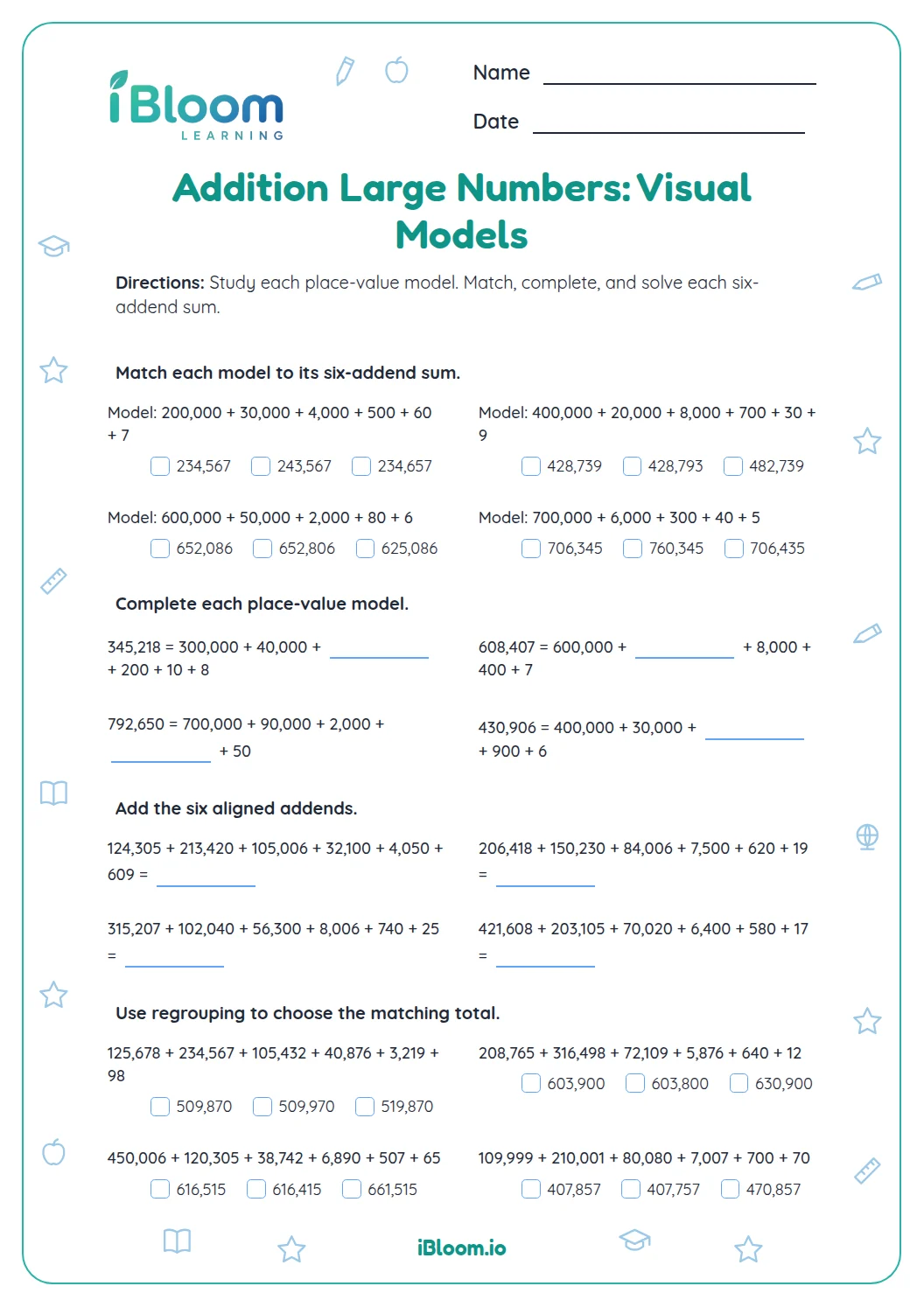
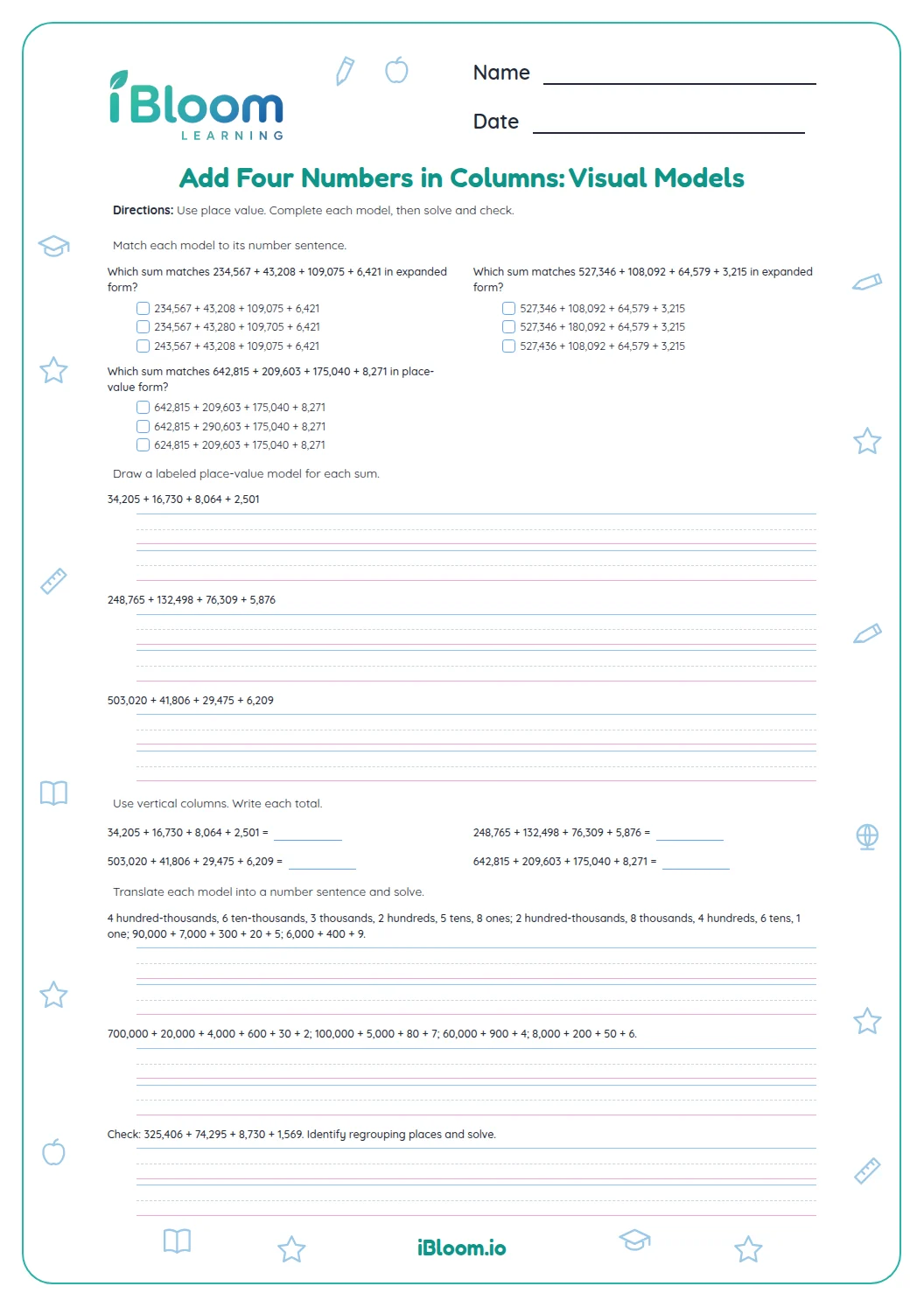
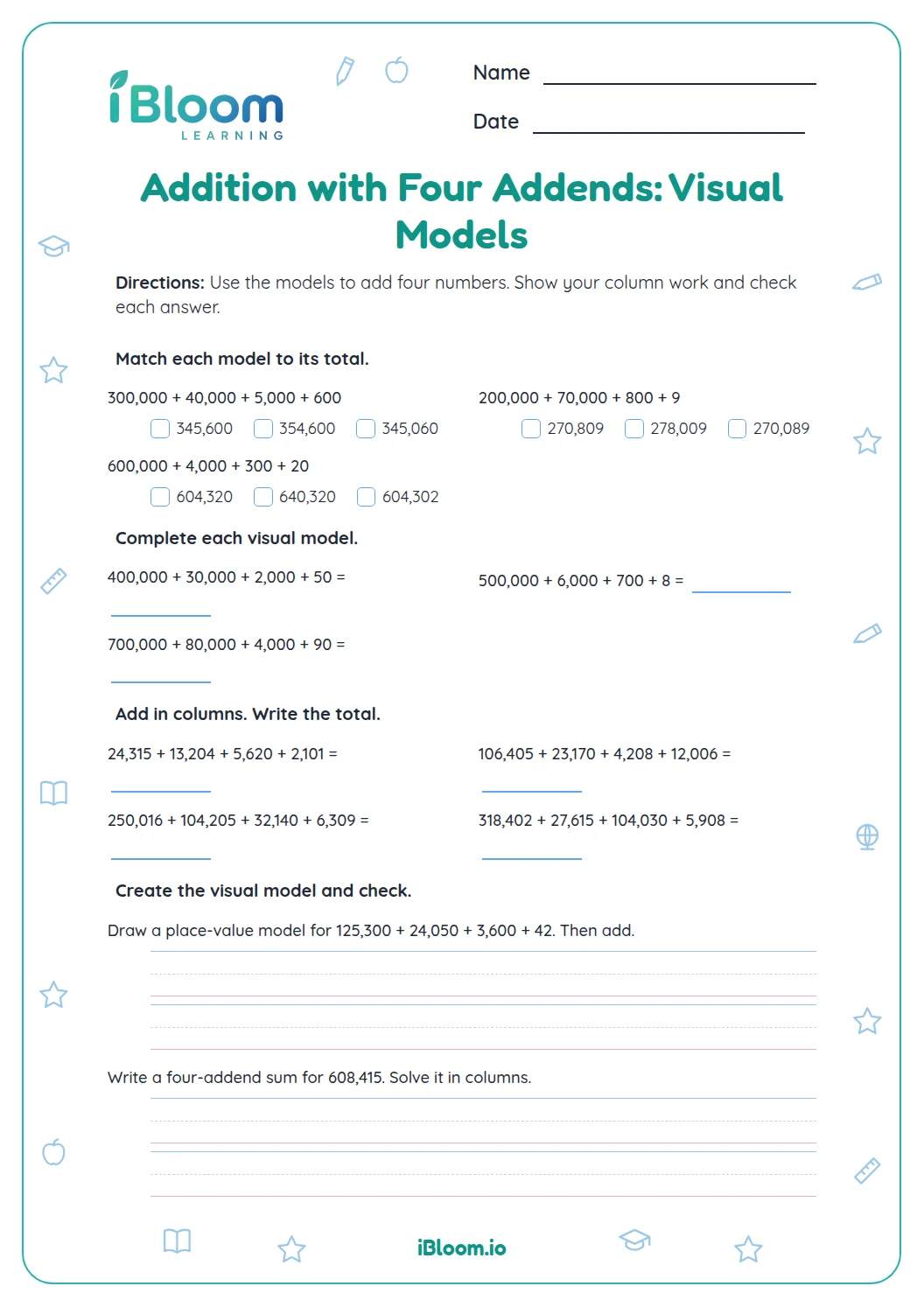
This Grade 5 printable starts with place-value warm-ups, then gives students ten six-addend sums to align in columns and regroup. The answer key supplies a checked total for every problem. Students practice organizing large whole-number sums by place and checking that every addend is included.
Aligned to 5.NBT.B.7
How do you keep six addends organized?
Line up ones under ones, tens under tens, and each larger place in its own column. Add from right to left and carry each regrouped ten into the next column.
- 110,000 + 20,000 + 3,000 + 400 + 50 + 6
- 2Answer: 33,456
How can you check a large sum?
Estimate first, then add the six values again in a different order. The total should be close to the estimate and include every addend.
What does each part practice?
Part A reviews place value and expanded form. Parts B and C build from separated place-value addends to larger six-number sums, all with a single total to check.
How to solve a six-addend sum
- 1Write each addend on its own row.
- 2Align digits in the same place-value column.
- 3Add the ones column and regroup any ten.
- 4Continue through the larger places.
- 5Estimate or add in a different order to check.
Addition slips to watch for
The mistake
One addend is left out.
The fix
Count six rows before starting and six values in your check.
The mistake
Digits drift into the wrong columns.
The fix
Align the last digits, then verify every place.
The mistake
A regrouped ten is not added to the next column.
The fix
Write the carried value above the next column before continuing.
Common Core alignment
This worksheet practices 5.NBT.B.7 through its calculation and reasoning tasks.
Add whole numbers using place-value strategies and check sums.
On this sheet: Add whole numbers using place-value strategies and check sums.
Show the official wordingHide the official wording
Add, subtract, multiply, and divide decimals to hundredths, using concrete models or drawings and strategies based on place value, properties of operations, and/or the relationship between addition and subtraction; relate the strategy to a written method and explain the reasoning used.
What to practice next
Make more practice
Further reading
Questions parents and teachers ask
How many sums ask students to add six numbers?
Ten questions ask students to find the total of six addends. Four opening questions review the place-value parts that make those sums easier to organize. The worksheet spans two pages, and the answer key gives a total for each numbered item.
Why does the worksheet begin with place value?
The first four questions review how large numbers are built from place-value parts. That gives students a quick way to check whether a six-addend total is reasonable before they work through the longer sums in the later sections. This sequence keeps the warm-up connected to the main task. This sequence keeps the warm-up connected to the main task.
What does the answer key include?
The separate two-page key lists the correct response to all 14 questions, including each expanded form and each six-addend total. Students can compare one column at a time if a sum differs, then locate the place where regrouping changed the result.
How should students check a six-addend sum?
First estimate the total by rounding the addends. Then add the six numbers in a different order or check the column totals from right to left. The estimate helps catch a missing addend or a misplaced digit before students mark the work complete. before students mark the work complete.
How long does the worksheet take?
Plan for about 25 to 35 minutes for all 14 questions. The place-value warm-ups are brief; the larger sums take longer because students need room to align the six addends and regroup carefully across several columns. across several columns.