


About this worksheet
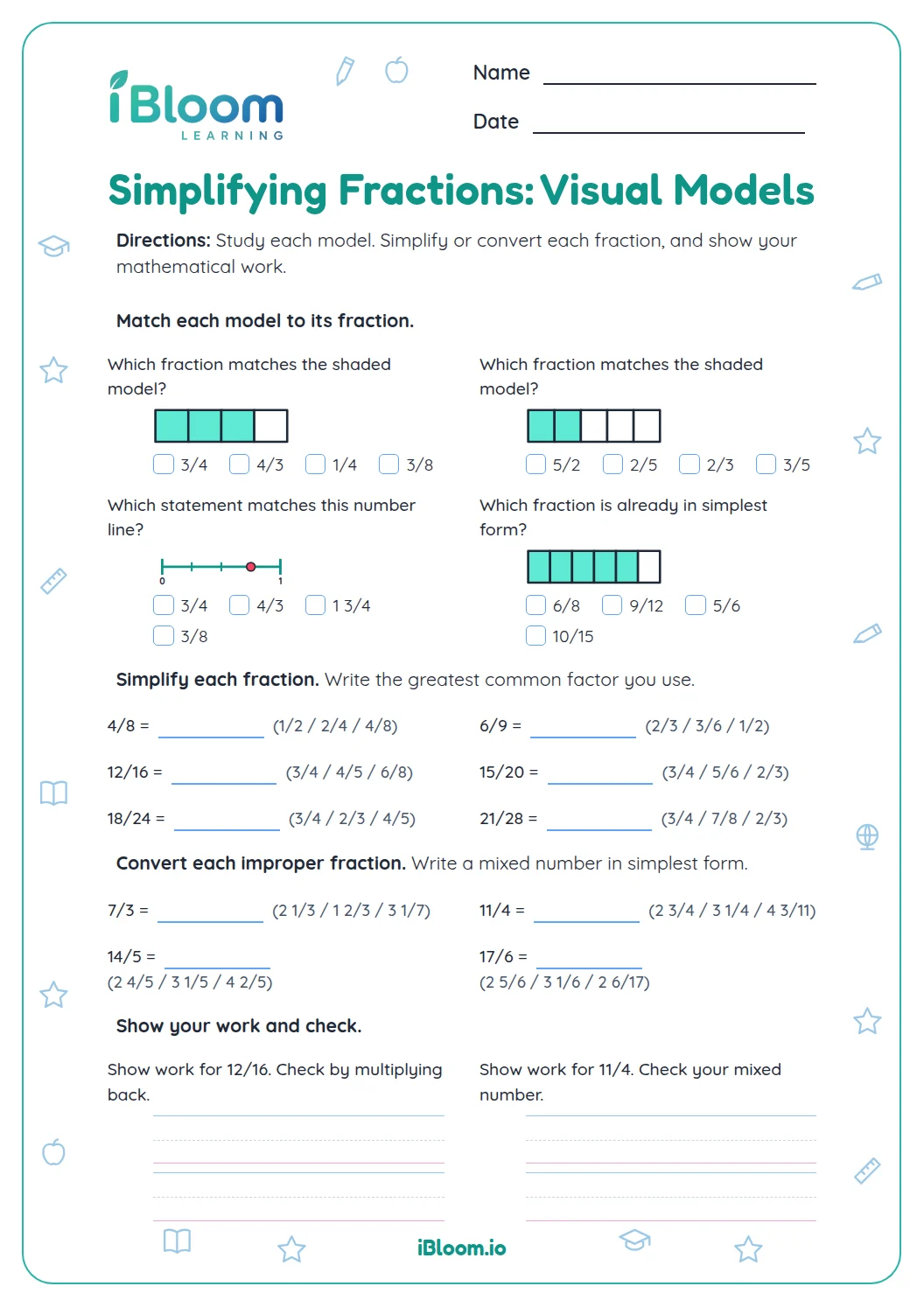
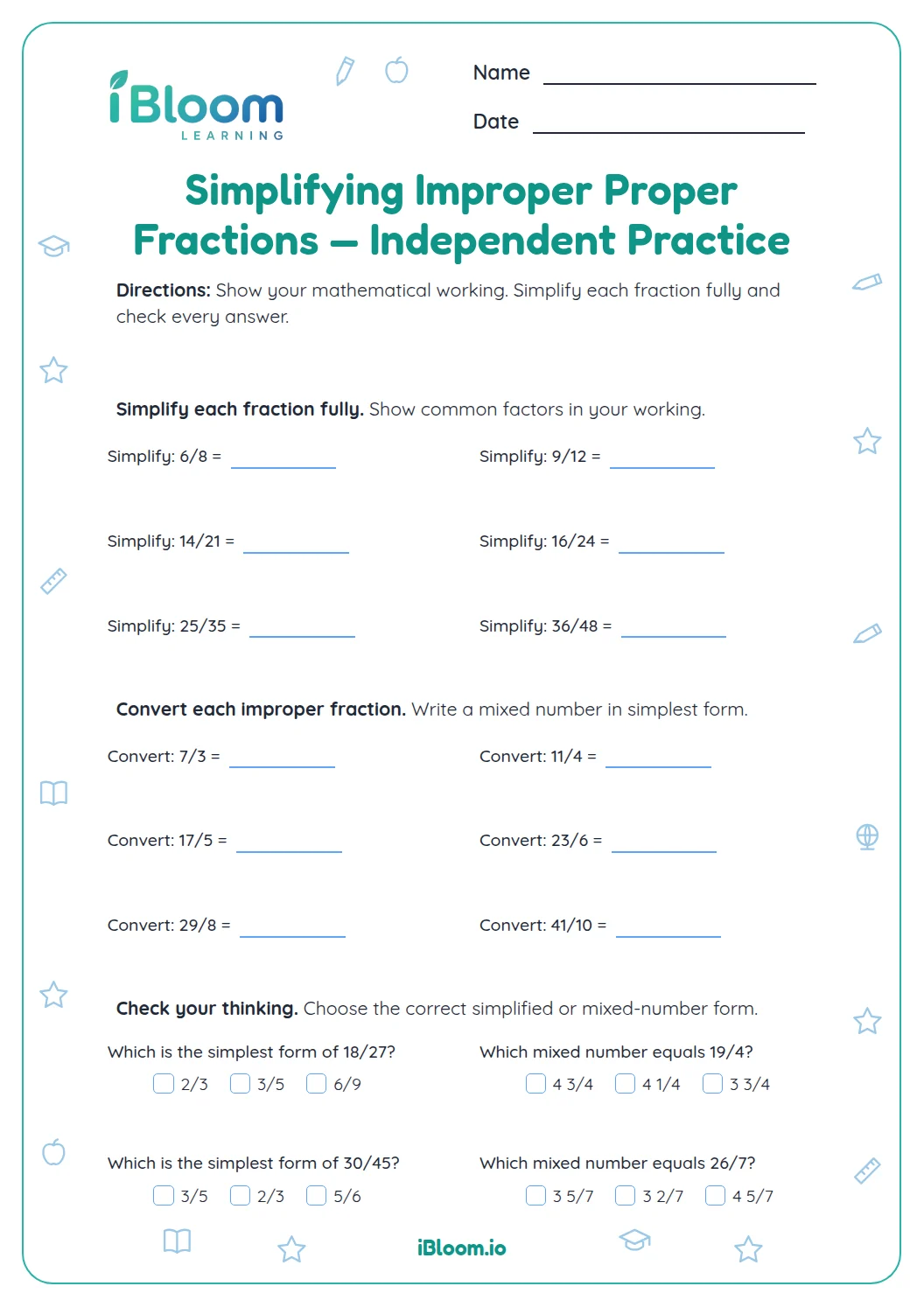
This two-page Grade 6 worksheet gives students guided practice with proper and improper fractions. Part A divides numerator and denominator by a shared factor; Part B connects division to quotient-and-remainder form; Parts C and D simplify fractions and write mixed numbers. A separate two-page key lists multi-blank answers in the same order as the blanks.
Aligned to 6.NS.B.4
How do you simplify a fraction?
A fraction stays equivalent when its numerator and denominator are divided by the same nonzero factor. For 12/18, dividing both numbers by 6 gives 2/3. The value is unchanged because both parts were scaled equally.
- 112 ÷ 6 = 2
- 218 ÷ 6 = 3
- 312/18 = 2/3
How does a quotient become a mixed number?
Divide the numerator by the denominator. The quotient is the whole-number part, the remainder is the new numerator, and the original denominator stays in the fractional part.
- 17 ÷ 3 = 2 remainder 1
- 27/3 = 2 1/3
How to use this worksheet
- 1In Part A, divide the numerator and denominator by the same number.
- 2In Part B, divide the numerator by the denominator and record quotient and remainder.
- 3In Part C, reduce each fraction until no common factor above 1 remains.
- 4In Part D, put the quotient first and use the remainder over the original denominator.
- 5Check each result by multiplying back or converting to an improper fraction.
Common mistakes and fixes
The mistake
Dividing only one part of a fraction.
The fix
Use one shared factor on both numerator and denominator.
The mistake
Using the remainder as the denominator.
The fix
Keep the original denominator in the mixed number.
The mistake
Stopping before the fraction is simplest.
The fix
Check whether the new numerator and denominator still share a factor above 1.
Common Core alignment
This worksheet gives students practice with the fraction skills described below.
Use the greatest common factor to simplify fractions.
On this sheet: Students divide each numerator and denominator by a greatest common factor to write a fraction in simplest form.
Show the official wordingHide the official wording
Find the greatest common factor of two whole numbers less than or equal to 100 and the least common multiple of two whole numbers less than or equal to 12. Use the distributive property to express a sum of two whole numbers 1–100 with a common factor as a multiple of a sum of two whole numbers with no common factor.
What to practice next
Make more practice
Further reading
Questions parents and teachers ask
What does the remainder become?
The remainder becomes the numerator of the fractional part. For 7/3, 3 goes into 7 twice with 1 left over, so the mixed number is 2 1/3. The denominator stays 3 because the original fraction was measured in thirds.
How do students simplify a fraction?
Find a number that divides both numerator and denominator evenly, then divide both by it. For example, dividing 12 and 18 by 6 changes 12/18 to 2/3 without changing its value. Students can check that the calculation matches the values and directions printed in this worksheet before using the separate key to review the result.
Why are there two blanks in the first questions?
The first blank is for the new numerator and the second is for the new denominator. The answer key lists those values separately and in order. Students can check that the calculation matches the values and directions printed in this worksheet before using the separate key to review the result.
Does the worksheet include proper and improper fractions?
Yes. Students simplify proper fractions and convert improper fractions such as 7/3 into mixed numbers using quotient and remainder. Students can check that the calculation matches the values and directions printed in this worksheet before using the separate key to review the result.
What should students check after converting?
Convert the mixed number back to an improper fraction. For 2 1/3, compute 2 × 3 + 1 = 7, which restores 7/3. Students can check that the calculation matches the values and directions printed in this worksheet before using the separate key to review the result.