






About this worksheet
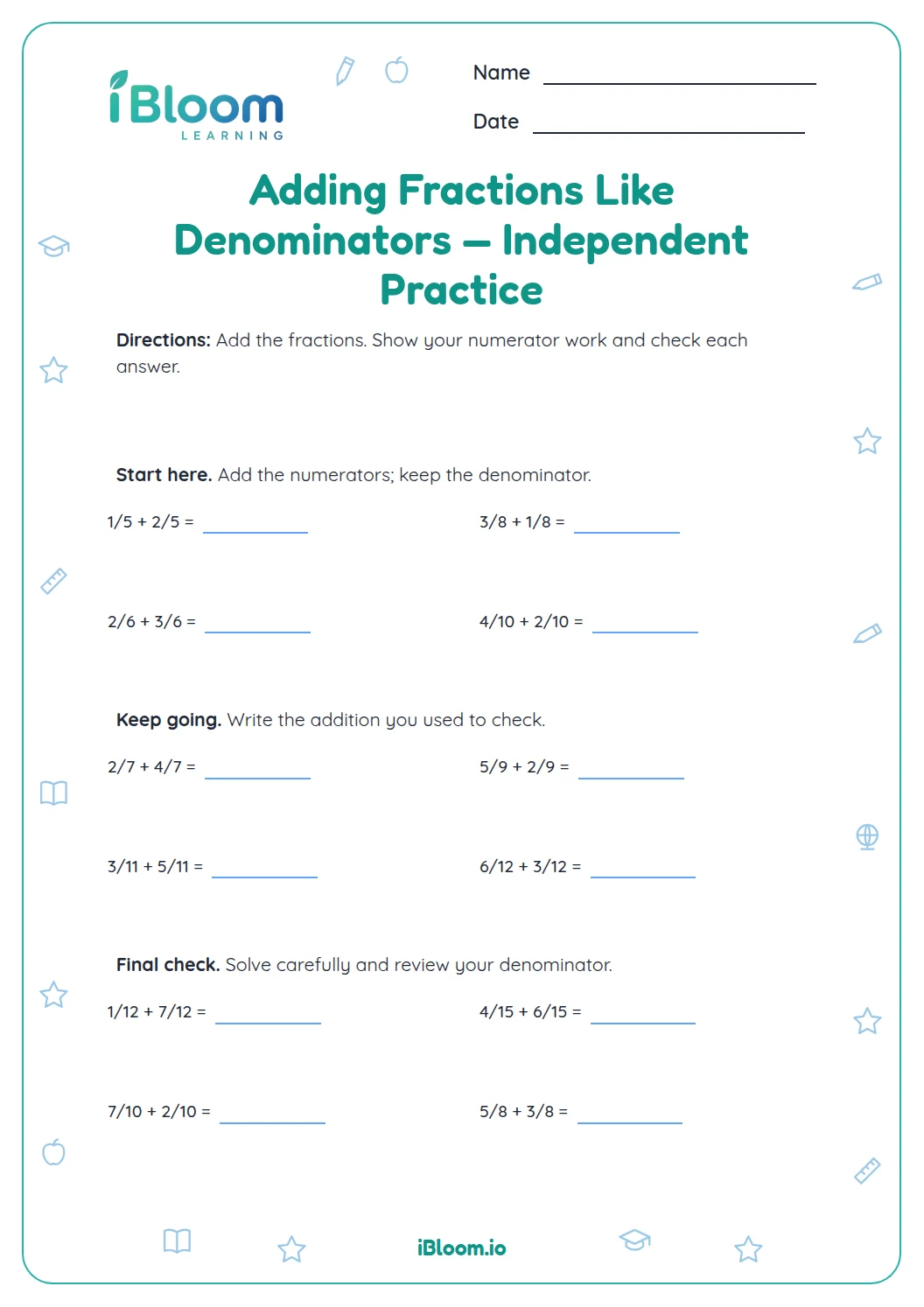
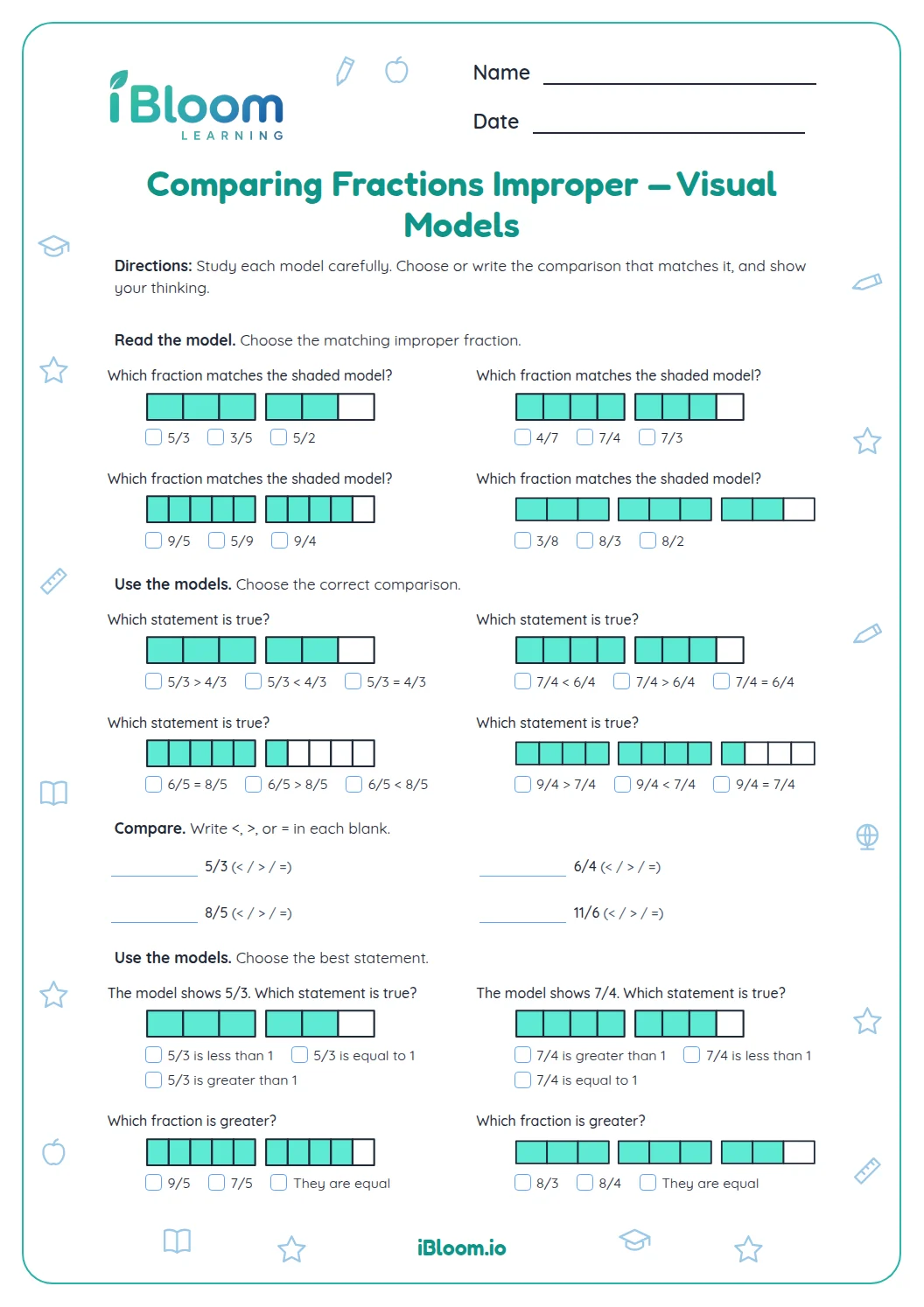
This independent practice page gives Grade 3 students a chance to identify fractions without a worked example beside each item. They read four shaded models, interpret short everyday situations, name numerator and denominator, and check common reversals. The 15 questions use thirds, fourths, sixths and eighths and include a separate answer key.
How do I identify a fraction in a situation?
Find the whole, then count its equal parts. The total parts form the denominator; the parts named in the question form the numerator. In question 6, three of eight snack pieces were eaten, so the fraction is 3/8.
- 18 equal snack pieces in all.
- 23 pieces were eaten.
- 3Numerator = 3; denominator = 8.
- 4Sam ate 3/8.
What kinds of answers will students give?
Some answers are fractions read from a model or story, and some are single numbers identifying the numerator or denominator. Two choice questions ask students to spot a reversed fraction, and the final item asks for a brief explanation.
How to work through the fraction models
- 1Mark the whole before counting its sections.
- 2Use all equal sections for the denominator.
- 3Use only the parts named in the question for the numerator.
- 4Pay attention to whether the question says shaded, eaten, planted or unshaded.
- 5Read the fraction in numerator-over-denominator order.
Common fraction mistakes and quick fixes
The mistake
Writing the total pieces over the selected pieces.
The fix
Use the phrase “selected out of total” to keep numerator then denominator.
The mistake
Reporting shaded pieces when asked for unshaded pieces.
The fix
Identify which group the words ask about before counting the numerator.
The mistake
Using unequal parts as if they were equal shares.
The fix
Check that the whole is partitioned into equal pieces before naming a fraction.
What to practice next
Make more practice
Further reading
Questions parents and teachers ask
Is this sheet meant for independent work?
Yes. It is designed for students who have already learned that the numerator counts selected parts and the denominator counts all equal parts. Students can work through the models and short situations on their own, then use the separate answer key to check. Have the student name the total equal parts first, then the selected parts, and
How do I answer the unshaded-parts question?
Keep the total number of equal parts as the denominator, then count only the parts that are not shaded for the numerator. With six parts total and two shaded, four are unshaded, so the fraction is 4/6. Have the student name the total equal parts first, then the selected parts, and connect each count to its place in the fraction.
Why does the worksheet ask for the numerator and denominator separately?
Naming each number separately checks that students understand what the notation means, rather than only copying a fraction. For 5/8, five is the numerator and eight is the denominator. Have the student name the total equal parts first, then the selected parts, and connect each count to its place in the fraction.
What does the final explanation need to include?
A clear response says that 4/6 means four selected or shaded parts out of six equal parts in the whole. The key gives a short sample; students may use different words if they explain both the selected amount and the total. Have the student name the total equal parts first, then the selected parts, and connect each
Does the answer key include all 15 answers?
Yes. It lists the four model fractions, each story fraction, numerator and denominator responses, the two choice answers and a sample for the final explanation. The key is a separate page so it can be kept aside during practice. Have the student name the total equal parts first, then the selected parts, and connect each count to