
About this worksheet
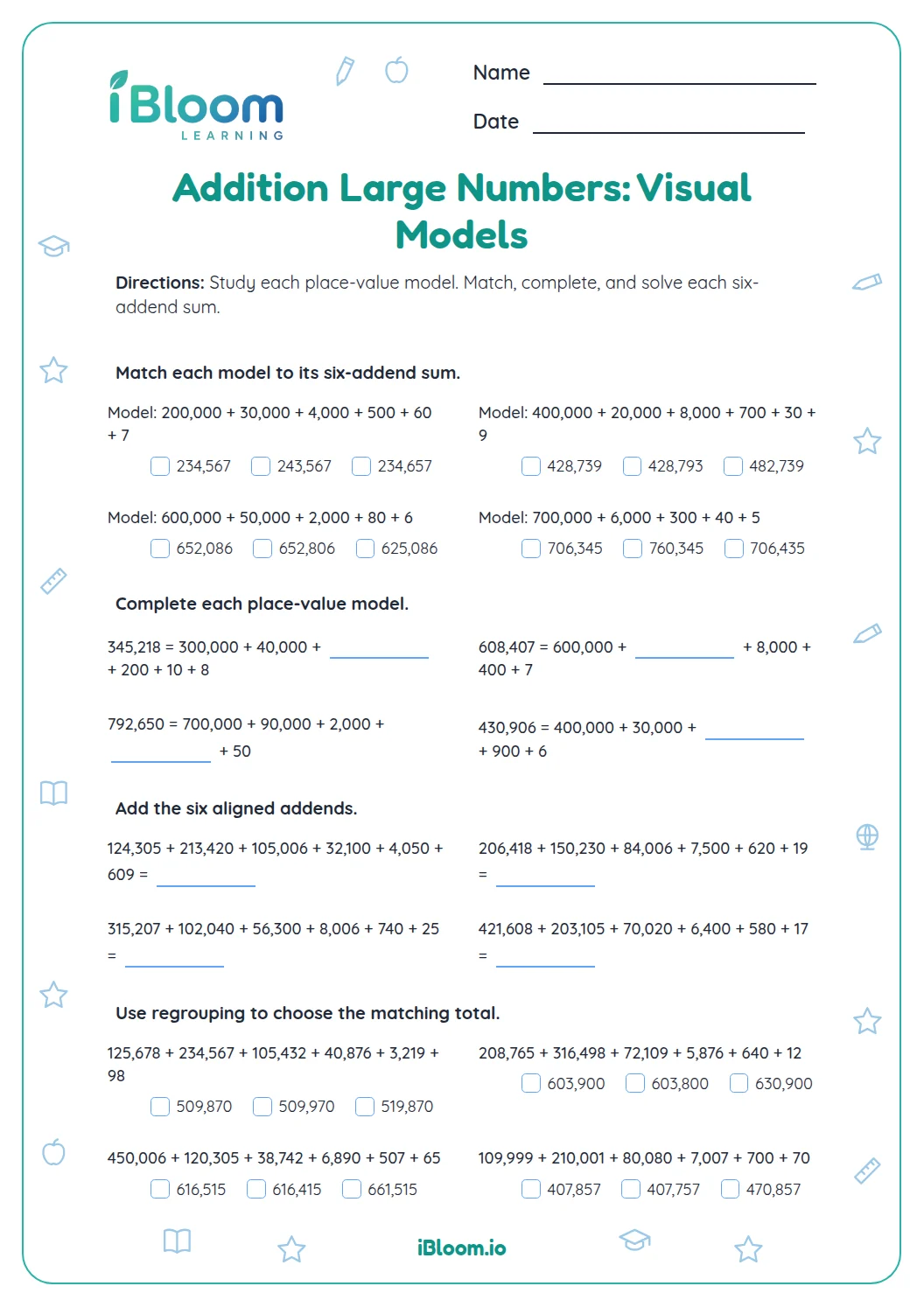
This Grade 5 printable has 16 real-world addition problems, each with six multi-digit addends in its prompt. Students line up place values, regroup as needed, and check totals with an estimate. The contexts include books, tickets, distances, donations, supplies, and scores. Each prompt identifies the quantity being counted, and the answer key gives the sum without repeating a printed unit. The practice connects to CCSS 4.NBT.B.4.
Aligned to 4.NBT.B.4
How do you add six amounts in columns?
For q1, write 1,245; 2,386; 1,754; 2,098; 1,327; and 1,890 in aligned columns. Add from ones to ten-thousands, regrouping whenever a column reaches 10. The total is 10,700.
How can an estimate check a total?
Round the six values to friendly hundreds or thousands, add those estimates, and compare with the exact sum. A result far from the estimate is a signal to check for a dropped addend or regrouping slip.
How should answers be labeled?
Use the unit stated in the story when writing your response. The answer key gives the numeric total because the worksheet prompt already names the quantity.
How to use this worksheet
- 1Copy the six amounts into columns, lining up ones, tens, hundreds and thousands.
- 2Estimate the total to check whether your answer is reasonable.
- 3Add the ones column first and regroup when needed.
- 4Continue left, then label the total with the story unit.
Common mistakes and quick fixes
The mistake
Leaving out one of the six addends.
The fix
Check off each amount as you copy it, then count six entries in your setup.
The mistake
Misaligning digits by place value.
The fix
Keep ones under ones, tens under tens, and so on before adding.
The mistake
Forgetting a regrouped ten.
The fix
Write the carried digit above the next column and include it in that column’s sum.
Common Core alignment
The questions practice this standard through the specific calculations and models on the sheet.
Use the standard algorithm to add multi-digit whole numbers accurately.
On this sheet: The six-addend totals require accurate multi-digit whole-number addition.
Show the official wordingHide the official wording
Fluently add and subtract multi-digit whole numbers using the standard algorithm.
What to practice next
Make more practice
Further reading
Questions parents and teachers ask
How should students add six numbers?
Write each amount in a vertical column and line up digits by place value. Add from the ones place toward the left, regrouping when a column totals ten or more. Then estimate to check the total and attach the unit from the story.
Why are six addends included in each problem?
Six addends give students practice organizing more than a simple pair of numbers. They must track every amount, keep place values aligned and regroup accurately across several columns. The contexts provide a reason for combining all six amounts. Repeat this check for each story. It helps catch a skipped number before the final total is written.
Should students estimate before calculating?
Yes. A quick estimate helps catch a total that is far too large or small. Round each amount to a nearby hundred or thousand, add those rounded values, and compare the estimate with the exact sum from column addition. Compare the estimate with the exact sum. This makes a large place-value error easier to spot.
What does the answer key include?
The key lists each total as a number. The story already names what is counted, such as books, tickets, or meters, so students can add the appropriate label when they write their response. This avoids printing a unit twice when it appears beside an answer blank.
How can a student avoid skipping an addend?
Copy the amounts one at a time and mark each one off in the prompt. Before adding, count the six entries in the written setup. After calculating, estimate again using all six amounts to confirm the scale of the result.