Counting Numbers 1 To 20 worksheet for Class 1

Lesson-Wise Builder
A premium AI tool that creates syllabus-aligned questions and worksheets for any lesson in seconds.
Counting numbers from 1 to 20 involves more than reciting a rhyme. A Class 1 learner needs to say the number sequence in order, match one count word to each object, recognise the numerals, and know that the last number tells how many objects are in the group.
Use the Counting Numbers 1–20 activity for focused practice. Ask the child to show how they counted, especially when objects are scattered or when the sequence crosses from 9 to 10 and from 19 to 20.
Build a stable number sequence
Begin by counting aloud from 1 to 20 at a steady pace. Then change the starting point: begin at 4 and continue to 12, or begin at 11 and continue to 20. This checks whether the child understands the sequence rather than only repeating it from the beginning.
Short sequence prompts
- Say the numbers after 7.
- Start at 13 and count to 18.
- What comes immediately after 19?
- What number comes before 10?
Use number cards if the child gets stuck. Let them arrange a small part of the sequence and read it back.
Count each object once
One-to-one correspondence means giving one count word to one object. Children may know the words from 1 to 20 but still skip an object or count one twice. Encourage them to touch, point to, or move each object as they count.
Make the counting path visible
For scattered objects, start at one side and move in a consistent direction. For movable counters, slide each counted object into a new group. The movement leaves evidence of what has already been counted.
Understand that the last number tells how many
After counting 12 objects, ask, “How many are there?” A child with cardinality understands that the answer is 12 without starting again. If the child recounts every time, model the sentence: “I counted 12. The last number was 12, so there are 12 objects.”
Match a numeral card to the final quantity. This connects spoken counting, the set of objects, and the written symbol.
Recognise and read numerals 1 to 20
Mix number cards instead of always showing them in order. Ask the child to name a card, place it in the correct position, or build that quantity with counters. Recognising 14 in isolation is a different skill from saying 14 while reciting the sequence.
Count and write
After building a quantity, let the child choose or write its numeral. Focus on clear formation and correct digit order. If 12 is written as 21, rebuild the group and compare the two cards.
Give extra attention to teen numbers
Numbers 11 to 19 can be harder because their spoken names do not all follow the same simple pattern. Build them as ten and some more: 14 is one group of ten and four ones. This makes the quantity visible.
Useful contrasts
- 12 and 20: say, build, and point to each one.
- 13 and 30: explain that 30 is outside today’s 1–20 range but sounds similar.
- 19 and 20: practise the sequence across the change.
- 9 and 10: notice that 10 uses two digits.
Use missing-number questions to check order
Start with one blank in a short sequence: 6, 7, __, 9. Then place the blank at the beginning or end. Ask how the child knows which number belongs, not only what the answer is.
Examples
- __, 12, 13
- 15, __, 17
- 18, 19, __
- Write the number before 8 and the number after 8.
Use a number line as a checking tool
A number line shows that each next number is one more. The child can point while counting, locate a missing number, or check what comes before and after. Encourage prediction first, then use the line to verify.
A number line should support thinking, not replace it. Hide part of the line occasionally and ask the child to continue the sequence.
Count different arrangements
Five objects stay five whether they appear in a row, a circle, or a scattered group. Children need practice with different arrangements so they do not rely only on familiar pictures.
Rows and scattered sets
Rows support an organised counting path. Scattered sets require the child to choose a path or move objects. For larger groups, making a group of ten and counting the remaining ones can reduce mistakes.
Common mistakes and quick fixes
Skipping an object
Slow down and touch each object. Arrange the set in a row when necessary.
Counting one object twice
Move counted objects to a separate space or mark each picture lightly.
Losing the sequence after 9 or 19
Practise a short window such as 7 to 12 or 17 to 20 rather than restarting from 1 every time.
Reciting without matching objects
Pause the rhyme and use a small set. One spoken number should match one movement or touch.
A ten-minute counting routine at home
Choose a safe collection such as crayons, blocks, or spoons. Ask the child to estimate whether there are more or fewer than 10, count the objects, match the numeral, and check by grouping or recounting.
Finish with three number cards placed out of order. The child can arrange them and name the missing number between two cards. Keep the session positive and correct one pattern at a time.
Teacher and tutor guidance
Observe four separate skills: oral sequence, one-to-one correspondence, cardinality, and numeral recognition. A child may be secure in one and need help in another. Use the activity as a short diagnostic rather than marking only the final answers.
For small groups, give each learner a different quantity within 20. Ask them to count, select the numeral, and explain how they checked. Change the arrangement before a second attempt.
Continue with related iBloom practice
- Reading and Writing Numbers 1–50 to connect quantities with numerals.
- Counting Numbers 1–100 when the 1–20 sequence is secure.
- Reading and Writing Numbers 1–100 for broader number practice.
Frequently Asked Questions
What should a Class 1 child understand about counting to 20?
The child should know the sequence, count each object once, recognise the numerals, and understand that the last number gives the total quantity.
Why can my child recite to 20 but count objects incorrectly?
Reciting and one-to-one counting are different skills. Slow down and match one touch or movement to each number word.
How can I teach teen numbers?
Build each teen number as ten and some more, then connect the quantity to its numeral and spoken name.
Should children always start counting from 1?
No. Once the sequence is familiar, practise starting from other numbers so the child learns the order flexibly.
How long should counting practice last?
Ten focused minutes with objects, number cards, and one short sequence is enough for many children.
More practice for this grade
More Math worksheets
.webp)
Free Add First, Then Subtract (Numbers 1 to 10) Worksheets for Class 1
Looking for class 1 math help? Download free, interactive add first, then subtract (numbers 1 to 10) worksheets. AI-personalized and Common Core-aligned. Practice math with iBloom.
.webp)
Use Addition to Solve Subtraction to 20 | Class 1
Help Class 1 learners solve subtraction within 20 by finding the missing addend first, then checking each difference with the related addition fact.
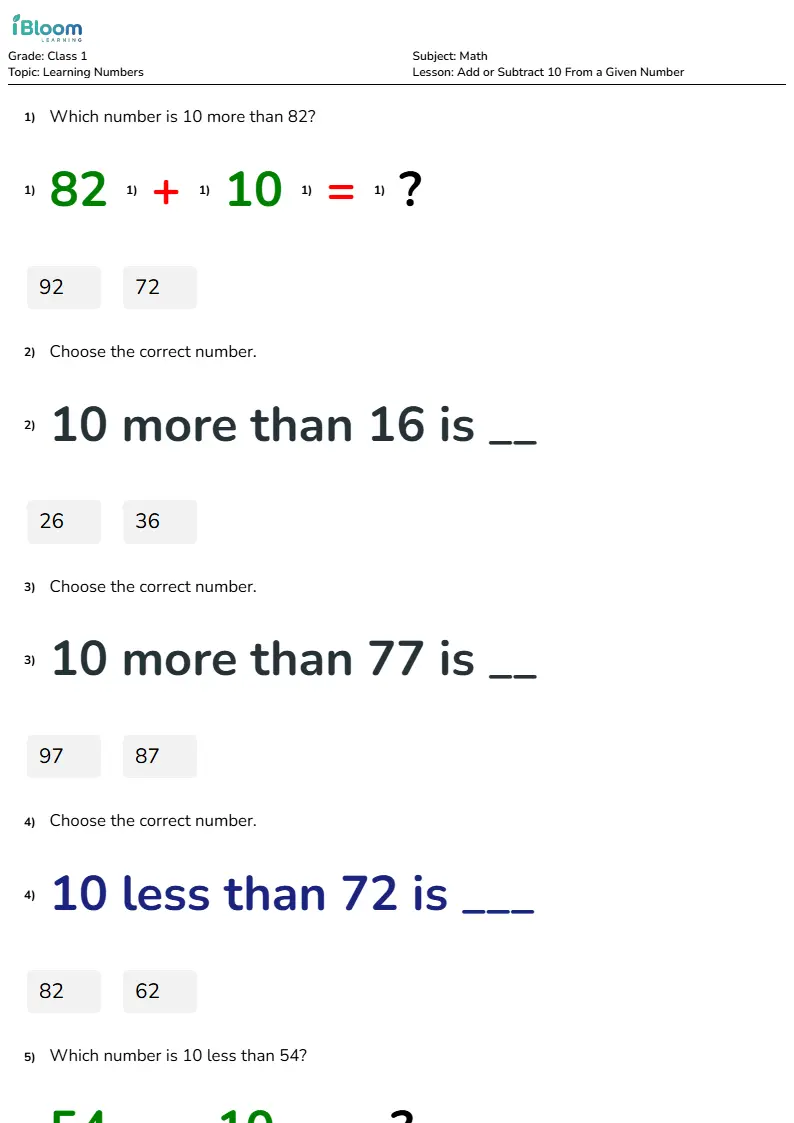
Free Add or Subtract 10 From a Given Number Worksheets for Class 1
Looking for class 1 math help? Download free, interactive add or subtract 10 from a given number worksheets. AI-personalized and Common Core-aligned. Practice math with iBloom.
.webp)
Free Adding in Any Order (Numbers 1 to 10) Worksheets for Class 1
Looking for class 1 math help? Download free, interactive adding in any order (numbers 1 to 10) worksheets. AI-personalized and Common Core-aligned. Practice math with iBloom.
.webp)
Free Adding in Any Order (Numbers 1 to 20) Worksheets for Class 1
Looking for class 1 math help? Download free, interactive adding in any order (numbers 1 to 20) worksheets. AI-personalized and Common Core-aligned. Practice math with iBloom.
.webp)
Free Addition Facts (1 to 10) Worksheets for Class 1
Looking for class 1 math help? Download free, interactive addition facts (1 to 10) worksheets. AI-personalized and Common Core-aligned. Practice math with iBloom.
.webp)
Free Addition Facts (1 to 15) Worksheets for Class 1
Looking for class 1 math help? Download free, interactive addition facts (1 to 15) worksheets. AI-personalized and Common Core-aligned. Practice math with iBloom.
.webp)
Free Addition Facts (1 to 20) Worksheets for Class 1
Looking for class 1 math help? Download free, interactive addition facts (1 to 20) worksheets. AI-personalized and Common Core-aligned. Practice math with iBloom.
.webp)
Free Addition Facts (1 to 5) Worksheets for Class 1
Looking for class 1 math help? Download free, interactive addition facts (1 to 5) worksheets. AI-personalized and Common Core-aligned. Practice math with iBloom.
.webp)
Free Addition on Number Line (Numbers 1 to 10) Worksheets for Class 1
Looking for class 1 math help? Download free, interactive addition on number line (numbers 1 to 10) worksheets. AI-personalized and Common Core-aligned. Practice math with iBloom.
.webp)
Free Addition on Number Line (Numbers 1 to 20) Worksheets for Class 1
Looking for class 1 math help? Download free, interactive addition on number line (numbers 1 to 20) worksheets. AI-personalized and Common Core-aligned. Practice math with iBloom.
.webp)
Ten-Frame Addition Worksheet for Class 1
Help Class 1 children model addition within 10 on ten frames, compare coloured groups, count the total, and write matching addition sentences.
.webp)
Free Addition Using Ten Frames (Numbers 1 to 20) Worksheets for Class 1
Looking for class 1 math help? Download free, interactive addition using ten frames (numbers 1 to 20) worksheets. AI-personalized and Common Core-aligned. Practice math with iBloom.
.webp)
Free Addition with Three Numbers (1 to 10) Worksheets for Class 1
Looking for class 1 math help? Download free, interactive addition with three numbers (1 to 10) worksheets. AI-personalized and Common Core-aligned. Practice math with iBloom.
.webp)
Free Addition with Three Numbers (1 to 20) Worksheets for Class 1
Looking for class 1 math help? Download free, interactive addition with three numbers (1 to 20) worksheets. AI-personalized and Common Core-aligned. Practice math with iBloom.
.webp)
Free Addition Word Problems Using Frames (Numbers 1 to 10) Worksheets for Class 1
Looking for class 1 math help? Download free, interactive addition word problems using frames (numbers 1 to 10) worksheets. AI-personalized and Common Core-aligned. Practice math with iBloom.
.webp)
Addition Frames Word Problems | Class 1
Help Class 1 children read addition stories, identify the start, added amount and total, model numbers to 20 with frames, and write number sentences.
.webp)
Number Line Addition Word Problems Class 1
Teach Class 1 children to solve addition stories within 10 by finding the start, making forward hops on a number line and writing the number sentence.
.webp)
Free Addition Word Problems Using Number Line (Numbers 1 to 20) Worksheets for Class 1
Looking for class 1 math help? Download free, interactive addition word problems using number line (numbers 1 to 20) worksheets. AI-personalized and Common Core-aligned. Practice math with iBloom.
.webp)
Free Addition Word Problems Using Objects (Numbers 1 to 10) Worksheets for Class 1
Looking for class 1 math help? Download free, interactive addition word problems using objects (numbers 1 to 10) worksheets. AI-personalized and Common Core-aligned. Practice math with iBloom.
.webp)
Free Addition Word Problems Using Objects (Numbers 1 to 20) Worksheets for Class 1
Looking for class 1 math help? Download free, interactive addition word problems using objects (numbers 1 to 20) worksheets. AI-personalized and Common Core-aligned. Practice math with iBloom.
.webp)
Free Addition Word Problems with Three Numbers (Numbers 1 to 10) Worksheets for Class 1
Looking for class 1 math help? Download free, interactive addition word problems with three numbers (numbers 1 to 10) worksheets. AI-personalized and Common Core-aligned. Practice math with iBloom.
.webp)
Free Addition Word Problems with Three Numbers (Numbers 1 to 20) Worksheets for Class 1
Looking for class 1 math help? Download free, interactive addition word problems with three numbers (numbers 1 to 20) worksheets. AI-personalized and Common Core-aligned. Practice math with iBloom.
.webp)
Free Addition Word Problems with Three Numbers Using Frames (1 to 10) Worksheets for Class 1
Looking for class 1 math help? Download free, interactive addition word problems with three numbers using frames (1 to 10) worksheets. AI-personalized and Common Core-aligned. Practice math with iBloom.