Reading And Writing Numbers 1 To 100 worksheet for Class 1

Lesson-Wise Builder
A premium AI tool that creates syllabus-aligned questions and worksheets for any lesson in seconds.
Reading and writing numbers from 1 to 100 means connecting the number a child sees, the number they say, the quantity it represents, and the way it is written. Class 1 learners become more accurate when they work with these forms together instead of memorising a long list without patterns.
Use the Reading and Writing Numbers 1–100 activity for focused practice. The goal is not speed. A child should be able to read a numeral, write it carefully, and explain how the tens and ones help them know what it means.
A clear read-and-write routine
- Look: notice both digits and their places.
- Build: say how many tens and ones the number contains.
- Say: read the whole number aloud.
- Write: copy or write the numeral with the digits in the correct order.
- Check: read the written number back and compare it with the model.
For 47, a learner can say “four tens and seven ones,” read “forty-seven,” write 47, and then check that 4 is still in the tens place. This short explanation reveals more understanding than copying 47 several times.
Connect numerals and number names
A numeral such as 32 and a number name such as thirty-two represent the same number. Start with groups of ten: 10, 20, 30, and so on. Then add the ones. For example, 60 and 8 make 68, read as sixty-eight.
Examples to read and write
- 14: one ten and four ones; read fourteen.
- 30: three tens and zero ones; read thirty.
- 75: seven tens and five ones; read seventy-five.
- 99: nine tens and nine ones; read ninety-nine.
- 100: ten tens; read one hundred.
English spellings such as forty and eighty can be tricky. Teach one small set at a time and keep the number visible while the child says and writes its name.
Use a hundred chart to notice patterns
A hundred chart helps children see structure. Moving one square to the right usually adds one. Moving one square down adds ten. Numbers in the same column share the same ones digit. Ask the child to predict a number before pointing to it.
Pattern questions
- What number comes immediately after 39?
- What happens to the tens digit when 49 changes to 50?
- Which numbers end in 6?
- If you move down from 24, which number do you reach?
These questions turn the chart into a reasoning tool instead of a sheet to recite.
Build place value with tens and ones
Two-digit numbers are easier to read and write when children can separate tens and ones. Use bundled sticks, groups of ten counters, or quick drawings. Show 53 as five groups of ten and three single objects. Then write 5 in the tens place and 3 in the ones place.
Say it before writing it
Ask, “How many tens? How many ones?” before the child writes. This prevents common reversals such as writing 35 after hearing fifty-three. If a reversal occurs, rebuild the number and compare each digit with its place.
Practise sequences and missing numbers
Reading and writing numbers also depends on knowing what comes before and after. Use short sequences that cross a group of ten: 27, 28, 29, __, __. Ask the child to say the sequence aloud, fill the gaps, and explain why the tens digit changes.
Useful sequence variations
- Write the number before 61 and the number after 61.
- Complete 86, 87, __, 89.
- Start at 43 and write the next five numbers.
- Count by tens from 10 to 100, then identify the shared ones digit.
Compare and order two-digit numbers
To compare 36 and 63, look at the tens first. Six tens is greater than three tens, so 63 is greater. When the tens are the same, compare the ones. This reasoning helps children order a small set from least to greatest or greatest to least.
Keep comparison practice close to the page’s main skill: the child should read each number accurately before ordering it. Misreading 16 as 60 changes the entire comparison.
Common mistakes and practical fixes
Reversing the digits
Return to tens and ones. Build the number, point to each place, and write one digit at a time.
Confusing teen numbers and multiples of ten
Contrast pairs such as 14 and 40 or 16 and 60. Say, build, and write each one instead of relying only on sound.
Skipping a number at a new ten
Practise short transitions such as 28 to 32 or 58 to 62. Highlight the point where the tens digit changes.
Copying without checking
Ask the child to read the written answer back. A mismatch between what they say and what they wrote becomes easier to notice.
A ten-minute home routine
Choose five numbers rather than the full range. Mix a teen number, a multiple of ten, two other two-digit numbers, and 100. Let the child build, say, and write each one. Finish with one missing-number question and one comparison.
Use real contexts when helpful: page numbers, house numbers, scores, or a collection of objects. Do not turn every mistake into a long lesson. Correct one pattern, retry with a nearby number, and stop after a successful check.
Teacher and tutor guidance
Use the activity as a warm-up, a small-group check, or focused intervention. Listen for the source of the error: numeral recognition, spoken number language, place value, sequence knowledge, or digit formation. Different errors need different support.
For a quick assessment, show three numerals for the child to read, say two numbers for the child to write, and ask one tens-and-ones question. Record the exact error rather than only marking correct or incorrect.
Continue with closely related iBloom practice
- Reading and Writing Numbers 1–50 for a smaller range.
- Counting Numbers 1–100 for sequence fluency.
- Counting Numbers 1–20 when the child needs a stronger foundation.
Frequently Asked Questions
What should a Class 1 child know about numbers to 100?
A useful foundation includes reading and writing numerals, saying number names, counting in order, and explaining tens and ones in two-digit numbers.
How can I help a child who reverses digits?
Build the number with tens and ones, say each place aloud, and compare the written numeral with the model before moving on.
Should children memorise every number name at once?
No. Teach patterns in small groups, revisit difficult spellings, and connect each written name to its numeral and place value.
How long should practice last?
Ten focused minutes with a few numbers is often more useful than copying a full chart without explanation.
Why use a hundred chart?
It makes number order, groups of ten, and repeated digit patterns visible, which helps children predict and check answers.
More practice for this grade
More Math worksheets
.webp)
Free Add First, Then Subtract (Numbers 1 to 10) Worksheets for Class 1
Looking for class 1 math help? Download free, interactive add first, then subtract (numbers 1 to 10) worksheets. AI-personalized and Common Core-aligned. Practice math with iBloom.
.webp)
Use Addition to Solve Subtraction to 20 | Class 1
Help Class 1 learners solve subtraction within 20 by finding the missing addend first, then checking each difference with the related addition fact.
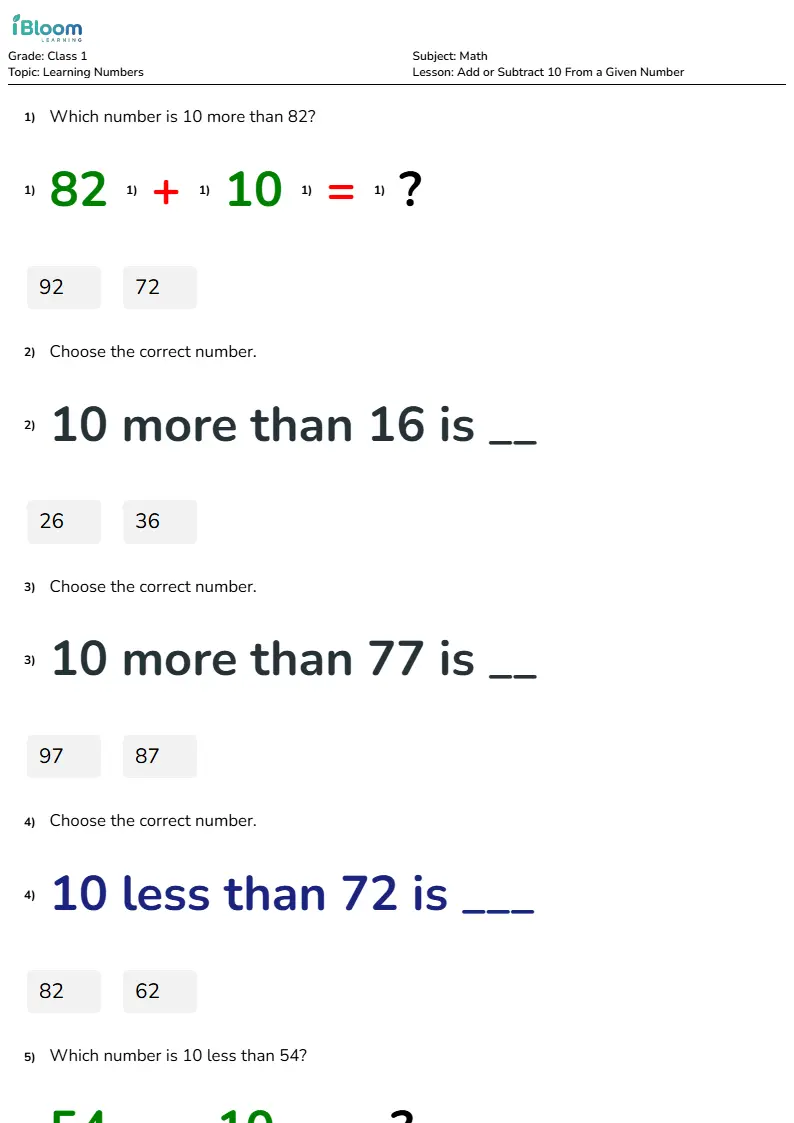
Free Add or Subtract 10 From a Given Number Worksheets for Class 1
Looking for class 1 math help? Download free, interactive add or subtract 10 from a given number worksheets. AI-personalized and Common Core-aligned. Practice math with iBloom.
.webp)
Free Adding in Any Order (Numbers 1 to 10) Worksheets for Class 1
Looking for class 1 math help? Download free, interactive adding in any order (numbers 1 to 10) worksheets. AI-personalized and Common Core-aligned. Practice math with iBloom.
.webp)
Free Adding in Any Order (Numbers 1 to 20) Worksheets for Class 1
Looking for class 1 math help? Download free, interactive adding in any order (numbers 1 to 20) worksheets. AI-personalized and Common Core-aligned. Practice math with iBloom.
.webp)
Free Addition Facts (1 to 10) Worksheets for Class 1
Looking for class 1 math help? Download free, interactive addition facts (1 to 10) worksheets. AI-personalized and Common Core-aligned. Practice math with iBloom.
.webp)
Free Addition Facts (1 to 15) Worksheets for Class 1
Looking for class 1 math help? Download free, interactive addition facts (1 to 15) worksheets. AI-personalized and Common Core-aligned. Practice math with iBloom.
.webp)
Free Addition Facts (1 to 20) Worksheets for Class 1
Looking for class 1 math help? Download free, interactive addition facts (1 to 20) worksheets. AI-personalized and Common Core-aligned. Practice math with iBloom.
.webp)
Free Addition Facts (1 to 5) Worksheets for Class 1
Looking for class 1 math help? Download free, interactive addition facts (1 to 5) worksheets. AI-personalized and Common Core-aligned. Practice math with iBloom.
.webp)
Free Addition on Number Line (Numbers 1 to 10) Worksheets for Class 1
Looking for class 1 math help? Download free, interactive addition on number line (numbers 1 to 10) worksheets. AI-personalized and Common Core-aligned. Practice math with iBloom.
.webp)
Free Addition on Number Line (Numbers 1 to 20) Worksheets for Class 1
Looking for class 1 math help? Download free, interactive addition on number line (numbers 1 to 20) worksheets. AI-personalized and Common Core-aligned. Practice math with iBloom.
.webp)
Ten-Frame Addition Worksheet for Class 1
Help Class 1 children model addition within 10 on ten frames, compare coloured groups, count the total, and write matching addition sentences.
.webp)
Free Addition Using Ten Frames (Numbers 1 to 20) Worksheets for Class 1
Looking for class 1 math help? Download free, interactive addition using ten frames (numbers 1 to 20) worksheets. AI-personalized and Common Core-aligned. Practice math with iBloom.
.webp)
Free Addition with Three Numbers (1 to 10) Worksheets for Class 1
Looking for class 1 math help? Download free, interactive addition with three numbers (1 to 10) worksheets. AI-personalized and Common Core-aligned. Practice math with iBloom.
.webp)
Free Addition with Three Numbers (1 to 20) Worksheets for Class 1
Looking for class 1 math help? Download free, interactive addition with three numbers (1 to 20) worksheets. AI-personalized and Common Core-aligned. Practice math with iBloom.
.webp)
Free Addition Word Problems Using Frames (Numbers 1 to 10) Worksheets for Class 1
Looking for class 1 math help? Download free, interactive addition word problems using frames (numbers 1 to 10) worksheets. AI-personalized and Common Core-aligned. Practice math with iBloom.
.webp)
Addition Frames Word Problems | Class 1
Help Class 1 children read addition stories, identify the start, added amount and total, model numbers to 20 with frames, and write number sentences.
.webp)
Number Line Addition Word Problems Class 1
Teach Class 1 children to solve addition stories within 10 by finding the start, making forward hops on a number line and writing the number sentence.
.webp)
Free Addition Word Problems Using Number Line (Numbers 1 to 20) Worksheets for Class 1
Looking for class 1 math help? Download free, interactive addition word problems using number line (numbers 1 to 20) worksheets. AI-personalized and Common Core-aligned. Practice math with iBloom.
.webp)
Free Addition Word Problems Using Objects (Numbers 1 to 10) Worksheets for Class 1
Looking for class 1 math help? Download free, interactive addition word problems using objects (numbers 1 to 10) worksheets. AI-personalized and Common Core-aligned. Practice math with iBloom.
.webp)
Free Addition Word Problems Using Objects (Numbers 1 to 20) Worksheets for Class 1
Looking for class 1 math help? Download free, interactive addition word problems using objects (numbers 1 to 20) worksheets. AI-personalized and Common Core-aligned. Practice math with iBloom.
.webp)
Free Addition Word Problems with Three Numbers (Numbers 1 to 10) Worksheets for Class 1
Looking for class 1 math help? Download free, interactive addition word problems with three numbers (numbers 1 to 10) worksheets. AI-personalized and Common Core-aligned. Practice math with iBloom.
.webp)
Free Addition Word Problems with Three Numbers (Numbers 1 to 20) Worksheets for Class 1
Looking for class 1 math help? Download free, interactive addition word problems with three numbers (numbers 1 to 20) worksheets. AI-personalized and Common Core-aligned. Practice math with iBloom.
.webp)
Free Addition Word Problems with Three Numbers Using Frames (1 to 10) Worksheets for Class 1
Looking for class 1 math help? Download free, interactive addition word problems with three numbers using frames (1 to 10) worksheets. AI-personalized and Common Core-aligned. Practice math with iBloom.