Free printable practice
Combinations Of Ten Practice Activities
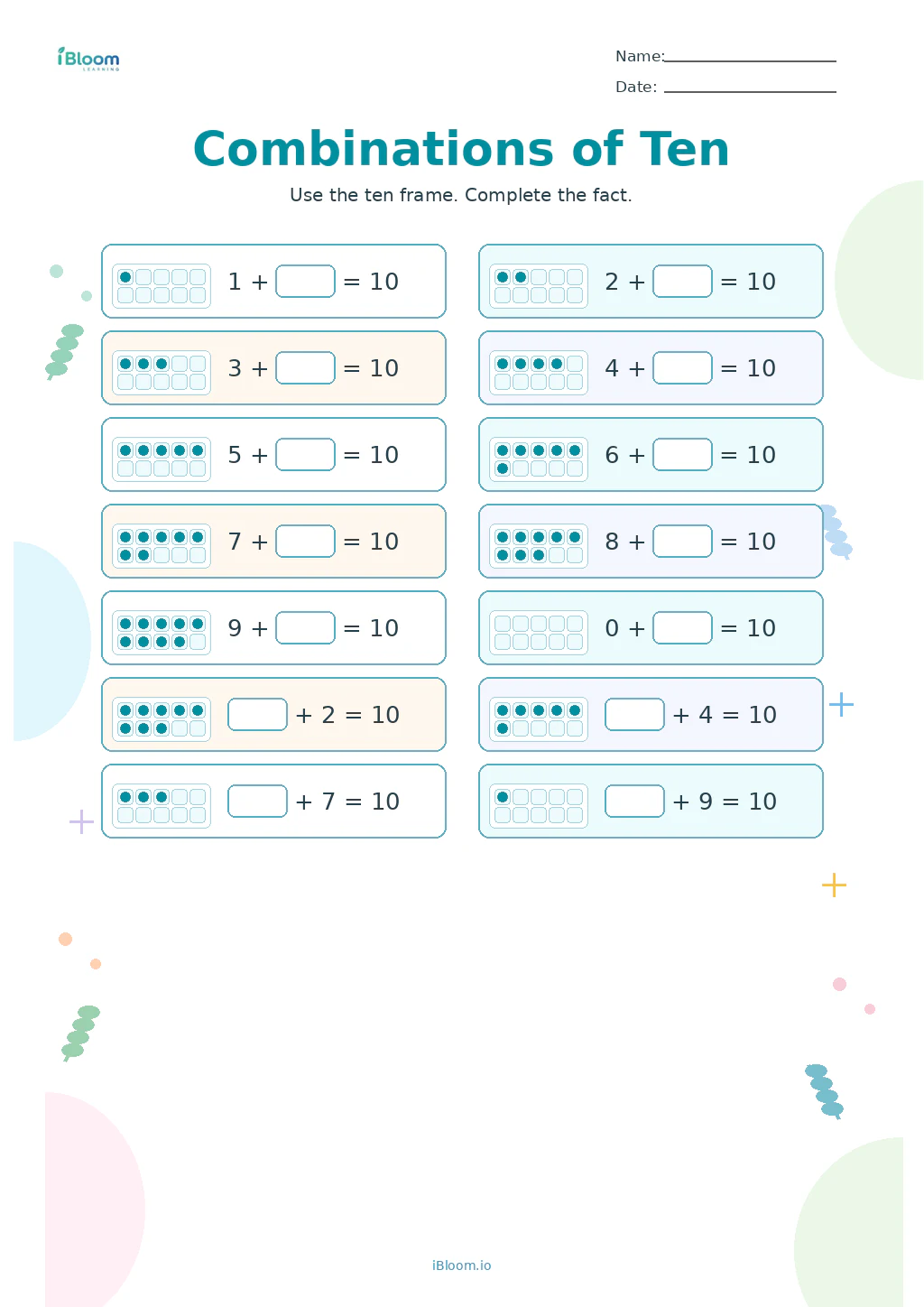
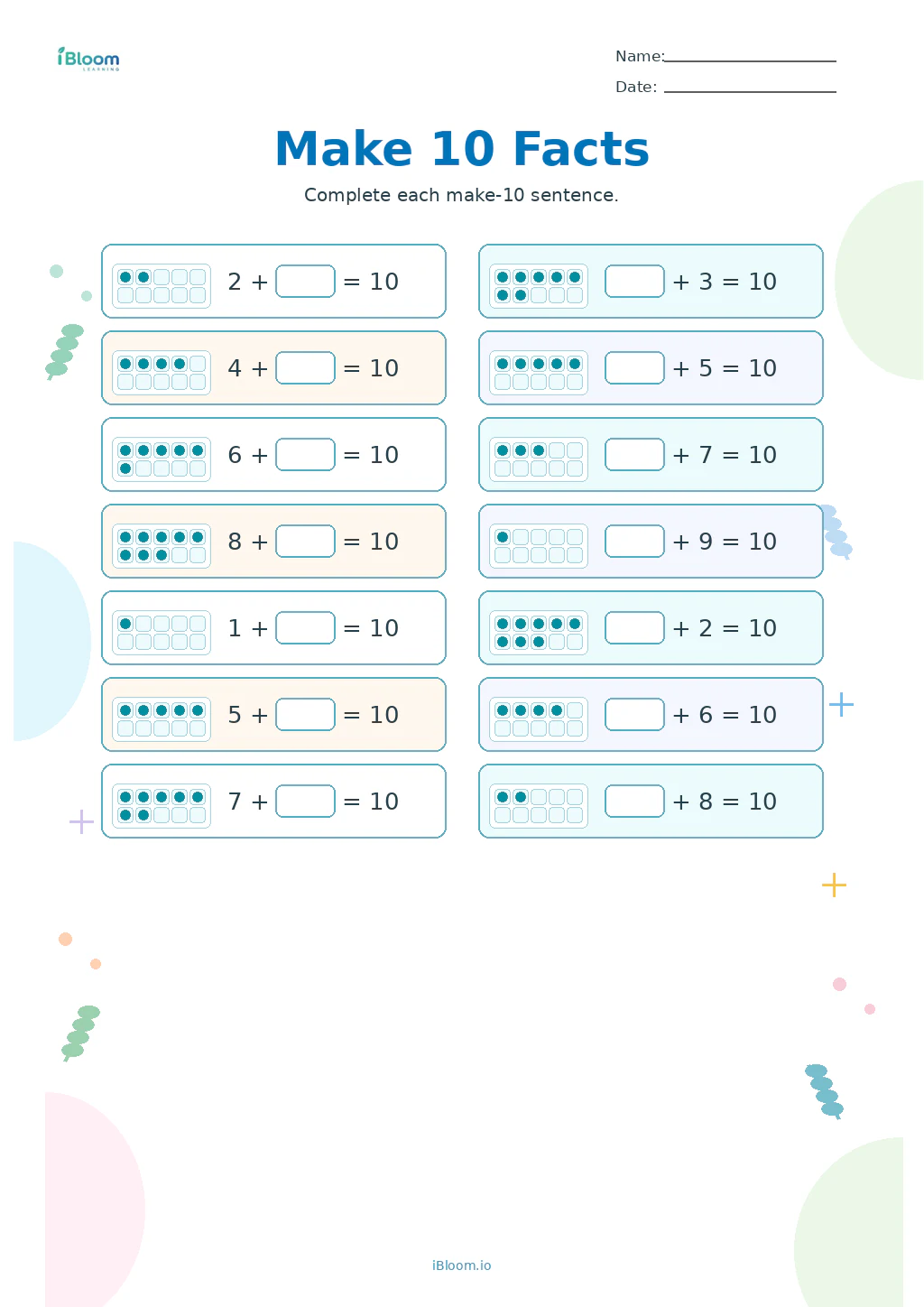
Grade 1 worksheets for practicing the number pairs that make 10 through equations, missing addends, matching, and visual addition models.
Free printable worksheet PDFs
Preview every available page, then download the free worksheet PDF for home, homeschool, tutoring, or classroom practice.
Preview the exact activity before downloading it.
Practice that builds confidence
What children learn
These Grade 1 addition worksheets help children practice combinations of ten: the pairs of numbers that add to 10, such as 1 + 9, 4 + 6, and 10 + 0. Students build quick recall while still seeing why each pair makes a full ten.
The printable activities use clear equations, missing addends, matching tasks, and simple visual models so children can connect counting objects to addition facts. They are useful for classwork, math centers, homework, or extra practice at home.
Combinations of ten are the addition facts that complete 10. In Grade 1, this skill supports mental math because children begin to see 10 as a benchmark number, not just the next number after 9. Worksheets may ask students to solve facts like 7 + 3, find the missing number in 2 + __ = 10, or match two numbers that make 10.

How the practice progresses
Children usually start with visual support such as ten-frames, counters, dots, or simple groups of objects. They then move to number pairs and equations, including both orders of the same fact: 8 + 2 and 2 + 8. Missing addend questions help students understand that addition and subtraction are connected, even while the focus remains on making 10.
A simple parent routine
At home, begin with ten small objects, such as buttons, cereal pieces, or blocks. Show 6 objects on one side and ask, “How many more to make 10?” Have your child move the remaining 4 into place, then say the full fact: “6 and 4 make 10.” After a few hands-on examples, complete one worksheet section together and ask your child to explain one answer aloud.

Classroom uses for teachers
Teachers can use these printables for independent practice after a mini-lesson, partner checking, morning work, or math centers. A useful center routine is to pair a worksheet with ten-frame cards or counters so students who need support can model each equation before writing it. The pages also work well for quick review before teaching make-a-ten addition strategies.

Common errors to watch for
Some children reverse digits or treat the missing addend as the total, writing 2 for 2 + __ = 10. Others count all objects each time instead of noticing the pair. Watch for confusion between facts that make 9, 10, or 11. Encourage students to check by counting the whole group or by saying, “Does this pair fill the ten?”
Free printable PDF download
Use this combinations of ten worksheets grade 1 page to preview the activity, print it, or download it as a PDF for quick practice. It works well for homework, homeschool lessons, tutoring, morning work, revision, and classroom centers.
Answers and answer key support
After the child completes the worksheet independently, parents and teachers can use the answer support or answer key information to check the work, review mistakes, and choose the next practice step.
Why iBloom worksheets help
The activities give repeated practice without reducing the skill to memorization only. Children see combinations in different forms—pictures, equations, matching, and blanks—so they learn that 5 + 5, 9 + 1, and 0 + 10 are all part of the same idea. Child-friendly strategy: start with the first number, count up to 10 on your fingers, and the number of fingers used is the missing partner.
Helpful answers
Frequently asked questions
What are combinations of ten in Grade 1 math?
Combinations of ten are number pairs that add up to 10, such as 0 + 10, 1 + 9, 2 + 8, 3 + 7, 4 + 6, and 5 + 5. Grade 1 students practice recognizing and using these pairs quickly.
Why should first graders learn number pairs that make 10?
Knowing the pairs that make 10 helps children add more efficiently. It prepares them for make-a-ten strategies, mental addition, missing addend problems, and later work with place value.
Do children need to memorize all facts to 10 before using these worksheets?
No. These worksheets can be used while children are still learning the facts. Visual models, matching activities, and repeated equations help them move from counting objects to remembering the pairs.
How can I help my child with missing addend problems like 7 + __ = 10?
Use ten objects or fingers. Show 7, then count how many more are needed to reach 10. Have your child say the complete sentence: “7 and 3 make 10.” This connects the blank to the missing partner.
What mistakes are common when learning combinations of ten?
Children may count too many or too few, confuse the missing number with the total, or remember only one order of a fact. Practice both 6 + 4 and 4 + 6, and ask students to check that the total is exactly 10.
Is this combinations of ten worksheets grade 1 free?
Yes. You can preview it for free and use the printable worksheet for home or classroom practice.
Can I download this combinations of ten worksheets grade 1 as a PDF?
Yes. Use the worksheet download option to save a printable PDF, or print the worksheet directly from the page.
Does this combinations of ten worksheets grade 1 include answers or an answer key?
When the activity has fixed answers, iBloom includes answer support so parents and teachers can check the completed worksheet.