Free printable practice
Vertical Objects Practice Activities
Printable Grade 1 addition worksheets where children add vertically arranged object groups and connect pictures to sums.
Free printable worksheet PDFs
Preview every available page, then download the free worksheet PDF for home, homeschool, tutoring, or classroom practice.
Preview the exact activity before downloading it.
Practice that builds confidence
What vertical objects means
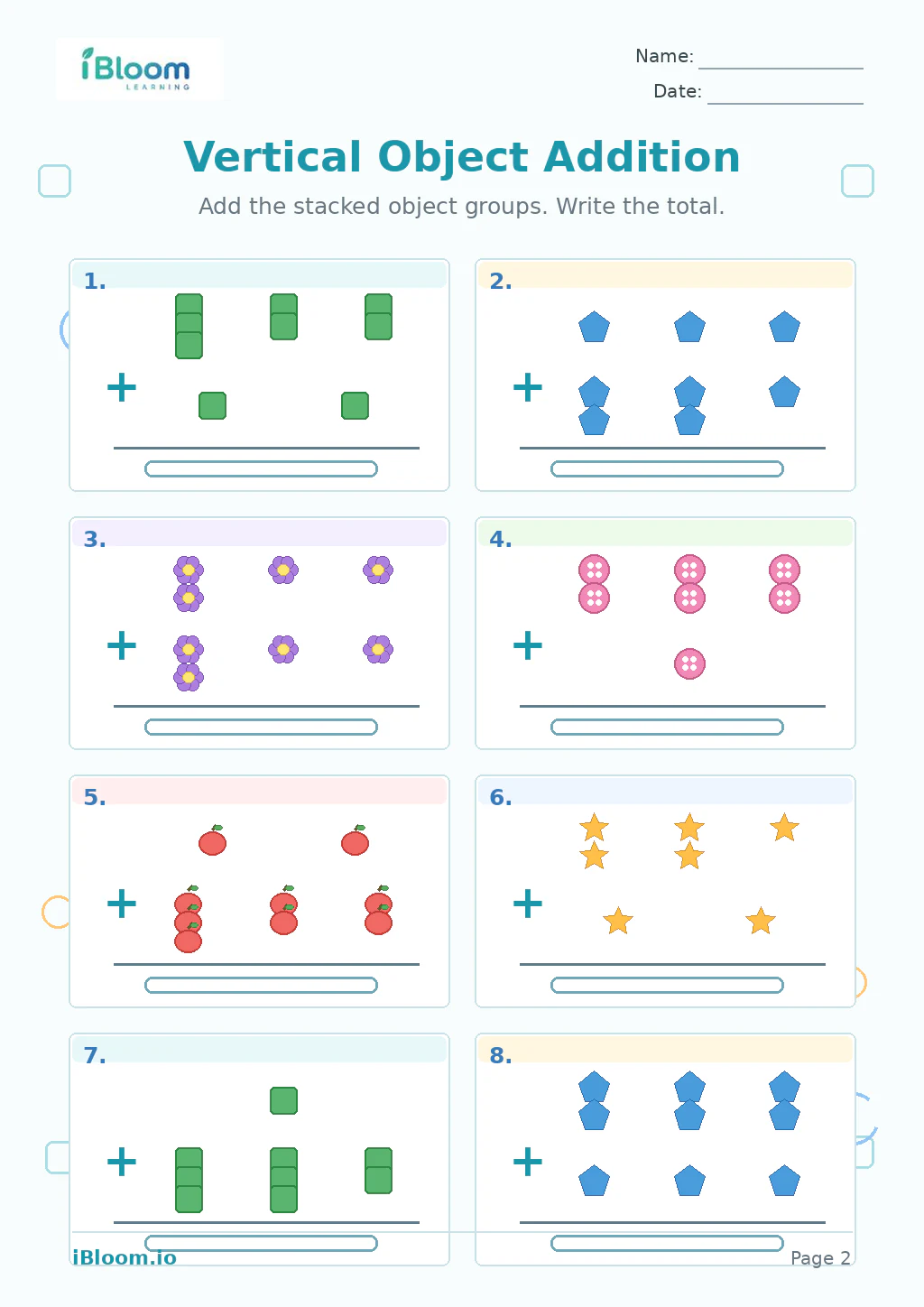
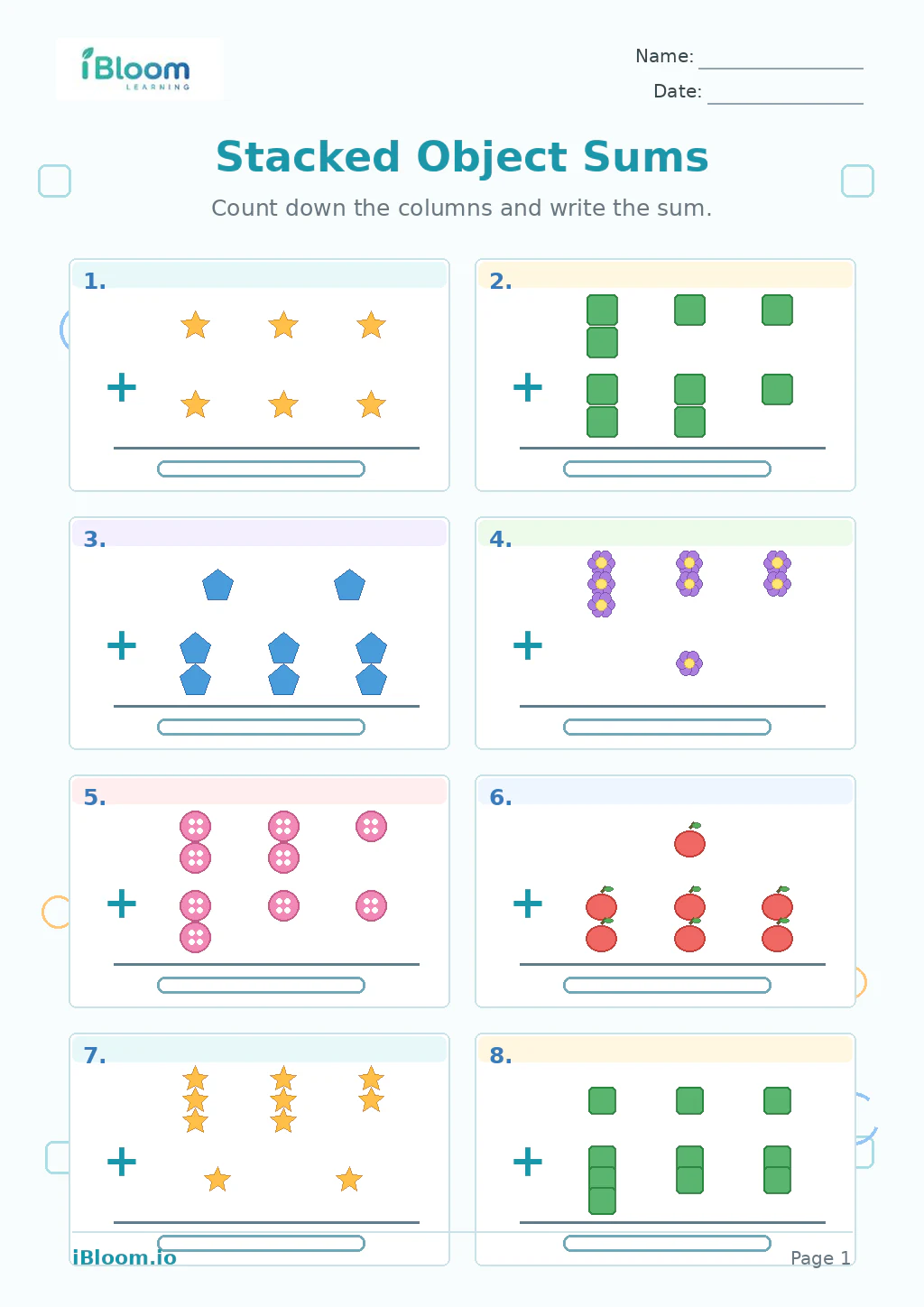
These Grade 1 addition worksheets help children add groups of objects shown one above the other, connecting picture counting with vertical addition. Children practise naming the two addends, counting all the objects, and recording the total as a sum.
The printables use clear object groups, vertical layouts, plus and equals signs, and answer spaces. Activities build from direct counting to more efficient strategies such as counting on, while keeping the addition visible and concrete.
In these pages, objects are arranged in two stacked groups so students can see one part above another part rather than across a line. A child might see 3 stars in the top group and 2 stars in the bottom group, then connect the picture to 3 + 2 = 5. This layout prepares students for later vertical number problems without removing the support of images.

Skill progression
Begin by having children touch or mark each object as they count. Next, ask them to identify the first addend, the second addend, and the sum. As confidence grows, children can count on from one group instead of starting at 1. They also learn that the total stays the same when the same two groups are joined.
Parent routine
Choose one page and sit beside your child with crayons or counters. Ask, “How many are in the top group? How many are in the bottom group? How many altogether?” Have your child circle each group in a different color, say the equation aloud, and then write the sum. If an answer seems rushed, cover the written equation and return to the objects.

Classroom use
Teachers can use these worksheets for a small-group lesson, a math center, morning work, or quick reteaching after a mini-lesson on addition. They are especially useful for students who understand counting but need help matching pictures to symbols. After students finish, invite them to compare methods: counting all, counting on, or recognizing a small group quickly.

Common errors to watch for
Some first graders count only one group, skip an object in a column, or write the total in the wrong place. Others read the vertical layout as two unrelated pictures instead of one addition situation. Encourage careful tracking with a finger, dot, or light check mark. Remind students that the plus sign means the groups are being joined.
Free printable PDF download
Use this grade 1 vertical objects addition worksheet page to preview the activity, print it, or download it as a PDF for quick practice. It works well for homework, homeschool lessons, tutoring, morning work, revision, and classroom centers.
Answers and answer key support
After the child completes the worksheet independently, parents and teachers can use the answer support or answer key information to check the work, review mistakes, and choose the next practice step.
Why iBloom worksheets help
iBloom worksheets keep the picture support close to the equation, so children see why addition works before relying on memory. The uncluttered vertical arrangement builds attention to parts and whole. A child-friendly strategy is: “Count the top, count the bottom, count on to find all.”
Helpful answers
Frequently asked questions
What does vertical objects mean in Grade 1 addition?
It means the objects are shown in stacked groups, often one group above another. Children count both groups together and connect the picture to an addition sentence.
How should my child solve these worksheets?
Have your child count the top group, count the bottom group, then count all the objects together. As they improve, encourage counting on from one group instead of recounting every object.
Why use objects instead of only numbers?
Objects make addition concrete. First graders can see the two parts being joined, which helps them understand addends and sums before working with number-only problems.
What mistakes are common with vertical object addition?
Children may count only one group, skip an object, count the same object twice, or place the answer in the wrong space. Finger tracking or lightly marking each object can help.
Can these worksheets be used in a classroom math center?
Yes. They work well for math centers, small-group practice, morning work, or reteaching because the picture layout lets students work independently while still seeing the addition model.
Is this grade 1 vertical objects addition worksheet free?
Yes. You can preview it for free and use the printable worksheet for home or classroom practice.
Can I download this grade 1 vertical objects addition worksheet as a PDF?
Yes. Use the worksheet download option to save a printable PDF, or print the worksheet directly from the page.
Does this grade 1 vertical objects addition worksheet include answers or an answer key?
When the activity has fixed answers, iBloom includes answer support so parents and teachers can check the completed worksheet.